Showing posts with label corruption. Show all posts

Monday, June 07, 2010

Fabricating Connections with Rod

You can't blame Republicans for trying. After all, Democrats would do the same thing. But, still, I had to chuckle at this item in the Hotline On Call blog from the National Journal:

RGA Ties Quinn To Blago

The GOP's biggest asset in their race to oust IL Gov. Pat Quinn (D) isn't the Dem or his GOP rival. It's Quinn's predecessor, ex-Gov. Rod Blagojevich (D).

Now, as Blagojevich's corruption trial kicks off in Chicago, the RGA is running ads linking the 2 governors, even though Quinn supported Blagojevich's impeachment last year.

You would think that, after all the controversies surrounding politicians fabricating their resumes, politicians would be more circumspect about fabricating connections between other politicians. The lesson from the resume-inflation scandal should be relatively simple: voters don't like being lied to.

So why lie here?

Anyone who has met Blagojevich or paid attention to Illinois politics over the last decade will realize that there isn't a lot to connect Rod Blagojevich with Pat Quinn -- or any other politician in the state. There were no "Blagojevich Democrats," as it were -- unless you want to count Capitol Fax Bill, the former governor's most loyal defender through it all.

And that's the way Blagojevich wanted it. The most outgoing of pols (Blagojevich couldn't pass up a hand to shack, even if you didn't want your hand shaken), he was the most introverted -- or, rather, isolated -- governor possible. People in southern Illinois may have complained about the (then) governor not spending any time in the Governor's Mansion, but everyone in Illinois had a right to complain about Blagojevich not spending much time in the Governor's office at the Thompson center.

And when he did come downtown, it seems like he had the whole building blocked off (presumably for his convenience, but Blagojevich also seemed to like the whole security detail aspect of it, which I assume fed his ego). Blagojevich claimed to have worked mostly out of his house (perhaps an imitation of his ambition to work out of the White House), and he intentionally kept the other Constitutional officers at arms length. Blagojevich was much more likely to take pot shots at his fellow elected officials (including Pat Quinn) through the press than talk to them on the phone, let alone face to face. Even in joint appearances, Blagojevich tended to be in and out, and it's safe to say that he spent little time with other politicians in Illinois.

So Republicans are largely reduced to inventing connections between Rod Blagojevich and other Illinois pols (Democrats or Republicans). Which is why the Rod Blajojevich effect on this November's elections is not likely to be that substantial.

Sure, Rod Blagojevich was corrupt. But this is Illinois, and corruption is not only a bipartisan endeavour, it is also largely ignored by the electorate. Don't get me wrong, it is shocking the level to which corruption is tolerated by people in the state. And there's not much to lead one to think that 2010 will be any different. Especially given the fact that the Republican candidate for Governor, Bill Brady, has already used his legislative position for personal gain -- something that hasn't exactly created an uproar around the state (or the Republican party).

But the Democrat's best defense in light of the onslaught coming during the Blagojevich trial is that no one was out there defending the governor when he was under fire by federal prosecutors. You won't find Democrats saying that it was a witch hunt, or that the (then) Governor was being rail roaded by those mean Federal prosecutors. Nor will you find Democratic legislators talking about voting to impeach Blagojevich as a "difficult decision," "tough vote" or even something they had to think long and hard about. Nope. I heard one longtime legislator call it "the proudest vote" he'd ever taken.

So the best Republicans have is innuendo, the inference from photoshopped images that suggest some form of connection.

I know this is contrary to conventional wisdom, but it's hard to see Blagojevich effecting Democratic prospects this November. Blagojevich did this himself, isolating himself from the rest of the party, carrying on his "imperial" governorship, whining constantly about the lack of respect he got from other party leaders -- which seemed to only isolate him even more.

Come what may, Democrats built their organizations, their loyalties, their relationships independent of Rod Blagojevich. And broadcast images won't change that. If Democrats do poorly in November, it won't have anything to do with Rod Blagojevich. And if Democrats do better than expected, it won't have anything to do with Rod Blagojevich. It's not the rest of the party that isolated itself from Rod Blagojevich, but the former governor who isolated himself from the rest of the party. Voters may be mad, voters may even be disgusted by the rather despicable budget quandry that Blagojevich left as his primary legacy, but the Blagojevich trial won't be the straw that broke the voter's back. And the voters who do come out and vote this November aren't as likely to be the low-info voters that could be more easily persuaded by these Republican tactics.

Blagojevich dug his own grave. He won't be taking Illinois Democrats with him, because he didn't have much to do with Illinois' Democrats. This is the pol that seemed to want to circumvent the party and take everything "directly to the people." Which doesn't mean that Illinois' Democrats have an easy path before them. They just don't have the Blagojevich albatross dragging them down. Blagojevich won two primaries and two elections, but he didn't take over the party. This election will be fought over the state of the economy and how well the recovery is creating jobs in Illinois. I don't think either party can (credibly) promise to end corruption in the state, but voters might be interested in which one can (credibly) return Illinois to a predictable, stable job-creating environment...

Read more...

Saturday, June 20, 2009

PAYING THE PRICE FOR CORRUPTION

The Chicago Citizen Newspapers has the first in a series of reports on the cost of corruption in the city of Chicago and the state of Illinois. The focus of this first article is about the effect of corruption on minority communities.

Instead of using funds appropriated by the state to pay for important social programs that help build communities, taxpayers are paying millions of dollars annually for the price of corruption.

A recent Chicago Sun-Times article pointed out that $2.7 million was reportedly wasted in state grants that could have gone towards helping communities with social programs including job training services for homeless men, youth services for African-Americans and literacy training for others.

While a Chicago Coalition for the Homeless report recently noted that Illinois should invest $2 million in transitional jobs programs with a therapy focus for people living in supportive housing facilities to help them move out of poverty and homelessness, Thomas J. Gradel, the coresearcher of a study entitled, Curing Corruption in Illinois: Anti-Corruption Report at the University of Illinois said, “You’re not only ripping off the taxpayers, but the homeless people that could have got the training. The people who were supposed to get the training, [didn’t receive] access to a job. The businesses would have benefited from the trained employees. So there’s a whole ripple effect caused by taking money to provide training and not providing it,” Gradel said. According to the Coalition’s report, less than one percent of the $270 million spent on workforce development in Chicago in 2004 targeted the homeless. The report pointed to another UIC study in 2001 on homelessness in the city and stated that of the 1,300 homeless adults in the collar counties, 19 percent were military veterans; 31.4 percent had been incarcerated, 46.3 percent were substance abusers and 13.8 percent were mentally ill.

In addition to groups like the homeless, it’s the children who end up paying the price through school dropouts and incarceration when funds fail to reach the people it was supposed to help, said Marrice Coverson, founder of the Institute for Positive Living, a non-profit organization that helps families solve educational, social and economic problems.

While 63 percent of Black male students in the Chicago Public Schools failed to graduate in 2005-2006 according to a study conducted by the Schott Foundation for Public Education based in Massachusetts, Coverson said, “We’re going to look up and we’re not going to have quality people to run our hospitals or banks.”
What about ethics reform is that the cure for all of our ills that includes corruption?
John Paul Jones, an Englewood community resident, said that ethics reform is not going to be a “quick fix” because the challenge lies in broadening the communication between elected officials and knowledge about how government works. “Those issues are not discussed in community settings. Until we get to that point where people can be comfortable talking about those things with their state officials without being blackballed, we’re going to have a disconnect of having state reform,” he said.
Go to the Chicago Citizen website and read the whole article!

Read more...

Saturday, February 14, 2009

Tribune: Illinois' endless history of greed

So I wonder who did Illinois gain its reputation for corruption by her public officials. Indeed one could ask how deep was this corruption. This Trib article should answer some questions.

Corruption has been embedded in Illinois' political DNA since pioneer days. European immigrants found jobs and housing easier to come by if they helped keep the powers-that-be in power.

"The social compact in this state was built on corruption," said Cindi Canary, director of the Illinois Campaign for Political Reform. "It worked very well for some people."

In the 1880s, the utilities and streetcar companies that helped transform the city into an industrial powerhouse gained exclusive franchises through huge payoffs to public officials. By Prohibition, Al Capone had much of City Hall and the police force in his pocket.

Well I should have you know the article didn't start with discussing the history of corruption in Illinois, but it does start in the present day with what happened with our former governor, Rod Blagojevich. This article says a lot about him, but let's start at the beginning:
We've put an impressive collection of cheats and boodlers into public office over the decades, and the public outcry has never led to more than a token crackdown by government.

So why should the curious case of Rod Blagojevich now make things different? One reason, perhaps, is that the December arrest of Illinois' now-ousted governor has reduced Illinois politics to a late-night TV punch line. ("Scumdog Million-Hairs" is Jon Stewart's nickname for the amply maned Blagojevich.)
That's it? Isn't there more about Rod Blagojevich in this article and perhaps the current enviroment the state finds itself in after the state legislature fired him from his post as Governor.

Well this passage makes the most sense to me...

Rod Blagojevich didn't invent crooked politics in Illinois, though if the charges of rampant shakedowns and hanging a "for sale" sign on a vacant U.S. Senate seat are true—and he insists they are not—he may have raised the art form.
Another episode worth noting even though this article offers some statistics on how many Illinois pols; well Cook County Judges, Illinois Governors, Chicago Aldermen and businessmen; have been sent to jail for corruption. I'm sure most of you who read this blog remember this episode.

A decade ago, then-City Treasurer Miriam Santos skipped the nuance and went to prison for ordering a city contractor to "belly up" with a $10,000 contribution—or else. The irony was that Santos tried the squeeze to meet a fundraising quota demanded of her by state Democratic Party Chairman Michael Madigan, who was not implicated.
It looks like he may be a part of the change since the former governor was fired from office. Is Illinois truly ready for reform?

As Illinois House Speaker, Madigan is spearheading the legislature's post-Blagojevich reform drive. He has been a Springfield powerhouse for nearly four decades and no one has ever accused him of being a change agent. That may be a secret to his longevity, explained Rutgers University political scientist Alan Rosenthal.

"Members are comfortable with the rules they've played by, and when you change those rules there's increased uncertainty and members don't like it," said Rosenthal, an expert on ethics in state legislatures.

If the status quo is finally broken, in a perverse sense we may have Rod Blagojevich to thank.

"Right this moment we have the perfect storm of scandal, public anger, a huge financial crisis and a citizenry not completely sure they still trust the foxes to guard the henhouse. Not to mention we are an international joke." Canary said.

"All of these things combine to give us an opening we've never had before."
I just hope that the actors in Illinois' political system are serious about making a change because we already seen one possible result of corruption at the state's highest level!

Read more...

Friday, January 23, 2009

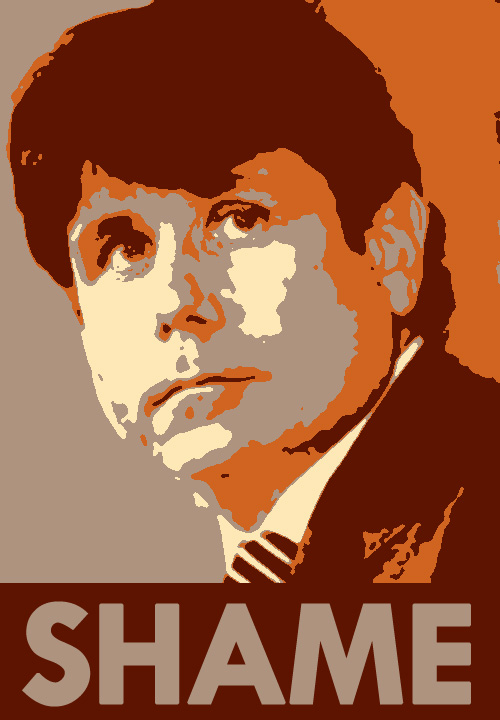
Blago "Shame" Poster


I found this "poster" in a video unrelated to the Blagojevich scandal. You can also find the image in question here.

There is a lot of commentary in that link. They wonder why Democrats aren't calling for his resignation. Also saying that "the process is working" line isn't enough and there's more to change than just a new face.

Now that I posted this picture I wonder if people will have this image in their head whenever Blagojevich continues to proclaim his innocence.

Read more...

Thursday, January 15, 2009

Illinois Residents See Broad Corruption in State Government and Seek Action for Change

Cross posted from ICPR's blog, The Race is On:

A majority of Illinoisans (58%) believe Governor Rod Blagojevich’s alleged corrupt behavior is common among public officials in Illinois, and an even larger percentage believes a series of reforms, including limits on campaign contributions, would make a difference and lead to better government. The findings are contained in a new statewide poll released Thursday by the Illinois Campaign for Political Reform (ICPR) and are available at www.ilcampaign.org. The poll itself is here (PDF) and the analysis is here (PDF).

About three-quarters of Illinois residents say an overhaul of Illinois’ weak system of campaign regulation would help make state government work better. According to the survey, 78% of residents say a ban on campaign contributions by corporations will make a difference, and 76% say a similar ban on labor union contributions would make a difference.

Similar sentiment (74%) was expressed for setting limits on the amount of contributions that could be given by individuals.

“The Blagojevich scandal and the other cases of corruption in state and local governments have taken their toll on voter confidence in public officials,” said Cynthia Canary, Director of ICPR. “Changing governors will not be enough to fix the system and restore the public’s faith in government.

“Illinois should join the federal government and 46 other states that limit the size of contributions, and our campaign finance, lobbying and ethics laws should be strictly enforced,” she said. “The public does not have much faith in state government, but voters do believe reform efforts are worthwhile. Legislators should give the public the change it deserves.”

Opinions of the state legislature have sharply worsened in recent months (49% of residents now believe the legislature is doing a “poor” job compared to 26% who said so in April-May 2008). Concerns about corruption and the influence of money in politics are deeper than the current scandal and are likely to continue even if the governor is removed.

“These survey results transcend political parties and all regions of the state,” stated Sheila Simon, a professor at the Southern Illinois University School of Law and a member of the ICPR Board. “Illinois residents are united in their views that our political system must be reformed.”

Even during tough economic times, Illinoisans are sending some strongly negative messages to officeholders across the state. Two-thirds support the creation of a new state agency to vigorously enforce Illinois’ campaign finance laws (66% support) and spending more tax dollars on stronger enforcement of laws to keep money out of politics (65%).

Underscoring the strong views of residents is another key finding: six in ten (61%) Illinois residents are “extremely” concerned about corruption in state government and more than half (54%) about the influence of money in state politics. Concerns of corruption exceed concerns over the economy (50%), jobs (45%), and the state budget (46%).

Other findings of the poll included:

• 71% of Illinois residents support a law limiting the amount of campaign money party leaders of the legislature are allowed to contribute to other legislative candidates;
• 89% of registered voters say their legislator’s support for legislation to reduce money in politics would be important to their decision to re-elect their legislator with half (50%) saying it would be “very important;”
• Eight in ten Illinois residents (78%) say the state is on the wrong track, an increase from the 68% who thought so in April-May 2008.

The poll was conducted by Belden, Russonello & Stewart (BRS), an independent
research firm located in Washington, DC. A random telephone survey of 802 adults in Illinois on attitudes toward government and political reform was conducted January 8 – 11, 2009. The margin of sampling error is plus or minus 3.5 percentage points at the 95% level of tolerance. Some questions in the survey track attitudes from BRS surveys on political reform conducted in 2006 and 2008. The survey was commissioned and funded by The Joyce Foundation.

To comment, please visit ICPR's blog.

Read more...

Friday, December 12, 2008

Why is Lisa Madigan Holding Up Impeachment Hearings?

Corruption in Illinois comes in many forms and all sizes. One wouldn't normally think of nepotism as a form of corruption, but when nepotism is added to the corrupt political practices in Illinois, it results in a concentration of power that won't be found elsewhere. Except maybe in the Mafiosa.

While the whole country is demanding the resignation or impeachment of our indicted Governor, Illinois' premiere political reporter, Rich Miller offers his opinion why Speaker Madigan is moving cautiously towards impeachment:

My own opinion is that Speaker Madigan probably wants to let his daughter take the lead. From today's news reports..
"I have the opportunity to go to our Illinois Supreme Court and ask them to declare our governor is unable to serve and put in our lieutenant governor as acting governor," Madigan said.

We talked about this procedure yesterday. The lawyers I've spoken to over the past couple of days say they doubt that the Supreme Court would step in. But winning the case (or at least presenting it) would make AG Madigan a national hero. Therefore, the slow-walk on impeachment.


More than 40 years ago, David Mayhew made the observation that politicians use credit-taking as a means for furthering their careers. In Illinois, credit-taking is one of those things you can't miss. Rod Blagojevich was certainly at the extreme of this practice, with signs up over parts of the Chicago Beltway (locally known as 294) saying, "Brought to you by Governor Rod Blagojevich." The normal citizen could be forgiven for wondering if our indicted Governor really wanted to take credit for the inevitable traffic jam around the (much needed) construction, but it made sense within the need (or what might now be seen as a compulsion) for taking credit.

In that context, you can understand why Lisa Madigan might prefer the state legislature to go slow on impeachment so that the Illinois Supreme Court can rule on her "threatened lawsuit:"

Madigan is threatening to file a lawsuit asking the state Supreme Court to declare Blagojevich unfit to hold office if he doesn't resign or get impeached. The move put her in the national spotlight as the scandal unfolds before a huge audience because of its connections to Barack Obama's vacant U.S. Senate seat.


Lisa Madigan, Illinois' Attorney General, is thinking about invoking Rule 382 to "determine if the governor has the ability to serve or resume office." One of the state capitol television stations calls it "a last-resort option."

The problem with this tactic that our Attorney General has been touting all over the media is that it requires two things: that our indicted Governor refuses to resign (which seems likely) AND that the legislature doesn't act quickly (which is in the hands of her father). Madigan can only be the "hero" if this last resort option is the successful tactic that effectively removes Blagojevich from office. Bloomberg put it this way:

Illinois Governor Rod Blagojevich, accused of plotting to sell President-elect Barack Obama’s former U.S. Senate seat, may face a state lawsuit to remove him from office if the Legislature doesn’t act quickly to oust him.

Attorney General Lisa Madigan, who is considering a run for the governor’s office in 2010, urged lawmakers to remove Blagojevich from office quickly. If they don’t act within a reasonable time, Madigan will ask the state’s highest court to unseat him, said Robyn Ziegler, a Madigan spokeswoman.

“We certainly believe that the governor should resign or that the Legislature should begin impeachment proceedings,” Ziegler said yesterday in a phone interview.


Speaker Madigan's forces have been all over implying that the legislative option could drag out for awhile. As the Daily Herald tells it:

Barring Blagojevich quitting in the coming days, something many officials think is unlikely even as they recommend it, none of the potential remedies to the state's ethical dilemmas are speedy.

Take impeachment, for example. That process would begin in the Illinois House, which would weigh the circumstances and vote on whether to send an impeachment case onto the Illinois Senate for a trial and possible removal of the governor from office.

It's not a fast process.

"It can't be a slapdash kind of thing. That's not how (House Speaker) Mike Madigan operates," said Madigan spokesman Steve Brown. "It would take some time. I don't know how much more quickly we'd get a resolution than a federal case."


Rich Miller plays Rachel Maddow: "Really? As slow as a federal case? That means years and years of waiting."

Midwest blogfather Archpundit, who -- with Miller and Firedoglake's Emptywheel -- has provided the best coverage of this scandal on the net, reacts:

What the hell is wrong with these people? Have they read the Illinois Constitution? It’s not that hard.

1) There is NO reason to believe this would take longer. In the case of Heiple a more deliberative process was used because there was no significant problem day to day. In this case, we have evidence of a Governor selling off state resources/benefits. The degree of deliberation is a function of the will of the Chamber. The only reason it would take six weeks is because Speaker Madigan made it take six weeks.

2) Jones has no choice at this point. Oh, he could try and not have it, but he’s not that stupid and everyone understands the problem at this point.

3) Chief Justice Fitzgerald is there to preside. He does not set the rules or anything else. He’s there to enforce Senate rules and processes.ave it, but he’s not that stupid and everyone understands the problem at this point. If I’m wrong, put him on the spot.

This is not a legal process–it is a political process and the Speaker’s office should understand that. Everyday they delay, people get angry at him and that backfires on Lisa.


But Rich's and Larry's coverage assume a certain rationality in the political process. And that brings us back to David Mayhew. Rationality on the part of the political process is different from rationality on the part of an individual politician, such as Lisa Madigan. From her perspective, she benefits most if she can swoop in and claim credit for ridding the state of the indicted Blagojevich. And the only way that she can be "a national hero" is for the governor to refuse to resign (again, it's widely assumed he won't) AND for the legislature to go slow on impeachment. Her singular interest collides with the state's best interest.

But this is Illinois. So who do you think will win here? Did I mention that this is Illinois?

Michael Madigan has his hands firmly on the levers of the Democratic machine in Illinois. And Madigan is nothing if not a dotting father. His fondness for (and pride in) his daughter is obvious to all. Even if the speaker has lost a step or two as a political strategist, this is not a hard call. "Rushing to impeachment" -- as if that were possible -- harms his daughter's interests.

If that inherent conflict of interest is not apparent to all, I'm fairly certain that it is not relevant to the considerations of the Speaker or the Attorney General. In any other state, it might be a factor that would be raised. But not in Illinois. The legacy of corruption, the legacy of nepotism, the legacy of the concentration of power into the hands of a few political families is simply too great. Of course the father will do whatever he can to further his daughter's political career. Impeachment? "It can't be a slapdash kind of thing."

It would seem that how quickly Rod Blagojevich is removed from office really depends on one person, Illinois Attorney General Lisa Madigan. This isn't because of the power of her office, but because of the unique characteristics of Illinois politics and its legacy of corruption that has allowed the concentration of political power into a small number of families in the state. The fact that this current corruption scandal might taint the Change we voted for or Illinois' favorite son being sworn in as our next president is hardly a consideration. It's all about the career path of one favorite daughter. You can hardly blame daddy Madigan for being proud of daddy's girl. I can't imagine that we could be more ashamed of where this legacy of corruption and the concentration of power in the hands of a few families has taken this state.

So why is Lisa Madigan holding up impeachment hearings? Because she can. And because it serves her best interests. Credit-taking in its most blatant form. But that's Illinois...

Read more...

Tuesday, December 09, 2008

Blago Is Busted

Today's episode of Hotline TV talks about the Governor's current legal troubles and some advice on whether or not Obama's successor should be merely a caretaker who won't run again in 2010. Interesting day it was today!


Read more...

A “new low” and a challenge for the future

House and Senate members are preparing to return early next week in an emergency session to change state law and call for a special election to replace President-elect Barack Obama in the U.S. Senate. The power to appoint a replacement currently is held by Gov. Rod Blagojevich, but that power is the focus of today’s federal corruption charges against the governor.

“It’s a very sad day for Illinois government,” said U.S. Attorney Patrick Fitzgerald, whose office is spearheading the ongoing corruption investigation. “Gov. Blagojevich has taken us to a truly new low.”

Numerous state officials are requesting that Blagojevich to step aside, resign or prepare for the Illinois House to investigate whether there is cause for impeachment.


The FBI awoke Blagojevich at 6 a.m. with an arrest warrant at his Chicago home, according to Robert Grant, U.S. special agent-in-charge of the FBI’s Chicago office. A day before the governor’s 52nd birthday, he’s charged with extensive political corruption related to the five-year-old Operation Board Games investigation that exposed the rigging of state boards to benefit the governor’s political campaign fund. But the focus of today’s charges are much more appalling, Fitzgerald said. Today’s charges focus on Blagojevich’s actions since October, particularly allegations that he wanted to financially gain from his U.S. Senate selection. See the criminal complaint for details.

Fitzgerald said the complaint made no allegations that Obama knew anything of Blagojevich’s actions.

Obama, heard during an unrelated news conference on CNN, said: “I had no contact with the governor or his office, and so I was not aware of what was happening. It’s a sad day for Illinois. Beyond that, I don’t think it’s appropriate to comment.”

The complaint
Perhaps most surprising to many throughout the day was the timing of the arrests of Blagojevich and his chief of staff, John Harris. Illinoisans have suspected for quite some time that the governor might be indicted. But given the investigations, as well as the corruption trial of convicted felon and Blagojevich insider Tony Rezko, and the upcoming enactment of a new ethics law trying to prevent so-called pay-to-play conduct, it’s shocking that the governor allegedly would participate in a “political crime spree” as recently as a week ago, Fitzgerald said.

“You might have thought in that environment that pay-to-play would slow down. The opposite happened. It sped up,” he said during a Chicago news conference, heard through Web casts.

Fitzgerald said the investigation was made public today in order to stop conduct that could have had dire consequences for the nation, as well as specific individuals.

A 76-page criminal complaint released this morning alleges that Blagojevich feverishly tried to collect as much campaign cash as possible in anticipation of the new ethics law, which was aimed at Blagojevich. Starting in the New Year, it will be illegal for executive officers to collect donations from those seeking significant business with the state. Fitzgerald said recent wiretaps of Blagojevich’s phone revealed that the governor allegedly wanted to ensure the financial welfare of his family and of his political future. Blagojevich’s campaign fund, at last report, was paying a significant amount in legal fees related to the ongoing investigations.

Fitzgerald mentioned more specific allegations:

  • Conspiring to threaten to withhold state aid for the Tribune Co. if it didn’t fire Chicago Tribune board members who were critical of Blagojevich.
  • Conspiring to withhold $8 million state aid for Children’s Memorial Hospital in Chicago if the chief executive officer didn’t donate to Blagojevich’s political campaign.
  • Conspiring to shake down the person who wanted state legislation enacted that would shave profits from the state’s riverboats and casinos to help the horse racing industry compete. (Here’s a statement from the Illinois Harness Horsemen’s Association: “[The association] has not been cited, named or implicated, nor are we involved, in any of the issues contained in the Department of Justice complaint against Gov. Blagojevich.)

The governor’s office issued a statement trying to reassure Illinois residents that this wouldn’t prevent them from accessing services: “Today’s allegations do nothing to impact the services, duties or function of the state.” The paragraph did not indicate whether Blagojevich would step aside or resign.

As of this post, Blagojevich still has the authority to appoint Obama’s Senate replacement and to serve as governor. However, numerous officials are urging the governor to step aside and are working to stop the governor’s power to fill the Senate seat.

The impeachment
In case Blagojevich doesn’t step aside, House Minority Leader Tom Cross requested that the House immediately start impeachment hearings. However, legislators must tread carefully, as Blagojevich is entitled to due process. He’s been arrested, not convicted.

But the Illinois Constitution allows the House to investigate whether there is cause for impeachment, which would require a majority of House members voting to do so (scroll down to Section 14). The state Senate then would conduct a trial, with a state Supreme Court justice officiating. It would take a two-thirds vote of Senate members to convict the governor. The conviction would only remove him from office and prevent him or her from holding any public office in the state. It’s not a criminal conviction.

But given how extremely rare impeachment proceedings are in Illinois, there are no permanent rules for impeachment in Illinois, according to the annotated state Constitution. For how Blagojevich’s arrests fits in with Illinois history, check out our list of legally challenged governors from The Illinois Governors: Mostly Good and Competent.

Kent Redfield, political scientist with the University of Illinois at Springfield, estimated that impeachment proceedings also would take at least a month to conduct. Just like a court case, the process would involve forming an investigation, gathering evidence, calling witnesses and prosecuting and defending the charges. It would be hard to do quickly and shouldn’t be done quickly if the General Assembly wants to ensure due process, he said.

In the meantime, Redfield said the House speaker and the new Senate president could try to “govern around the governor.” We’ll have more on this possibility in the coming days and weeks.

The future
It’s clear that Illinois has a reputation. FBI Agent Grant had this to say: “If it isn’t the most corrupt state in the United States, it’s certainly one hell of a competitor.” He added that agents who listened to the wiretaps “were thoroughly disgusted and revolted by what they heard. And I think even the most cynical agents in our office were shocked.”

Redfield said he, like the FBI agents, hoped that Ryan’s corruption convictions last year would send a message that personally gaining from public office is a thing of the past.

“As long as we allow politicians to treat politics that way, where it’s all about private gain and personal advantage, then we’re going to continue to have this stuff. Thank God for a vigilant, aggressive federal prosecutor. But at some point, the citizens of Illinois have got to start electing better people to public office and applying higher standards.

The kicker: “Because we did reelect this person two years ago.”

Read more...

Wednesday, April 09, 2008

Recall measure could drag down Quinn legacy

I’m going to tick off a lot of people with this statement, but I have always considered the concept of a “recall” election to be one of the most Un-American things permitted in U.S. politics.

I always took a bit of pride in my home state of Illinois for not succumbing to the silliness of allowing people to un-do the results of a perfectly good electoral system.

Now, the people who couldn’t defeat Rod Blagojevich on Election Day in ’02 or ’06 want the possibility of ambushing the Illinois governor with special elections at their whim to try to undo the will of the majority of Illinoisans – who actually voted for this goof to be guv.

The Chicago Tribune is trying to throw the muscle of its editorial page behind the concept, which doesn’t surprise (or concern) me all that much. What really bothers me is that the lieutenant governor, Pat Quinn, is giving the ridiculous recall concept his backing.

He is supportive of the measure pending in the General Assembly that would allow for people to call for new elections, if they could get significant support on petitions. It also would provide for an immediate replacement election (so no, Pat isn’t calling for a recall, just so he could move up to the gubernatorial post).

I will be the first to agree that there is a high level of discontent with the political performance of Blagojevich – more so than just the usual malcontents who want to “throw the bums out of office” regardless of whom the bums actually are.

But I honestly believe the American Way of doing things would be for these people to focus their attention on the next Illinois government elections in 2010. Get yourself organized and put up a credible candidate who can challenge Blagojevich.

If the level of discontent with Rod is truly as high as they want to believe it is, they should be able to defeat him. If they can’t, then they should quit whining like sore losers.

All too often, the people in states where recalls are permitted who screech the loudest are the sore losers who are just too miffed that a majority of the public didn’t agree with them on Election Day.

And in the cases where a government official turns out to be a political mope, I happen to believe that people tend to get the quality of public officials they deserve. Maybe the majority of us who voted for Blagojevich (including myself, both times) deserve this.

My observations are that the people pushing the hardest for a recall provision in Illinois law are those Republican followers from rural Illinois who have seen how the Land of Lincoln has turned Democrat in recent years. They want to come up with another way to get rid of a states chief executive who won’t cater to their demands over those of the bulk of Illinois.

With the condition the Illinois Republican Party is in now (virtually brain dead), I’ll be the first to admit that Blagojevich’s chances of winning re-election to a third term in office in the 2010 election cycle are excellent.

Even when they had a respectable candidate in 2006 (Judy Baar Topinka), the Republican political mechanisms have become so rusty they were unable to do anything significant to help her. A tainted Blagojevich was able to beat her easily.

Now some people are going to bring up (probably, they have been screaming all through reading this commentary) about the sleazy details that will come out of the federal corruption trial of Antoin “Tony” Rezko, who helped Blagojevich raise funds for his political campaigns and who helped pick some of the people who got government appointments during the Blagojevich era.

There have been people who for years now have insisted that Rod will wind up facing his own criminal charges for political corruption, and could someday wind up doing time himself in a federal penitentiary.

To my mindset, that is not a good enough reason to whack the people of Illinois with the concept of a recall election. If it turns out that Blagojevich truly has done something seriously illegal, Illinois law already contains provisions for impeachment.

For those people who will argue that the standards required to impeach and convict a public official to remove him from office are too high, I say, “So what?”

It is supposed to be hard to remove a public official from a government post. The burden of proof ought to be on the accuser, not the politico. This is a Democracy we have in Illinois, where the results of an election of the people, by the people and for the people (remember the Constitution?) ought not to be cancelled out just because a few individuals in our society are sore losers.

Just think of how ridiculous the spectacle would be if all the malcontents of our society were to decide to want a recall of President Bush. It serves us right for voting for him twice (or voting for him once and allowing the Supreme Court to pick him the other time).

Actually, we don’t have to imagine how pathetic the concept of recall elections are in actual practice. We saw for ourselves a few years ago in California, when voters there got worked up by the malcontents and went along with the whim of dumping Grey Davis.

As if replacing him with actor Arnold Schwarzenegger wasn’t silly enough, we got to endure the spectacle of a special election with more than 100 candidates – and not a single legitimate pick in the batch. If I had been a Californian back then, I may very well have voted for Gary Coleman just as a protest of allowing electoral politics to devolve into a circus.

Yet this is the direction that Quinn would like to take our fine state. Here’s hoping that the Statehouse observers are correct in saying that the recall measure will never come up for a vote in the Illinois Senate. If true, then Senate President Emil Jones, D-Chicago, will have performed a great service on behalf of all the people of Illinois – even though some will be too blind to realize it.

Quinn is among the blind. During an appearance earlier this week on WTTW-TV’s “Chicago Tonight” program, the lieutenant governor insisted that a recall measure is necessary to ensure good government. In reality, it is more likely to cause chaos by making it easier for a disgruntled minority to wreck havoc on the majority.

What is sad is that Quinn is the man who already has earned his place in the Illinois history books for leading the effort that slashed the Illinois House of Representatives from 177 individuals to 118.

That move benefited politics by eliminating excess politicos, particularly those who were only managing to get elected because state law required every district to have officials form each major political party (Republicans in Chicago, Democrats or Independents in rural Illinois).

The people who got dumped from the Legislature in the “cutback amendment” were those who didn’t have the support of the constituents they allegedly represented. The old way of compiling a Legislature created the illusion of bipartisanship, whereas the current way is probably more honest to the feelings of the people.

By pushing for a recall, Quinn threatens to undo the good he accomplished back in 1981. Pat needs to quit while he’s ahead, or else he threatens to reinforce the image that political observers joke about – the egomaniac who just loves to have press conferences while standing in the shadow of the Statehouse statue of Abraham Lincoln.

-30-

Originally posted at http://www.ChicagoArgus.blogspot.com/

Read more...

Thursday, April 03, 2008

Peraica tactic includes HDO 'demonization'

Is this going to be the tactic of those people who want to take down a Latino politico – dredge up the letters “HDO” and try to scare white ethnic Chicago into believing that those crazy Hispanics are somehow more corrupt than their Irish and Polish and Croatian counterparts at City Hall ever were?

It is the means being used by Tony Peraica, the Republican nominee for state’s attorney of Cook County, to try to trash his opponent. He has to resort to this in large part because Democratic opponent Anita Alvarez is so far better qualified for the top prosecutor’s post that he can’t argue on the merits of his record.

Specifically, Peraica is waving around copies of El Dia, a Spanish-language newspaper based out of Cicero (and not exactly a heavy-hitter in the world of Chicago’s Spanish media), which ran on its front page a photograph taken at a political fundraiser.

It is the standard shot of an aspiring politico (Alvarez) standing next to someone else and trying to smile. It is meant to give the person in the picture with the politico some sort of personal souvenir, and perhaps a bit of physical evidence that an actual relationship exists between the two.

Peraica is trying to use the photograph for the same reason – it is a picture of Alvarez posing with the son of the newspaper’s owner. It turns out that Jorge Montes de Oca, Jr. actually had a warrant issued for his arrest at the time of the March 6 fundraiser at a neighborhood restaurant.

In theory, as a high-ranking deputy in the state’s attorney’s office who aspires the top job in the Nov. 4 election, Alvarez is a law enforcement official who should have arrested Oca.

She didn’t.

I’m not going to get all bent out of shape about this. I don’t view it as a moment of corruption (as Peraica would like us to think of it). It is more a sense of reality that makes me realize I don’t expect anybody to know at all times the names of every single person who happens to have an arrest warrant issued in their name.

I particularly am willing to overlook this lapse (I believe that had it been brought to her attention, Alvarez would have acted like the life-long employee of the state’s attorney’s office that she is), especially since the warrant was not even issued in Cook County.

It was issued by a judge in neighboring Lake County, Ill., after Oca allegedly wrote bad checks to a car dealership in the far northern suburbs of Chicago. Since his photographic appearance with Alvarez, he has been picked up by police, hit with the relevant criminal charges, and is only free now because he posted the mandatory 10 percent of bond set at $30,000.

Now if someone could come up with evidence that Alvarez in some way is trying to cover up for him, or get his charges reduced, or in some way is interfering with the ability of Lake County officials to prosecute the case, that would be a sign of inappropriate behavior by a potential state’s attorney.

That would be an example of potential corrupt behavior. Heck, it would be just a good story.

Peraica doesn’t have any of that.

He just has that Alvarez was in the same room with someone whom the police were interested in, and didn’t do anything because she didn’t know anything.

I would be willing to overlook this ridiculous charge, if that were the extent to which Peraica took it. But he went further, dragging the acronym “HDO” into the mix by noting that the fundraiser was largely attended by HDO members.

For those of you who are clueless about City Hall and Chicago politics, HDO is the Hispanic Democratic Organization. It is the political action committee used by some Latinos who want to be involved in Chicago politics, which theoretically makes it no different than the organizations used by women, labor unions or any other special interest group that wants to get ahead politically.

It also is a group whose founder faces criminal charges for his alleged involvement in the city’s now-defunct “Hired Truck Program,” where private companies were hired to provide trucks and drivers to do municipal work.

Federal prosecutors say some of the companies had ties to organized crime, while others paid bribes to city officials to get contracts. In many cases, the companies hired by the city were grossly overpaid for their work, or the companies did no work whatsoever.

Peraica wants to create the impression of the Hispanic politicos dragging a city program into corrupt behavior, and then trying to show that Alvarez is merely one of their followers. “The HDO has been at the epicenter of all the corruption that has done on at the city of Chicago,” Peraica told WBBM-TV, which played the story up big during their Tuesday evening newscast.

That is just a ridiculous statement. There’s too much improper behavior that takes place at Chicago City Hall for “epicenter of all the corruption” to be true.

HDO didn’t give Chicago corruption. It merely is trying to use the means of the past by which other ethnic groups used politics to get ahead – not realizing that the ways of Michael “Hinky Dink” Kenna are long dead and buried, although their zombie corpse occasionally tries to come crawling out of the grave.

The other thing to realize about HDO is that it does not speak for all Latino political people in Chicago. It is a group whose leaders are firmly behind the policies of Mayor Richard M. Daley. It’s members routinely focus their political work on bashing the candidacies of would-be Latino politicos who appeared as though they might oppose Daley if they won elective office.

HDO’s real “sin” is that it is willing to put politics ahead of the concept of increased Latino political empowerment – it has been known to back the candidacies of white politicos in Latino neighborhoods in order to help Daley maintain his political control in Chicago.

Of course, none of this nuance came through in Peraica’s charges. He just wanted to create the image of a batch of corrupt Hispanic people, one of whom was literally a “wanted man” by the police – with Alvarez smiling for pretty pictures.

This tactic does not shock me in the least. This is, after all, the man who engaged in the ultimate “sore loser” behavior after losing his 2006 bid to be Cook County Board president to Todd Stroger. Peraica is not somebody who’s going to take the political high road.

I fully expect Peraica to keep hitting us with subtle (like a sledgehammer) reminders that Alvarez is Mexican-American, hoping that he can stir up enough people who have a problem with the concept of the first Latina to win a county-wide office to get their votes.

That is why Alvarez herself was totally justified when she responded as she did to Peraica’s charge by refusing to discuss whether or not she had her picture taken with Oca (She did, so what!) and instead denounced the whole attack as “racist.”

“To insinuate that any public official of Hispanic heritage has connections to the HDO is racist,” she said, in a prepared statement. “These allegations are completely absurd and if they were not coming from (Cook County Board) Commissioner Tony Peraica, our campaign would consider this an April Fool’s Day joke.”

-30-

Originally posted at www.ChicagoArgus.blogspot.com.

Read more...

Sunday, March 30, 2008

Gov replies -- but he never answers

Carol Marin talks about the governor this morning in her Sun-Times column. In this story it starts off with the Governor attempting to have a press conference talking home mortgage relief. This was supposed to be about this "positive" story but the reporters who were there had other ideas. There were questions not about home mortgage relief but Tony Rezko.

Rogers kicked off the questioning: Governor, did that conversation happen?

Blago: “Let me answer that question with an answer. I’m not a party in that trial. I’m not following the trial. It would be inappropriate of me to comment on a trial I’m not a part in.”

Rogers tried again: Don’t the people of Illinois deserve to know whether or not those allegedly incriminating conversations took place with Stuart Levine, a person who has pled guilty to a variety of federal charges?

Blago: “I already answered your question. Those characterizations do not characterize how I operate.”

Rich Samuels of WTTW: Did Blagojevich have a conversation on an airplane with Stuart Levine?

Blago: “You know it’s a good question. I’m not a party in that trial. I’m not in a place where I think it’s appropriate to comment on a trial I’m not involved in.”

Then Carlos Hernandez-Gomez of CLTV: Was the governor’s chief of staff Lon Monk clearing decisions through Tony Rezko as Levine has testified?

Blago (taking a noisy sip of water): “Let me answer that question. I’m not a party to that trial.”

Then Phil Rogers once again: What was the governor’s relationship to Tony Rezko and Stuart Levine?

Blago (another noisy sip of water, his eyes peering over the paper cup):

“Look I’ve asked and answered that a million times. You just ought to go back and take a look at your clippings.”
I'd like to have seen that press conference. It's not wonder he's in his "bunker". He don't want to take questions about this case. I don't blame him, but there are some legitimate questions he's avoiding. Surely he can't avoid them forever, but he certainly can's assume that things are all hokey dorey. Marin continues...
All they show us is that since the feds began showering the Blagojevich’s administration with subpoenas three years ago for everything from state hiring practices, to how lucrative pension investment contracts were handed out and to whom, to the governor and his wife’s personal finances, there isn’t a single answer on a single one of those clippings that provides citizens of this state with a clear answer to any question about his conduct or his relationships.

And if the governor is referring to video clips of past news conferences, all you’ll see, time and again, is the governor running for the door. Literally.

So, budding crisis managers, the lesson here is don’t call a news conference unless you can say something that doesn’t insult the intelligence of the public.
If you were reading this column. I tried not to give too much away almost reads like a lesson for both aspiring crisis managaers and aspiring journalists. The lesson for aspiring journalist and I will include in that description citizen journalists is to never stop asking questions.

Read more...

Saturday, March 29, 2008

Aldermen lash out at $75,000 for Stone

From today's Sun-Times...

Chicago aldermen ridiculed and condemned a federal hiring monitor on Friday for awarding $75,000 to the son of the City Council's elder statesman as compensation for a 2003 aldermanic election that was stacked against him.

Federal monitor Noelle Brennan believed Stone's claim that he didn't stand a chance against then-Ald. Ted Matlak (32nd) because Matlak had the support of a political army of city workers commanded on city time by now-convicted former First Deputy Water Commissioner Donald Tomczak.

Veteran aldermen begged to differ. They argued that Stone "never stood a chance, period" because he was a lousy candidate.

By giving Stone $75,000, Brennan deprived more worthy applicants of more substantial settlements, the aldermen said. "We've got potholes to fix. We spend $20 million on snow removal, and the federal monitor decides in her infinite wisdom to give somebody $75,000 because they lost an election? Can I sign up for that program?" said Ald. Tom Allen (38th).
Has Jay Stone ever worked for the city? Should he get a settlement from the city only because he had to face a ward political machine mostly manned by city workers? And why aren't the aldermen trying to go after the corruption that is a cause & effect of rigging city hiring?

I haven't read that Mr. Stone ever worked for the city. Stone surely should not have gotten a settlement for only being a political candidate facing a political machine of city workers. Hopefully someone can provide an answer for the third question I posed, because the best I can do is that the aldermen on Chicago's city council aren't willing to tackle this issue.

Many of the aldermen are correct in opposing this. Indeed a lot of Aldermen are correct that this money could go towards providing services to Chicago residents. Still if the city is tired of these payouts, I wish they could address the underlying causes.

Read more...

Monday, March 03, 2008

Rezko trial a civics lesson, not the Crime of the Century

Political junkies with a special interest in Chicago and Illinois are hyperventilating these days over the prospect of a criminal trial that they say will expose the underbelly of our government officials in a way that has never been done before.

When Antoin Rezko goes on trial in U.S. District Court in Chicago (barring any unforeseen last-minute complications, jury selection will begin Monday), we’re going to see how dirty our political culture really is, and we’re going to be so outraged that we’ll throw the bums out of office.

We're even going to see how the “golden child” of Democratic politics, presidential hopeful Barack Obama, is tainted his ties to “the Chicago Machine,” and his aspirations of living in the White House are going to be flushed down the toilet by the time this trial is over.

What we all need to do is stop and catch our breath, so that we can think about this situation a bit more rationally.

It is true that this trial will provide a good technical grasp of how politics is done in Chicago, since the bulk of Rezko’s defense is that he was merely engaging in the same activities other lobbyists perform. Prosecutors say he stepped way over the legal line between legitimate influence peddling and criminal behavior, particularly when he arranged for the appointment of certain people to government posts allegedly knowing of their intent to commit extortion.

But I can easily envision a trial that delves into such technical material that it loses the interest of the general public, even though it is bound to get big play in the newspapers and on television newscasts (where time constraints will result in stories so short and lacking in detail that no one will really understand what is going on).

Detail. That is what a trial like this is really about.

We get to pick up on some details that may smudge the reputations of some political people. But their careers will survive, no matter how much federal prosecutors are determined to push for criminal convictions.

Any testimony related to Obama is going to be minor – of less importance to people interested in good government but of major significance to people searching for something that can be exaggerated into political scandal.

My view of this upcoming trial (which will probably last about two months and I wish I could spare the time in my life to cover it) is tainted by the fact that I still remember the last major political corruption trial that gave us a view of the way people influenced government officials.

It was MSI.

That’s Management Services of Illinois, a long-defunct Springfield, Ill.-based consultant to state government agencies. Specifically, they received a contract to do work for the Illinois Department of Public Aid by which they would go through records and search for instances where a Medicaid recipient might have some sort of medical insurance – which would then allow the state to play the role of collections officer and seek reimbursement.

What was seen as criminal was the amount of money the company got for their work, much of which later turned out to be worthless as the so-called insurance policies were usually long expired.

Prosecutors contended the reason MSI was over-paid by $7 million for their work was because of all the campaign contributions and other favors the company’s officials provided to the then-Republican majority that ran Illinois government.

I still remember the testimony how the company’s CEO devoted a Saturday afternoon to visiting Gov. Jim Edgar’s “log house” in the Springfield suburbs to help our low-tech governor set up his new computer, which the CEO helped him to purchase at a discount.

I still remember the day Edgar himself had to take the witness stand in U.S. District Court in Springfield and testify that he knew nothing of the personal motivations for why MSI officials wanted to help him.

Not even when he had a personal dinner with the executives, and each of them pledged a $10,000 contribution to his re-election campaign in 1994. He claimed to be unable to recall specifics, and said the dinner meeting was just giving “some face time” to potential supporters.

The trial also brought out stories of executives providing mid-level state agency officials with fine cuts of steak and lobster, trips to the Super Bowl and to Mexico, and even to an Arkansas strip joint where the defendants gave the state employees a few hundred dollars in cash each so they wouldn’t have to spend their own money while ogling the girls.

Some of these details have stuck in my mind, while others I had to go look up. The point is that much of the trial also delved in the technical workings of the Illinois Public Aid Department to such a degree that defense attorneys and prosecutors literally had to put together a glossary for jurors so they would understand all the legalese being spewed about.

There was a very strong sense that the jury in that case was overwhelmed with testimony and ultimately found two corporate executives and two mid-level state officials guilty without really understanding what they were guilty of.

I can easily see the same thing happening during the next few months with the Rezko case.

Prosecutors say Rezko was a man who used his personal ties to political people – including Gov. Rod Blagojevich – to persuade companies to pay him significant amounts of money in order to get their desires approved by the government.

That, in and of itself, is NOT illegal, unless you have such a narrow view of what government should be doing that you want to find it all improper.

Prosecutors say the amounts of money involved and the degree to which he would lean on government officials to get his clients’ desires accomplished goes far beyond any legitimate activity by a government lobbyist (a.k.a., legislative affairs consultant, in government geek-speak).

Court documents related to the case make mention of Rezko’s ties to a “Public Official A,” and tell stories that would appear to indicate that this official knew full well, and approved, of the scale to which Rezko’s lobbyist activities reached.

Some officials say “Public Official A” is the legal pseudonym used to refer to Blagojevich, who is not as of yet facing any criminal charges in connection with the matter.

But the “Blagojevich Bashers” of the world (they are a large breed of rural politicos who resent a Chicago governor, supplemented by the many Dems offended by Blagojevich’s arrogant style of governing) want to believe this is just the first step toward the eventual indictment of Gov. Rod.

Rational people ought to wait to hear what comes out of the trial before they start accusing Blagojevich of anything resembling illegal activity.

Back during the summer of ’97, there was a feeling among some political junkies that Edgar’s reputation would be forever sullied because of the embarrassing stories of his ties to government people, and that some people on his own personal staff would wind up doing jail time as well.

That never happened.

When federal prosecutors in Springfield tried to ratchet up their case and go after high-ranking Illinois Public Aid Department officials, including the director, they were unable to prove anything resembling criminal behavior.

Then-Public Aid Director Robert Wright did wind up having to resign a couple of months later (to pursue “personal opportunities,” in government geek-speak), but no one on the governor’s staff ever got indicted. No one on then-Illinois Senate President James “Pate” Philip’s staff was prosecuted either, even though stories came out that his chief of staff knowingly deceived Illinois State Police investigators when they asked for details about computer equipment provided by MSI executives.

It could wind up being more of the same with Rezko.

Political junkies will get a few hard details that provide for stories to be used to ridicule the governor’s judgment. Trial spectators would do well to pay close attention to any details about gifts Blagojevich ever received.

Whenever political people reminisce about MSI (most of the general public has long forgotten the case), they still bring up the testimony about the $5,600 worth of steak and lobsters given to Philip, his chief of staff and an aide, and to longtime Republican powerbroker William Cellini.

Oddly enough, Edgar didn’t get any steaks or lobsters. He had to settle for the new computer and some special software providing information about horse breeding – a topic that Edgar and first lady Brenda had a special interest in.

What will really hurt Blagojevich is that any details about his political ties will dump all over his campaign talk from the past about how he was going to be a serious government reformer.

In both 2002 and 2006, he used his GOP opponents’ ties to former Gov. George Ryan (who now is an inmate at the minimum-security work camp located adjacent to the federal maximum-security prison in Terre Haute, Ind.) as a way of tarnishing them.

He claimed he was the solution for clean government, even though people who really understand politics always knew it was ridiculous to think of Blagojevich as a reformer. No son-in-law of a Chicago alderman is going to want to reform things – his priority is going to ensure that the pieces of the government pie are distributed to different interests.

But to those naïve sorts who actually held out hope that Blagojevich was a good-government type, their delusions will be trashed. That’s probably for the best. We’re better off understanding that Blagojevich is not, “St. Rod.” He’s just a politico, no better or worse than any other.

-30-

Originally posted at www.ChicagoArgus.blogspot.com

Read more...

Sunday, February 10, 2008

Mayor Daley, Personal Buffer, Illegal Activities

I saw this on Newsalert tonight. From a book by disgraced city clerk James Laski. Here's a brief excerpt from Michael Sneed...

• • Daley schmooze: In his book, Laski claims Daley invited him into his private City Hall conference room and asked if he'd heard "from anybody down the street." -- Hizzoner's reference to the feds -- during a probe of alleged time-sheet fraud at City Hall.

• • The upshot: When Laski said, "No!" Daley offered to give him some advice.

• • Quoth Laski: "He spoke quietly as if we were being bugged. He told me, in a very serious tone of voice, that, in order to survive in this business, I had to have a buffer.

"At that point, he reminded me of Captain Queeg in The Caine Mutiny, when he warned me that everyone would be trying to get me, especially the press.

"He basically told me that I needed someone to protect me, and that where the buck would stop, everything would end there with that person.

"In my opinion, Daley was forever surrounding himself with his own personal buffers.

"Even today, I still hear the Mayor, over and over, pleading ignorance about the latest Chicago political scandal.

"I was in government service for about twenty-seven years, sixteen of those as an elected official, and, in my opinion, the mayor knows everything that goes on in City Hall."
Check out these websites from Sneed's column with regards to Laski's book.

From the publisher, Author House. And Laski's website, My Fall From Grace. The book itself is titled, My Fall from Grace: City Hall to Prison Walls.

Read more...

Wednesday, January 23, 2008

Chicago May Be ready for Reform

I found this post from Crimefiles first over at Second City Cop. I could almost wonder how Crimefiles was able to get this scoop that I thought I would only find in the major newspapers. I wonder how Mr. Paul Huebels got any piece of this story of a power couple he refers to as "the King and Queen of Chicago...

A new investigation is expected to be launched into the criminal activities of Chicago Alderman Edward M. Burke and his wife, Illinois Supreme Court Justice, Anne M. Burke. The Burkes are accused of fixing murder cases and at least one high profile child molestation case.

There are some serious issues involving statutes of limitations that won’t affect State Bar and judicial conduct matters. There are plenty of matters recent enough to bring indictments.

Payoffs in the form of contracts awarded for Chicago’s legal work, Chicago Mob ties, new ghost pay-rolling allegations, along with fixing a court appeal to help the Emerald Gambling Casino regain their revoked license will all be under a new government microscope.
So what does everyone think. Is there any truth to this? Any reason to doubt this?

If this is true I look forward to finding out more soon!

Read more...

Wednesday, January 09, 2008

Who's Your Daddy?

Lately we've been hearing an awful lot about lobbyists' influence on elected officials. Senator Barack Obama passed legislation in the Senate late last year that limits lobbyists' influence on elected officials and increases transparency standards for government contractors. Senator Hillary Clinton's presidential campaign has caught a lot of heat from John Edwards and Obama for accepting lobbyists' donations. Edwards decries the influence of large multi-national corporate influence on government and refuses to accept lobbyists' and PAC contributions. Obama seemingly talks out of both sides if his mouth, accepting bundled contributions from lobbyists and appointing a pharmaceutical lobbyist as chairman of his New Hampshire campaign organization. It goes on and on. On the national stage, the discussion about lobbyists' influence on government is impossible to ignore.

When it comes to lobbyists' influence on politics in our own backyard, the view is much murkier. Chicagoans have historically been much more accepting of corruption, even embracing it at times. We tend to romanticize our Fast Eddie Vrdolyaks as modern day Al Capones. When the system is taking care of people and when everyone seems to be sharing in the wealth, Chicagoans have always looked the other way. It's basically democratic corruption. As long as everyone is getting a piece of the pie, nobody's saying nothin'.

But what if there was an elected official who unabashedly surrounded himself with lobbyists every single day and his constituents never saw that piece of the pie? The candidate's father is a lobbyist and shares an office with the son, while a Chicago alderman who happens to also be a lobbyist is located right next door. The candidate's staff moonlights as lobbyists. A tangled web of campaign contributions slither through the father's lobbying interests to the son's campaign committee and back to the father. The father uses a fund set aside for activities for 7th and 8th grade kids to help elect his preferred candidates to office, namely his son. Obama, Clinton and Edwards can go back and forth with the corporate cash accusations all day long. They'll never hold a candle to Rep. Dan Lipinski and his father, former Congressman Bill Lipinski.

In 2004, Rep. William Lipinski won the Democratic primary only to immediately resign after 20 years of service. In what was widely considered a gross act of nepotism, Bill was able to convince the Democratic committeemen to slate his son Dan to run in his place. So Junior, who had been living out of state for years, was immediately shuttled in to claim the throne in Illinois' 3rd Congressional district. The district is solidly Democratic and voters had been voting for a Lipinski for 20 years. Needless to say, Bill Lipinski's heir apparent won the general election handily.

It took two years of internal lobbying before Rep. Dan Lipinski was appointed to the Transportation Committee, just as his father had been for many years. Upon retiring from Congress, Bill Lipinski promptly started a new life as a transportation lobbyist. He has unapologetically worked side by side with his son ever since.

On Oct. 7, 2007, Chicago Suntimes columnist Mark Brown reported on former Congressman Bill Lipinski's unscrupulous activities pretending to raise money for his All-American Eagles youth program. Though the program is meant to support extracurricular activities for 7th and 8th grade kids, the fund is actually an Illinois political action committee with the stated purpose "to elect the candidates for public office endorsed by the organization and support or oppose questions of public policy endorsed by the organization." The fund hasn't actually spent any money on activities for kids lately, unless we're talking about Bill Lipinski's kid. The fund has been used heavily as a fundraising tool for Rep. Dan Lipinski's campaign committee.

It's interesting to note that Rep. Lipinski's close alliances with lobbyists and family member's financial interests would be illegal if he was in the U.S. Senate. If Dan Lipinski were a senator, his father would not be able to interact with staff, attend constituent events or travel with his son. Since he's in the House and doesn't have much to worry about it in that regard, he doesn't think it's a problem to break all of the rules U.S. senators must abide by.

Rep. Lipinski unapologetically shares political office space with his father's lobbying firm, Blue Chip Consulting. 5838 S. Archer Ave. also houses the notorious All-American Eagles; the political offices of Alderman (and lobbyist) Michael Zalewski of the 23rd Ward, the 23rd Ward Democratic Organization and state Rep. Bob Molaro D-21st; and Rose Marie Lipinski's State of Illinois Court of Claims office. It also houses a mortgage firm and a security firm. That's an awful lot to fit into four office suites!

If you wanted to volunteer at Dan Lipinski's Chicago campaign offices, you would have a hard time finding it without an address. "The Bunker," as the Lipinski's call it, is located in the back of a building that resembles many along Archer Avenue. From the road, it looks like the generic, two-story building is just an Herbalife weight loss clinic. There are no requisite campaign signs in the windows. There's no buzzer or signage on the doorway. Its appearance would leave most people to think that the Lipinskis "don't want nobody, nobody sent." And, perhaps, that they don't feel that it would be prudent to flaunt these ties in public.

The Lipinskis have the staff interaction bit covered as well. Bill Lipinski not only interacts with Rep. Lipinski's staff, he pays them as well! Rep. Lipinski's chief of staff, Jerry Hurckes, as been paid consulting fees by Bill through the All-American Eagles program, as has Rep. Lipinski's former communications director, Chris Ganschow. The younger Lipinski has also funneled cash to Daddy by paying out consulting fees to Blue Chip Consulting.

The blatancy with which Rep. Lipinski and his father operate working on transportation issues and trading cash is stunning, even by Chicago's corrupt standards. Dan has pledged to build a Central Avenue underpass in Bedford Park while serving on the House Transportation Committee, while Bill was paid by Bedford Park to lobby specifically for the underpass. Additionally, Bill is registered as a railroad lobbyist while Dan works on these issues in committee. So, Rep. Lipinski pushes transportation bills in Congress that benefit Bill Lipinski's clients, who then pay Bill big bucks.

But the scam wouldn't work too well if the kid can't stay in office, right? For that, he'll need cash, and the elder Lipinski's lobbying clients have plenty. They include Burlington Northern Santa Fe, United Airlines and the Association of American Railroads — all of who happen to be large donors to Rep. Lipinski's reelection campaign.

It has been widely speculated that Bill Lipinski is acting as Rep. Lipinski's campaign manager for his reelection bid, just as he did in 2004 when he stated to the Chicago Tribune, "I have a perfect right to run my son's campaign." Bill Lipinski routinely takes it upon himself to make sure his little prince gets what he wants, so why would this be any different?

(As of press time, the Lipinski campaign had not supplied comment.)

###

Revenge of the Second City
GAPERS BLOCK

Read more...

Tuesday, November 13, 2007

Book review: Andrew Ferguson's "Land of Lincoln: Adventures in Abe's America"


Abraham Lincoln has shrunk over the years. Not his height of course, his physical size is one of the few things Lincoln buffs, Lincoln scholars, and Lincoln-haters agree on.

Author Andrew Ferguson set out to find the new and diminished 21st century Lincoln and writes what he found in Land of Lincoln: Adventures in Abe's America.

As he writes in his foreword:

From the enormous figure of the past he's been reduced to a hobbyist's eccentricity, a charming obsession shared by a self selected subculture, like quilting or Irish step dancing. He's been detached from the national patrimony, if we can have a national patrimony any longer. He's no longer our common possession. That earlier Lincoln, that larger Lincoln, seems to be slipping away, a misty figure, incapable of rousing a reaction from anyone but buffs.

But a newspaper headline caught Ferguson's eye, one about opposition to a Lincoln stature in Richmond. Lincoln mattered to these southerners.

And so the adventure begins. Ferguson makes a rendezvous with the the anti-Lincoln group in Richmond as the statue unveiling looms over the former Confederate capital.

He also attends a couple of Lincoln conference, where Ferguson comes to the conclusion during a Lincoln symposium, one with a decided liberal bent, that the participants believed "If Lincoln had been born 125 years later, he could have been Bill Moyers."

When Ferguson reconnects with an anti-Lincolnite, he's sarcastically asked, "Did you learn about the greatness of the great man?"--Ferguson counters with, "They think he was a wimp."

"Jesus, even I don't think he was a wimp" was the reply he got.

Naturally Ferguson spends a lot of time in Springfield, and meets with Julie Cellini, secretary of the board of the Abraham Lincoln Presidential Library Foundation. The author doesn't overlook her powerful lobbyist husband, Bill, and his controversial business dealings with the Abraham Lincoln Hotel and downstate casino.

As it's hard to write about Illinois' state capital without bringing up politics, the corruption of sleaze is not overlooked either. And he doesn't stop there...

Ferguson recalls a conversation with a professor who specializes in the 16th president about the "impossibility" of getting jobs for his graduate students at Illinois Historic Preservation agency and the state library, saying "These are good scholars who would kill for these positions. But the jobs always went to the party hacks."

Ferguson was in attendance at the 2005 grand opening of the Lincoln Library, and goes behind to scene to tell the story of the story-tellers--and the dreaded "D" word--Disney--figures in prominently in this part of the tale.

Ferguson makes his way to New Salem, the Chicago Historical Society, a Chicago Thai restaurant with a Lincoln shrine, a Lincoln re-enactors convention, Lincoln's birthplace site in Kentucky, Gettysburg, and he even catches a musical rendition of Lincoln's life in southern Indiana.

Don't laugh: Each summer, Medora, North Dakota puts on a similar show for Theodore Roosevelt. David Soul, who appeared in the 1970s TV cop show "Starsky and Hutch," is an alumnus of that musical.

The author finds the resolve, something that I didn't do when I visited Springfield earlier this year, to stop in at the Museum of Funeral Customs--where there is of course a Lincoln exhibit.

"Death is only the beginning" is the museum's motto. Perhaps I'll drop by the next time I'm in Springfield. Or maybe the time after that...

If you've read this far, you've probably made it through at least one Lincoln book, this bookshould be your next.

And it's nice to know Lincoln still matters, despite the multi-front attempts to bring him down that will continue long past the sleep-aid drug Rozerem fades away.

To comment on this post, please visit Marathon Pundit.

Read more...

Tuesday, November 06, 2007

George Ryan reports to jail Wednesday

Former Gov. George Ryan and friend Lawrence Warner are ordered to report to federal prison Wednesday after the U.S. Supreme Court denied their plea to remain free while trying to appeal their 2006 corruption conviction before the nation’s highest court. Ryan will start his 6 ½-year prison sentence in a federal facility near Oxford, Wis., while Warner will start his 3 ½-year sentence in Colorado. They both remained free for more than a year-and-a-half after being convicted for racketeering and fraud for using public office for private gain during Ryan’s years as secretary of state (1991 to 1999) and as governor (1999 to 2003).

One day prior, the U.S. Department of Justice’s solicitor general thought Ryan and Warner should not remain free pending an appeal to the Supreme Court.

Last month, a full panel of the 7th Circuit Court of Appeals affirmed that they would not receive a retrial.

Former Gov. James Thompson, Ryan’s lawyer, responded to the Supreme Court's denial Tuesday in a Chicago press conference (posted on the Web). He said that the defense team is disappointed, but Ryan will report to jail as ordered.

“We knew the petition for bail was a long-shot,” Thompson said. “No Supreme Court justice has granted bail under the provisions of the Bail Reform Act for over 30 years. So, obviously, this was always a likely outcome.

“We are exerting, as we do for any client of Winston & Strawn, every effort on Gov. Ryan’s behalf. And we file an appeal to the Supreme Court of the United States on the merits of his conviction.”

Read more...

Saturday, October 27, 2007

Hear the news? Illinois has a wonderfully honest state government

It must have been more than a decade ago. I was watching the "Tonight Show," and Johnny Carson's guest was a nice old lady whose hobby was to collect hardened bird droppings and polish them into jewelry. The finished products did, I must admit, look pretty in a sort of cheap trinket sort of way. But I thought to myself at the time: 'It doesn't matter how hard she polishes this stuff, it's still bird sh*t.'

In today's Journal Star, reporter Karen McDonald turns in this less-than-stellar article about a survey that gave Illinois high marks for campaign finance disclosure and other laws that supposedly keep the public informed about their candidates.

A survey that evaluates campaign disclosure laws, electronic filing programs, public access to campaign finance information and Web site usability ranked Illinois among the top 10 states in the nation in disclosure with an overall score of "B." Thirty-six states earned passing grades for disclosure programs (the state of Washington ranked first), while 14 failed.

"People are either proud - as Illinois should be - in most categories,or say 'we need to do better.' It gives everybody a benchmark and lets them know how they compare to other states," said Bob Stern, president of the Los Angeles-based Center for Governmental Studies, which collaborated on the project with the California Voter Foundation and UCLA School of Law.

McDonald might not have been given much time to report and write this article. If so forgive me, but topic screams out for additional reporting. There are too many questions left unanswered.

Right off the bat, I've gotta know if this survey even bothered to address the issue of whether or not existence of campaign disclosure laws, electronic filing programs and the available of information on the Web has has done any good at all.

Illinois gets a high "B" in the survey, but I don't think anyone who lives and pays attention would give this state a passing grade for honest and open government. We have a ton of laws on the books here, but we somehow keep electing politicians who use the public dime to enrich themselves, their pals, their campaign contributors and their relatives. Our previous governor is headed to the federal pen for doing exactly that, and our current governor is under investigation as well.

The trouble with Illinois is not that we don't know how corrupt our government is. We know. These sorts of laws let us now exactly who puts money into our politicians hands. The problem is that We. Do. Not. Care. All we want to know is "Where's mine?" All we care about is whether the politicians are going to continue the gravy train and keep sending pork to our communities, keep those tax breaks for our businesses, keep sending "free money" to local governments, keep hiking pensions for teachers (at least in Chicago) and police and firefighters, and on and on.

Even when we complain about the leadership of the state House and Senate, we keep re-electing the state senators and representatives who put those leaders in place, because we know that's how it's done in Illinois if you want the gravy train to stop in your community.

So spare me the praise from out-of-state brainiacs who think our laws are wonderful examples of good government. Our actions demonstrate otherwise.

Feh.

Crossposted to Peoria Pundit

Read more...

Saturday, September 08, 2007

One Teamster officer, three former Teamster employees indicted on election fraud charges in Chicago

I'll say it again in the land of the free, use your freedom of choice. Devo, "Freedom of Choice," 1980.

But will workers really have "Freedom of Choice?"

Organized labor, through the Democratic Party, is trying to enact something into law with the deceptive name of the Employee Free Choice Act.

Workers hoping to unionize will be able to, if the bill becomes law, choose to join a union by signing a card--bypassing one of the most sacred foundations of American society--the secret ballot. The legislation passed the House of Representatives in the spring, but it faces a doubtful future in the Senate. If it somehow makes it out of the Senate, President Bush vows to veto the bill.

Opponents of the bill have raised the valid (to me) concern that workers, via the card-signing option, could be bullied into voting in favor of joining a union. In other words, their freedom to make a choice will be taken away from them by the "Employee Free Choice Act."

Unions have been hemorrhaging members since the 1950s, mostly because fewer Americans work in manufacturing jobs. However, government workers being an exception, workers have been less willing, via the secret ballot, to say "Union, Yes!"

The "Employee Free Choice Act" is an attempt, a desperate one, to if not reverse that trend, at least slow it down.

Can union officials be trusted to run an honest "free choice" card signing? Based on the alleged actions of three former Teamster Local 743 employees and one current officer from that local, I have my doubts.

That local, by the way, has a long history of corruption. For more, read this story from not the Wall Street Journal, but the Socialist Worker Online.

From CBS 2 Chicago:

Teamsters Local 743 officer and three former union local employees were indicted on federal charges of stealing ballots in an effort to rig two elections in favor of an incumbent slate of officers in 2004, according to the U.S. Justice and Labor departments.

In two closely-contested elections just months apart, the defendants and others allegedly diverted to their friends, family and confidantes hundreds of mailed, official ballot packages intended for delivery to Local 743 members, then cast the ballots or caused them to be cast to ensure election of the incumbent slate, the indictment alleges.

Local 743 of the International Brotherhood of Teamsters, based in Chicago, represents more than 12,000 members engaged in warehouse, office, medical, service and other industries, and is one of the largest Teamsters locals in the country.

The seven-count indictment was returned Thursday by a federal grand jury, according to a release from the U.S. Attorney’s office. All four defendants are charged with one count of conspiracy to commit fraud by depriving Local 743 of their honest services and to embezzle, or steal, the official ballots, the release said.

Organized labor is not a good environment to exercise "Freedom of Choice."

To comment on this post, please visit Marathon Pundit.

Read more...

  © Blogger template The Professional Template by Ourblogtemplates.com 2008

Back to TOP