Showing posts with label PACE. Show all posts

Tuesday, August 26, 2008

Yorktown Pace Bus Ban Demonstrates Public Space Importance
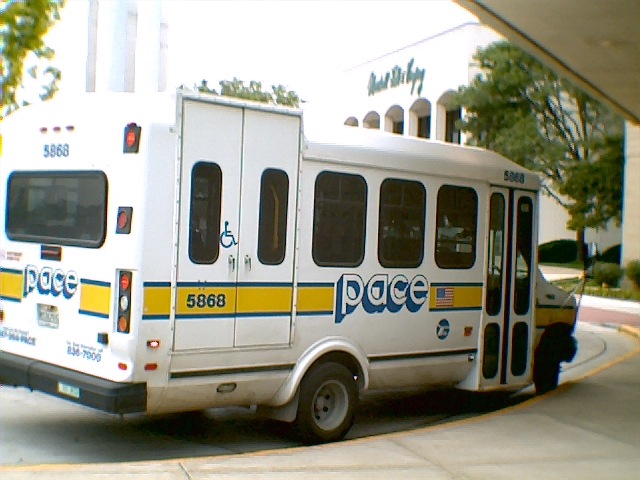
Yorktown's ban on Pace buses is just yet another reminder that commercial shopping malls, no matter how public they may appear, are still privately-owned and largely subject to the whims of the for-profit corporations that own them.

I have never heard of anyone having been given permission to circulate petitions in a shopping mall, the ownership usually giving the reason that such circulation would interfere with patrons' shopping experiences; yet at the same time, they allow the conduct of survey research by organizations who choose to rent space from them.

The disappearance of public spaces to serve as public forums, and their replacement by private spaces, such as shopping malls, is a serious issue that threatens our democracy. The car culture and poor planning is resulting in the disappearance of public spaces. By the time people leave their cars, they are far into the parking lots of the big box stores on private property and beyond the reach of the public forum.

In addition, through laws such as the Postal Reorganization Act, and the drive to privatize the property of the United States Postal Service, we are loosing other traditional public forums and our ability to meaningfully exercise our constitutional right to engage in free speech--political, religious, and otherwise.

Where is this all leading? It is leading to an environment where those who own the land, or the media, exclusively control the public debate. The private owner of a shopping mall simply has no legal duty to allow speech that does not support their private, commercial interests.

In the case referenced above, the owner of Yorktown Shopping Mall may have acted in what it feels is in its own private interest; but it certainly did not act in the greater public interest. Unfortunately, usually the only effective way to make such corporations act in the public interest is to refuse to patronize them and inform them of your reason for doing so. Of course, this approach doesn't always work.

There are arguments that such corporations SHOULD have a duty to act in the public interest. After all, corporations, which are artificial legal persons and creations of the state, are allowed to incorporate and profit with the assumption that they will act in the public interest; and the State rarely revokes a corporate charter for failing to do so.

California actually has a state law which requires shopping malls to allow certain types of constitutionally protected speech, such a petitioning, which is considered a form of political speech. The legal theory is that public shopping malls are largely responsible for the demise of the traditional main street, and they often receive zoning variances, exceptions, and many other value government subsidies.

We should consider a similar law here in Illinois. We should also pay more attention to zoning, planning, and land use issues which result in unwalkable communities, the disappearance of public spaces, and the demise of traditional public forums. Of course developers will no doubt balk at any such attempt, but protecting competition in our marketplace of ideas is far more important than protecting their pocketbooks.

Thankfully, there are already a few organizations working on related issues, notably including the Project for Public Spaces, Congress for the New Urbanism, the U.S. Green Building Council, and several others. Now we just need Illinois lawmakers to start working on the same.

Read more...

Sunday, January 20, 2008

Crazy Political Rantings: Fixing Illinois

The Crazy Politico offers his proposal for solving the problem of transit in the suburbs and for increasing representation in the General Assembly.

Instead, a "spread the weath" formula needs to be developed. While the 2020 groups contention that faster rail would make folks more likely to use it has merit, so does the idea that a non-Chicagocentric system for the RTA would help. Making it easier to get from Points A and B, without going through Chicago, or close to it would help. Metropolis 2020 ignores the fact that a lot of the traffic on Chicago freeways isn't going to Chicago, it's going somewhere less well served by our current transit structure.

One of the downsides to the current transit structure is that is makes it nearly impossible for the collar counties to develop their own transit systems, the money they have for it is already tied up in the bloated RTA, CTA, Pace, Metra system leaving little for regional transport outside of Chicago.

Chicago Metropolis 2020 points out that the number of trucks jamming the roads is part of the problem. Easing truck congestion is much easier than anyone will admit, because it doesn't fit in the "Chicago First" mold. Rockford has an excellent airport that is tossed occasional bones in cargo transit, but is basically locked out of becoming a major regional hub by O'Hare contracts. The same is true of major brand airlines trying to fly from Rockford. Anything that takes away from idea of O'Hare as the epicenter of Northern Illinois transit is looked on as bad, and whispers of punishment from the O'Hare folks shut down the idea quickly.

DeKalb and Rockford both have the rail, road and air transport facilities to reduce the congestion in the O'Hare area, and Chicago area as a whole, but have been, through state and regional actions, hampered in developing them to their full potential. Both area also closer to other states time and distance wise than Chicago, and could be used to attract business from them, growing Illinois, but the same groups that want to grow Illinois by making Chicago better ignore methods that would grow Illinois anywhere but Chicago.

So, how does this get fixed? Well this year Illinois has the chance to vote on holding a Constitutitional Convention to rewrite or Amend the State Constitution. Changing Article IV of the State Constitution to change the makeup of the state legislature would be a good start. Currently the makeup is completely population based, with 59 districts, each providing one Senator and 2 Assembly members. Because over 65% of the states population is located in Cook County and it's "collar counties" both houses of our the legislature are disproportionately representative of that area, making everything else in the state second rate as far as the legislature is concerned.

A good change would be to make the Legislature more like the Federal Government. The Assembly could be made slightly bigger, by coming up with 70-75 districts based on population, with 2 members from each. However, the Senate could be based on Counties instead of population, with 1 Senator from each of the 102 counties. By giving equal voice to all of the counties in one branch of the legislature we'd be able to mitigate some of the Chicago First mentality, and maybe, just maybe, grow the whole state from different angles, instead of hoping growth radiates from an overgrown and overburdened epicenter.

Read more...

Monday, September 10, 2007

CTA Fare Hikes

Click on the ad the Chicago Transit Authority spend oodles placing in Chicago’s newspapers and you will see what CTA riders will have to pay to get to and from work.

How does it compare with what you have to pay?

It looks like $6 a day on a rapid transit train and $5 per day, if you take a bus.

Get a monthly pass, however, and the cost is $84. With twenty working days a month, that seems to be about $4 a day, assuming one doesn’t use bus or train service any time else during the month.

What do you pay to get to work each month?

When you fill up your motor vehicle with gas, how much does it cost?

Did your cost of gasoline increase 50% this year?

Do you have to fill it up at least twice a month?

Do you have car payments?

Even if you don’t, there is obviously depreciation on your car as you use it. when it wears out, you'll have to buy a new one.

Just wondering.

Is keeping CTA, Metra and Pace fares down worth it to have your RTA sales taxes tripled from one-quarter of one percent to three-quarters of a percent,
even if half of the increase is going to be given to the McHenry County Board to spend improving the roads of its choice?

Just wondering.

It's going to cost the average McHenry County family about $200 a year if the CTA bailout bill is passed.

And for those reading from outside the Chicago area in Illinois, part of your share of the sales tax will be ripped off. In that Governor Rod Blagojevich's spokeswoman is correct.

The Metra engine is pulling into Crystal Lake's train station from Chicago. The Pace buses are on Bull Valley Road at the McHenry spur's grade crossing. Tell us where the CTA bus is, Chicago readers.

You know this went up on McHenry County Blog first.

Read more...

Friday, July 27, 2007

Doubling the RTA Sales Tax

Will any McHenry County legislators vote to double the Regional Transportation Authority tax burden on local residents?

That’s the question I’m asking after reading the latest Daily Herald article by Eric Kroh.

Those voting for it will gain instant “tax hiker” status.

Here is a full-sized bus that pulls out of a subdivision between Crystal Springs Road and Mason Hill Road, takes the McHenry Blacktop to Bull Valley Road, turns right, and goes to Route 31 where it turns right again. This is right before 8 AM.

I have yet to see it stop for a passenger.

That's just the kind of efficiency I want to subsidize more of.

Posted first at McHenry County Blog, where political news continues over the weekend, including the dissent on the $21,000 Oberweis fine, which McHenry County Blog reported six months ago.

Read more...

  © Blogger template The Professional Template by Ourblogtemplates.com 2008

Back to TOP