Showing posts with label Big Box Retail. Show all posts

Tuesday, August 26, 2008

Yorktown Pace Bus Ban Demonstrates Public Space Importance
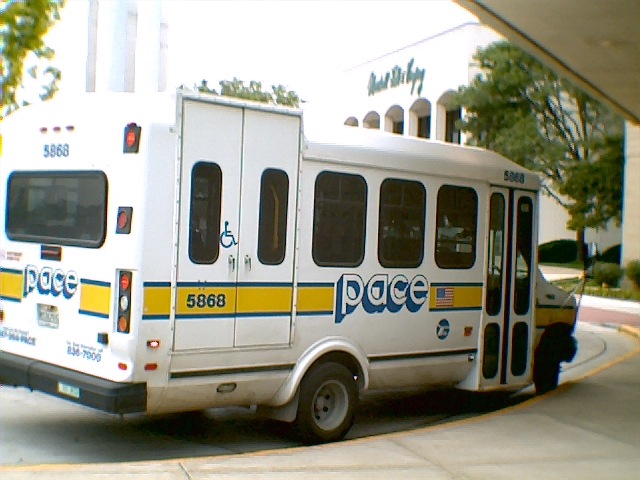
Yorktown's ban on Pace buses is just yet another reminder that commercial shopping malls, no matter how public they may appear, are still privately-owned and largely subject to the whims of the for-profit corporations that own them.

I have never heard of anyone having been given permission to circulate petitions in a shopping mall, the ownership usually giving the reason that such circulation would interfere with patrons' shopping experiences; yet at the same time, they allow the conduct of survey research by organizations who choose to rent space from them.

The disappearance of public spaces to serve as public forums, and their replacement by private spaces, such as shopping malls, is a serious issue that threatens our democracy. The car culture and poor planning is resulting in the disappearance of public spaces. By the time people leave their cars, they are far into the parking lots of the big box stores on private property and beyond the reach of the public forum.

In addition, through laws such as the Postal Reorganization Act, and the drive to privatize the property of the United States Postal Service, we are loosing other traditional public forums and our ability to meaningfully exercise our constitutional right to engage in free speech--political, religious, and otherwise.

Where is this all leading? It is leading to an environment where those who own the land, or the media, exclusively control the public debate. The private owner of a shopping mall simply has no legal duty to allow speech that does not support their private, commercial interests.

In the case referenced above, the owner of Yorktown Shopping Mall may have acted in what it feels is in its own private interest; but it certainly did not act in the greater public interest. Unfortunately, usually the only effective way to make such corporations act in the public interest is to refuse to patronize them and inform them of your reason for doing so. Of course, this approach doesn't always work.

There are arguments that such corporations SHOULD have a duty to act in the public interest. After all, corporations, which are artificial legal persons and creations of the state, are allowed to incorporate and profit with the assumption that they will act in the public interest; and the State rarely revokes a corporate charter for failing to do so.

California actually has a state law which requires shopping malls to allow certain types of constitutionally protected speech, such a petitioning, which is considered a form of political speech. The legal theory is that public shopping malls are largely responsible for the demise of the traditional main street, and they often receive zoning variances, exceptions, and many other value government subsidies.

We should consider a similar law here in Illinois. We should also pay more attention to zoning, planning, and land use issues which result in unwalkable communities, the disappearance of public spaces, and the demise of traditional public forums. Of course developers will no doubt balk at any such attempt, but protecting competition in our marketplace of ideas is far more important than protecting their pocketbooks.

Thankfully, there are already a few organizations working on related issues, notably including the Project for Public Spaces, Congress for the New Urbanism, the U.S. Green Building Council, and several others. Now we just need Illinois lawmakers to start working on the same.

Read more...

Wednesday, March 26, 2008

Vacant lots employ no one

The former Dominick's grocery store on the left employs no one. Just as the vacant lot at 83rd and Stewart on Chicago's South Side doesn't have anyone on its payroll.

Wal-Mart, the world's largest corporation, wants to build a store at 83rd and Stewart, and help revitalize an area that has few if any large grocery stores--a "food desert."

And some people want to keep it that way.

The Chicago Tribune, free registration may be required for the link, has an editorial today that about that lot. It's part of the Chatham Market redevelopment plan, and a clause in that plan calls for Chicago City Council approval for any store selling groceries with over 100,000 square feet. Two years ago, the council passed an ordinance, which was vetoed by Mayor Richard Daley, that would've forced any store with over 100,000 square feet of retail space, a "Big Box," to pay its workers more than smaller retailers. If that bill had becoome law, it would've been a disaster for Chicagoans. Fewer jobs, higher prices for goods.

From the Tribune editorial:

Despite the size trigger in the Chatham Market development and the now-defunct Big Box ordinance, this controversy has always been more about what's on the shelves than how many shelves there are. Wal-Mart is the nation's largest retailer—and the nation's largest grocer. Organized labor is determined to protect its unionized ranks at area Jewel and Dominick's grocery stores. That means it's determined to keep Wal-Mart and its big grocery departments out of Chicago.

Like Wal-Mart's employees, Lowe's workers also are non-union. Lowe's opened its 117,000-square-foot store in Chatham Market in December. Nobody protested. Lowe's doesn't sell groceries.

The city's latest rejection may not be the last turn of this wheel. Wal-Mart hasn't given up and neither has Ald. Howard Brookins (21st), who represents this area and knows how eager his constituents are for the hundreds of jobs and shopping convenience Wal-Mart would bring. But making this happen requires political courage from the mayor and from aldermen not beholden to labor. And there isn't much evidence of that.

The original developers of Chatham Market, Monroe Investment Partners LLC, vowed four years ago that "Wal-Mart is not now, and will not be, a part of our development." They might have added: A vacant lot is so much better.

Meanwhile, the food desert problem persists in Chicago and other large cities. The City of Chicago is aware of the problem, and as I noted in the related post, they are working to recruit medium-sized grocers (that means not Wal-Mart or Target) into the deserts.

Some people just don't get it.

Related Marathon Pundit posts:

Food deserts continue to plague Chicago
Obama's Wal-Mart connection: Wife served on board of big Wal-Mart supplier
Chicago's "food deserts" well known to Obama
My book report: The Wal-Mart Revolution: How Big Box Stores Benefit Consumers, Workers, and the Economy
The good life of working for the UFCW
Union leaders don't share their members pain
Chicago food desert update: Hyde Park Co-op to close
Big-box shy Chicago facing "food desert"

To comment on this post, please visit Marathon Pundit.

Read more...

Wednesday, June 20, 2007

Wal-Mart seeks to water Chicago's food deserts


On the left is a former Dominick's supermarket on Chicago's North Side. The Safeway owned chained closed over a dozen stores last year, leading to the creation of Chicago "food deserts"--areas not served by a supermarket.

Ironically the food-desertification of Chicago became acute shortly after the passing of the since vetoed big-box "living wage" ordinance by the Chicago City Council.

From the Chicago Sun-Times:

Wal-Mart is prepared to move "in six to 12 months, maybe sooner" to build as many as five South Side supercenters, but the world's largest retailer is scouting sites in neighboring wards in case local aldermen resist, a top official said Tuesday.

South Side Chicago Alderman Beale Anthony Beale adds more:

We have a food desert in our community. We're in desperate need of a quality grocery store. If Wal-Mart would commit to the site on 111th, that would give me two quality grocery stores and over 1,000 jobs.

Alderman Joe Moore, author of the "living wage" ordinance must be seething. But he has problems of his own. On Friday, Moore will learn the initial ruling from the judge presiding over challenger's Don Gordon's lawsuit over the results of April's 49th Ward aldermanic election--Moore was declared the winner. Gordon is alleging that vote fraud occurred and is asking that the results be overturned.

Related Marathon Pundit posts:

My book report: The Wal-Mart Revolution: How Big Box Stores Benefit Consumers, Workers, and the Economy

Breaking: Lawsuit alleges vote fraud in last week's 49th Ward election in Chicago

Big-box shy Chicago facing "food desert"

Chicago's "food deserts" well known to Obama

To comment on this or any other Marathon Pundit post, click here.

Read more...

Sunday, April 22, 2007

Wal-Mart, Chicago, might compromise on "living wages"

Now that Chicago's municipal elections are over, it appears to be time for Wal-Mart and the City to revisit the big-box "living wage" debate.

Last year, in a bill sponsored by Alderman Joe Moore, the Chicago City Council passed a "living wage" ordinance that would've effected only "big box" stores such as Wal-Mart, Target, and Home Depot. Mayor Richard M. Daley vetoed that bill, and the Council failed to in its attempt to override.

From Crain's Chicago Business, free registration may be required:

Despite post-election chest thumping, the first signs of a potential compromise are emerging in the political war between Wal-Mart Stores Inc. and union-led advocates of a big-box minimum wage bill.

Sources on both sides say they're willing to sit down and talk at length, and they raise the possibility of a deal in which Wal-Mart would get zoning approval needed for more Chicago stores in exchange for agreeing to support a wider minimum wage bill that applies to more than the super-sized retail outlets known as big boxes.

Wal-Mart recently backed a similar law in Maryland, and while such a proposal would stir intense opposition from some partisans on either side of the fray, it might also provide a starting point for substantive discussions, sources say.

But sometimes, as with Palestinian extremists, people prefer to fight. When responding to the possibility of adding other retailers to the "living wage" battle, Madeline Talbott of ACORN said:

I don't know if you want every Walgreens and CVS on your case," Ms. Talbott says. "Wal-Mart is a great political enemy to have.

To comment on this post, or vote in the Pajamas Media presidential straw poll, click here.

Read more...

Sunday, March 04, 2007

Austin Weekly News: Makeover for Madison Street in the works

From AWN,

When Rev. Michael Eaddy, pastor of Peoples Church of the Harvest, 3570 West Fifth Ave., was growing up in East Garfield Park in the 1960s, the neighborhood's Madison Street strip was a destination that drew in shoppers for miles around. At a press conference Tuesday at Edna's, 3175 W. Madison, neighborhood groups unveiled a new action plan for Madison Street between Damen and Central Park Avenue that Eaddy and other West Side residents hope will bring the street back to its former glory. While residential development in East Garfield Park has boomed in recent years, commercial development has lagged behind, a dynamic that has not gone unnoticed by Eaddy and other neighborhood leaders.

"When you didn't go downtown, you could always go out west," Eaddy recalled of his youthful days in the neighborhood. "We want to recapture that."
I remember watching tanks roll east down Madison St towards the fires when it all burned down. It takes forty years to start talking about rebuilding it all.
Abe Lentner, Coordinator for Technical Assistance Programs at UIC's City Design Center, said the neighborhood still has more than 100 vacant lots and a 30 percent vacancy rate in commercial structures.

"That sends a message that East Garfield Park is closed for business," Lentner said.

To combat that image, Lentner called for the recruitment of "quality retail" development, and said the new group should also push to find opportunities for neighborhood entrepreneurs to start new businesses or expand existing ones.
Big Box retailers can do nothing but help in these circumstances and the conditions for letting them in should be help for those technical assistance programs to spin off more retail. Chicago's done nothing for way too many neigborhoods for way too long.

Read more...

  © Blogger template The Professional Template by Ourblogtemplates.com 2008

Back to TOP