Showing posts with label Legislation. Show all posts

Thursday, June 25, 2009

Budget not the only thing in limbo

By Hilary Russell
Just as the state’s operating budget is in limbo with five days left in the fiscal year, many substantive bills were left in the lurch at the end of the regularly scheduled spring session. The following is a list of measures that Illinois Issues magazine covered in our monthly “legislative checklist” throughout the spring. See the full list in the July/August print edition. In the meantime, here is a list of bills that stalled but that could come up in this fall’s or next spring’s legislative sessions:


HJRCA 31 The constitutional amendment sponsored by Rep. Jack Franks, a Morengo Democrat, would give voters the option to remove a sitting governor from office. The resolution would require voters to decide whether they wanted to change the state’s Constitution to include a so-called “recall” provision. The bill passed the House, but it didn’t get called for a final vote in the Senate. Senate President John Cullerton recently said he would not call the measure for a vote until Gov. Pat Quinn signed another ethics reform measure, HB 7, which would cap the amount individuals, businesses and political organizations could contribute to candidates. Franks’ recall measure doesn’t have to be approved until May 2010, and he said he expects that it would pass without problems before then.

HB 2643, SB 1292 Newly hired state employees and teachers would receive less generous pension benefits than current employees. Quinn proposed the so-called two-tiered pension plan as a way to save the state money in the next fiscal year and to reduce the mounting pension liabilities in the long run. But public employee union members strongly oppose the idea and argue it ultimately won’t save the money projected by the governor’s office. The legislation, sponsored by Rep. Kevin McCarthy, an Orland Park Democrat, and Sen. Don Harmon, an Oak Park Democrat, stalled in both chambers.

SB 1381 A bill allowing the limited use of medical marijuana, sponsored by Sen. Bill Haine, an Alton Democrat, narrowly passed in the Senate, marking the first time in Illinois’ legislative history that such a proposal won approval. The clock ran out before House sponsor Rep. Lou Lang, a Skokie Democrat, presented it to the full chamber. Lang said he didn’t have enough votes to pass it and that he plans to lobby for the bill and could call it in the future.

SB 744, sponsored by Sen. Terry Link, proposed opening new casinos in Chicago, Danville, Rockford and Waukegan, as well as adding gaming positions at existing riverboats and allowing slot machines at horse racing tracks. According to Link, a Waukegan Democrat, the gaming package could generate as much as $1 billion a year. While the Senate approved the measure, the House sponsor, Lang, said he chose not to call the bill and would like to make changes so the bill would not specify where the gaming facilities would have to be built.

HB 2234 would recognize civil unions and give same-sex partners some of the same legal rights, including power-of-attorney, as married couples. Rep. Greg Harris, a Chicago Democrat, sponsored the legislation. It narrowly passed out of committee but wasn’t called on the floor because, Harris said, he didn’t have enough votes to ensure passage. He added that new legislation in Iowa that now legitimizes same-sex marriage could help pave the way for passage of Illinois’ bill in the future; however, Harris’ civil unions measure would not be the same as same-sex marriage.

HB 397 redefines stalking. The measure amends the 1961 criminal code by defining stalking as a behavior intended to terrorize or endanger another person through intimidation or threats. Rep. Dan Brady, a Bloomington Republican, sponsored the measure. The bill stalled in the House. Brady said the measure is undergoing further negotiations between the state’s attorney’s office and the attorney general’s office. He expects to present it again during the 2010 spring session.

HB 2633, sponsored by Democratic Rep. Julie Hamos of Evanston, called for stricter rules to define how and when inmates in minimum- and maximum-security prisons were transferred to Tamms Correctional Center in Alexander County. Questions about the treatment and living conditions of the prisoners prompted Hamos to write the bill, which she said is on hold because a new director recently took over the center. She said she wants to wait to see what kind of changes will come about as a result.

HB 288 proposes that public schools could give students a few moments before class begins to observe a moment of reflection. The bill is sponsored by Rep. John Fritchey, a Chicago Democrat, and Sen. Bill Haine, an Alton Democrat. The moment of reflection would be determined on a school-by-school basis. Fritchey’s definition of a moment of reflection would replace the existing Student Reflection and Student Prayer Act, which requires every school to have a moment of silence during which students could either reflect on the day ahead or pray. Because the law lacked consequences for not observing the moment of silence, some schools observed it while others did not.

Controversy has surrounded the moment of silence issue because federal court deemed it unconstitutional to require public school students to pray during school hours.

The law invited a lawsuit. Fritchey, who voted against the original moment of silence bill, proposed the new version that would remove the “student prayer act” from the name and allow teachers to choose whether to honor the moment.

Haine said the role of the government is to encourage freedom of expression, not force it on individuals who may hold different beliefs, but he said he didn’t know if he could get enough votes for the bill to pass next session.

Read more...

Sunday, May 31, 2009

House approves recall provision

By Jamey Dunn, with Hilary Russell contributing
Illinois voters could have the chance to vote on whether they want authority to boot the governor from office, thanks to a measure that passed the House Saturday.


The House approved a similar effort last year after frustration from then-Gov. Rod Blagojevich’s alleged corruption scandals. But it stalled in the Senate.

This year’s measure, Constitutional Amendment 31, would allow voters to cast their ballots on whether they want to change the state Constitution to include a so-called recall provision.

Many said that the provision should include the ability to recall all constitutional officers. Franks said he would like to add that later, but in the wake of the alleged Blagojevich scandal, he wanted to give voters a way to address corruption in the governor’s office.

“I firmly believe if we’d had it during the last administration, we’d have used it,” he said. Franks added that he thinks the legislature would have never removed Blagojevich from office had he not been indicted.

Gov. Pat Quinn Quinn said a recall provision would make the legislature accountable because if a corrupt politician had to be removed, the General Assembly would have to sign on to the effort, along with voters.

The requirement to have legislators sign off on recall drew the most ire from Republicans. They said that making voters get lawmakers’ approval takes the power away from the people.

Republicans said they want Franks to hold the bill and negotiate some changes. Franks’ measure would not need to be approved until six months before the general election to get on the 2010 ballot. But Franks said it could be called in the Senate after the midnight deadline Sunday, when the legislature adjourns.

Here are some numbers associated with the recall process laid out in the bill:

  • A governor must be in office for 6 months before the recall process is started.
  • 20 House members and 10 Senate members from both parties would have to sign off on an initial recall proposal from citizens.
  • Once legislators approved the measure to put the question on the ballot, individuals seeking to remove the governor would have 150 days to round up the signatures to put the question of whether to remove the governor before voters. They would need a number of signatures equal to 15 percent of the votes cast in the last gubernatorial election. For instance, Franks said the number of signatures currently needed would be 750,000 based off of the 2006 election.
  • There must be at least 25 different counties with 100 signatures each.
  • This version of the bill would only apply to the governor’s position, and it contains new safeguards intended to prevent abuse of the power. These new aspects came under fire from House Republicans.


Read more...

Friday, May 29, 2009

Medical marijuana may have to wait for a vote

By Hilary Russell
Despite two victories this week for legalizing medical marijuana, the bill probably won’t get a floor vote in the Illinois House before the May 31 deadline for the spring legislative session, according to it’s sponsor, Rep. Lou Lang of Skokie.


The bill passed out of a House panel last night. The Senate approved SBill 1381 the previous day. See background here.

But medical marijuana is taking a back seat to the state budget and whether it will include income tax increases, which could come up for a vote this evening.

If the medical marijuana bill isn’t called by Sunday, Lang said he could try again when lawmakers return from their summer break. “This bill is only difficult because people want to turn it into politics,” he said. "There are many people on this floor who have said to me, ‘It’s a really great idea, and I think it would help a lot of people, but I can’t vote for it.’”

Read more...

Texting bans head to the governor

By Hilary Russell
Drivers would be banned from texting while driving if Gov. Pat Quinn signs HB 71 into law. It passed both chambers, most recently in the House by a vote of 96-25. Quinn has 60 days to approve or veto it before it automatically becomes law.


Rep. John D’Amico, a Chicago Democrat, sponsored HB 71, which prohibits the use of cell phones, personal digital assistants (PDAs), portable computers or any device that allows users to write, read and send an electronic message.

The bill does, however, exclude global positioning devices built into cars, as long as the devices are used only for getting directions. The bill also excludes law enforcement, emergency vehicle operators and drivers reporting emergencies. Commercial vehicle drivers also would be allowed to use electronic devices, provided they’re no larger than 10 inches by 10 inches.

Drivers also could use electronic devices as long as they are hands-free or voice-activated. And they could still pull over and text while parked on the side of the road.

Cell phones banned in school and construction zones
Another bill that passed both chambers would ban the use of cell phones in school speed zones, construction zones. The House approved HB 72 by a vote of 96-21.

The bill, also sponsored by D’Amico, would allow construction workers to use wireless phones. And using cell phones during emergencies would be exempt from the ban.

Read more...

Thursday, March 12, 2009

Gas, Gambling, Games, Governor and Safeguard

By Jamey Dunn
A gas tax increase, a proposition to sell lottery tickets online and early plans for possible 2016 Chicago Olympic Games all progressed in the legislature today. So did a measure to protect youth from sex offenders who prowl on social networking Web sites.


Gasoline
A controversial measure to increase in the sales tax on gasoline, proposed by Democratic Rep. John Bradley of Marion, advanced this morning. Bradley warned that HB 1 still needed work, and he urged committee members to support the concept rather than the details as introduced.

Gambling
A bill backed by Senate President John Cullerton would allow the state to sell lottery tickets on the Internet. Sen. Don Harmon, a Democrat from Oak Park, said SB 1654 would do three things:

  1. Prohibit the state from selling the Illinois Lottery to private investors.
  2. Allow the state to hire a private firm to manage the lottery, while the state would still own it. Harmon said the idea would be to “contract with someone smarter than us to operate it.”
  3. Create a pilot program to sell tickets for the Lotto and Mega Million games online.

The measure advanced out of committee today, but Harmon said it needed work before it would be ready for a final vote on the Senate floor.

Games
The Senate sent a bill to the House that is an early step towards preparing for the possibility of the 2016 Olympic Games being held in Chicago. The specifics of the bill will be worked out in the House, but sponsor Sen. Kwame Raoul, a Chicago Democrat, said it was important to get the ball rolling to meet an April deadline set by the International Olympic Committee.

Governor
Also in the Senate today, Cullerton announced that Senate Secretary Deborah Shipley (scroll down for bio) will join Gov. Pat Quinn’s staff as director of legislative operations. It’s another move that could build bridges between the executive and legislative branches, which have had frosty relationships during the past six years.

Shipley was elected secretary by Senate members in January 2007, replacing retired secretary Linda Hawker. Shipley will bring some institutional knowledge and offer guidance to Quinn’s relatively new and young legislative staff.

Safeguard against sex offenders
By Hilary Russell
The state could make it harder for individuals convicted of sex crimes to use the Internet.

Rep. Sandra Pihos, a Glen Ellyn Republican, is sponsoring HB 1314, a bill that would make using a social networking Web site a Class 4 felony for registered sex offenders. Convicted offenders must register with the state.

Earlier this year, Pihos said she read a report that nearly 100,000 sex offenders were removed from social networking Web sites in Connecticut and North Carolina, where two state attorneys general targeted sex offenders who used the Web.

“If they can remove that many sexual predators, we can do that here,” Pihos said. “Until we’re sure we have a mechanism in place that actually safeguards our children from sexual predators being on that site, I just feel that here in Illinois, we need to put some legislation in place.”

Her bill would apply a Class 4 felony or up to a three-year prison sentence if someone used social networking Web sites while registered as a sex offender. As a condition of parole, probation or release, the offender would have to agree not to use such sites as MySpace or FaceBook.

MySpace and FaceBook have more than 180 million users, and Pihos said that it’s an ideal anonymous place for sexual predators to troll for young people.

Read more...

Tuesday, February 24, 2009

Illinois Senate Legislates Status of Pluto

Reason magazine on an attempt by state Sen. Gary Dahl wants the state to recognize Pluto as one of the big nine planets of our solar system. Of course it should be noted one good read for this push is for the fact that the person who discovered the planet is said to be from Illinois.

So here's the gist...


An Illinois Senate committee on Thursday unanimously supported planet Pluto and declaring March 13 "Pluto Day..." The push for a state decree on Pluto comes from state Sen. Gary Dahl, a Republican whose downstate district includes Streator, birthplace of Pluto discoverer Clyde Tombaugh. Dahl told colleagues Pluto is important to the local community, which considers the vote to downgrade Pluto to "dwarf" planet was unfair...
I had to go back to this post from Betsy's Page for more about this story...

Dahl told colleagues Pluto is important to the local community, which considers the vote to downgrade Pluto to "dwarf" planet was unfair as it involved only 4 percent of the International Astronomical Union's 10,000 scientists.

Dahl noted that Tombaugh is the only American ever to discover a planet. Tombaugh first detected Pluto in 1930 at the Lowell Observatory in Arizona.

Dahl called Thursday's committee vote a key step forward, not only for Pluto and Streator, but also for bipartisan cooperation in the Senate. He said previous Democratic leadership sat on the proposal last year but new Senate President John Cullerton let it advance.
Interesting, very interesting.

Read more...

Tuesday, August 26, 2008

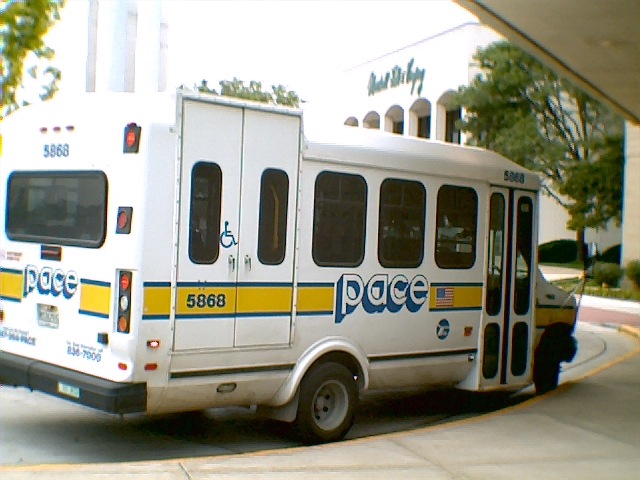
Yorktown Pace Bus Ban Demonstrates Public Space Importance

Yorktown's ban on Pace buses is just yet another reminder that commercial shopping malls, no matter how public they may appear, are still privately-owned and largely subject to the whims of the for-profit corporations that own them.

I have never heard of anyone having been given permission to circulate petitions in a shopping mall, the ownership usually giving the reason that such circulation would interfere with patrons' shopping experiences; yet at the same time, they allow the conduct of survey research by organizations who choose to rent space from them.

The disappearance of public spaces to serve as public forums, and their replacement by private spaces, such as shopping malls, is a serious issue that threatens our democracy. The car culture and poor planning is resulting in the disappearance of public spaces. By the time people leave their cars, they are far into the parking lots of the big box stores on private property and beyond the reach of the public forum.

In addition, through laws such as the Postal Reorganization Act, and the drive to privatize the property of the United States Postal Service, we are loosing other traditional public forums and our ability to meaningfully exercise our constitutional right to engage in free speech--political, religious, and otherwise.

Where is this all leading? It is leading to an environment where those who own the land, or the media, exclusively control the public debate. The private owner of a shopping mall simply has no legal duty to allow speech that does not support their private, commercial interests.

In the case referenced above, the owner of Yorktown Shopping Mall may have acted in what it feels is in its own private interest; but it certainly did not act in the greater public interest. Unfortunately, usually the only effective way to make such corporations act in the public interest is to refuse to patronize them and inform them of your reason for doing so. Of course, this approach doesn't always work.

There are arguments that such corporations SHOULD have a duty to act in the public interest. After all, corporations, which are artificial legal persons and creations of the state, are allowed to incorporate and profit with the assumption that they will act in the public interest; and the State rarely revokes a corporate charter for failing to do so.

California actually has a state law which requires shopping malls to allow certain types of constitutionally protected speech, such a petitioning, which is considered a form of political speech. The legal theory is that public shopping malls are largely responsible for the demise of the traditional main street, and they often receive zoning variances, exceptions, and many other value government subsidies.

We should consider a similar law here in Illinois. We should also pay more attention to zoning, planning, and land use issues which result in unwalkable communities, the disappearance of public spaces, and the demise of traditional public forums. Of course developers will no doubt balk at any such attempt, but protecting competition in our marketplace of ideas is far more important than protecting their pocketbooks.

Thankfully, there are already a few organizations working on related issues, notably including the Project for Public Spaces, Congress for the New Urbanism, the U.S. Green Building Council, and several others. Now we just need Illinois lawmakers to start working on the same.

Read more...

Monday, August 11, 2008

Ready, set, repeat

Reminiscent of last year, a whole host of state policy issues remain up in the air throughout the summer. Inaction mostly rests on the shoulders of Democrats, who are repeating history by agreeing on practically nothing. The main culprits are Gov. Rod Blagojevich and House Speaker Michael Madigan, each of whom blames the other for lack of action. Meanwhile, Illinois is in its ninth year without a capital construction plan, campaign funding reform remains dormant, many state services and agencies are operating with stagnant or decreased funding and long-term costs of health care and pensions continue to compound.

Legislators and the governor will return to Springfield this week with lots to talk about, but little progress is anticipated. Here’s a chronological list of activities with some context.

Today: Comptroller Dan Hynes issued a statement that he would not cut the checks for pay raises for state legislators and officers if they are enacted because the General Assembly never gave him authority to spend the necessary money. “We cannot implement the pay raises without an appropriation. But more importantly, I am of the opinion that this is no time for pay raises,” he said in a release, citing budget cuts for social services and Medicaid providers. The House rejected the pay raises, but the Senate has yet to do so. In the larger scheme of things, the pay raises simply are a battle of public perception. While such state services as substance abuse treatment struggle to meet demand because of $43 million in budget cuts, it would look disingenuous if legislators received their annual 3 percent cost-of-living adjustments at the same time they receive significant pay raises, costing about $1.1 million just for constitutional officers, legislators and top state agency officials, according to the comptroller’s office. That doesn't count pay raises for judges.

Tuesday: Expect Gov. Rod Blagojevich’s idea to move about 140 state employee positions from Springfield three hours south to be rejected by a bipartisan legislative review panel. Expect that rejection to be followed by the governor’s statement that the move is going to go forward, anyway. Lots of union-backed employees will be up in arms again. Meanwhile, they’re still working under last year’s contract with the state while their union, the American Federation of State, County and Municipal Employees Council 31, remains gridlocked (click this link and scroll down) with the administration. Among the key sticking points are employee wages and employee contributions to health care and pension benefits.

Tuesday and Wednesday: Gov. Rod Blagojevich called legislators back to the Capitol to address two major issues: funding for education on Tuesday and funding for capital construction projects Wednesday. But neither session meets until late in the afternoon, giving legislators time throughout the day to attend various events at the annual State Fair in Springfield. Governor’s Day (a.k.a. Democrats’ Day) is Wednesday and Republican Day is Thursday. Watch for political fireworks off stage.

Ongoing: The governor says he’ll “rewrite to do right,” his slogan for changing agreed-upon bills to include his agenda. If the General Assembly rejects his changes, then the underlying bill dies. So far, he’s changed two bills. One would allow all adults up to age 26 to remain on their parents’ health insurance plans. The original intent was limited to college students who took a medical leave or who reduced their course loads to part time because of an illness or injury. They would have been covered for a year on their parents' plans. A second amendatory veto would extend property tax exemptions to all veterans with service-connected disabilities certified by the U. S. Department of Veterans’ Affairs. The original bill regarded a tax increment financing district in the Village of Downs. Blagojevich has said he will continue amending numerous bills in his Rewrite to Do Right campaign, “to take positive action on legislation that has been sent to him by the General Assembly,” according to a statement from Brian Williamsen, his spokesman.

August 29: Later this month marks the deadline for the governor to sign, change or reject ethics reforms sent to his desk in June. His office repeatedly has said he doesn’t think the ethics reforms go far enough. One potential amendment could include banning state contractors from donating to statewide political parties. The original legislation, which received unanimous approval by the General Assembly in May, only prevented state contractors holding contracts worth $50,000 or more from donating to statewide officeholders who sign the contracts.

Also coming up: One of the House Democrats’ point people on education, Rep. Mike Smith of Canton, announced that he’ll host a series of public hearings to consider a proposal to abolish property taxes for school funding by 2010. It’s been floated by Sen. James Meeks, a Chicago Democrat who previously threatened to run against Blagojevich for governor in the absence of education funding reforms. Meeks didn’t run, but he also didn’t get what he wanted. So here we go again. Add education funding reform to a huge pile of politically sensitive Statehouse issues that likely will grab some headlines but will remain stalled, at least before the November elections.

Read more...

Monday, June 23, 2008

Seven days


By Bethany Jaeger
Illinois starts a new fiscal year in seven days. That means some new state laws take effect July 1. But also, for the first time in history, many public employees could have to work without a contract in place with the administration. Four years ago, the state’s largest public employee union, the American Federation of State, County and Municipal Employees Council 31, negotiated a contract with the administration that spells out how much employees make and how much they pay for such benefits as health care and retirement.

This year’s negotiations between union officials and Gov. Rod Blagojevich’s administration have stretched about seven months, potentially creating the first time that Illinois’ AFSCME Council 31 won’t have an agreement in place before the existing contract expires. “That alone shows the level of contentiousness and the distance between the parties is unprecedented,” says Anders Lindall, union spokesman.

The lion’s share of the disagreement is health care, he says, but it’s complicated by the sagging economy. “It’s higher health care costs, higher pension costs, coupled with pay increases that don’t even keep pace. And at a time when people are being socked at the gas pump, they’re being soaked at the grocery checkout and everywhere else for higher cost of living, to have health care and to have pension funds going through the roof, it’s not acceptable. It’s not [the making] of a fair contract agreement.”

Negotiations continue this week after a few thousand union supporters rallied at the Capitol today. Neither the administration nor union officials would comment on what happens if the contract expires before they reach an agreement. They would only say they’re continuing “good faith negotiations” and are mindful of each other’s concerns.

Local union leaders and members gathered at the Capitol wearing green T-shirts and waving signs that said, “Governor, don’t cut our health care.” Marion Murphy, caseworker for the Illinois Department of Human Services, AFSCME Local 2806, is on the bargaining committee and spoke during the rally. She cited Blagojevich’s priority to ensure all residents can access quality and affordable health care. “But I guess he forgot about us,” she said. “Why should we be left out in the cold? He’s got the All Kids program, but what about our kids?”

The number of vacancies also repeatedly came up, including the speech by Louis Volpi, president of AFSCME Local 1591 and employee of Tinley Park Mental Health Center and Howe Developmental Center. He said during the rally that the administration refuses to fill vacancies even though workers are forced to work overtime, as required by their contracts. His statements reflect a situation I wrote about in Illinois Issues magazine this month. We're waiting to get the actual number of vacancies from the Illinois Department of Human Services.

BUDGET WATCH
The state budget approved by the General Assembly May 31 hasn’t made it to the governor’s desk for review yet, preventing the governor from acting on solutions to what his office says is a $2 billion gap between spending and revenues. The legislature has until June 30 to send it over. Steve Brown, spokesman for House Speaker Michael Madigan, said it’s normal for such a huge bill to take the full 30 days allotted by law to process the legislation.

NEW STATE LAWS
By Patrick O’Brien
Also on July 1, some new state laws go into effect. A few examples follow. The full text of the laws and other information can be found at www.ilga.gov.

Minimum wage
SB 1268 (of the 94th General Assembly) The state’s minimum wage rises to $7.75 an hour beginning July 1. About 650,000 Illinoisans will see an increase, according to the governor’s office. The raise is part of a gradual increase of the minimum wage to $8.25 an hour by 2010.

Teen driving
SB 172 (Starts in third paragraph.) Student drivers will have to complete at least six hours of actual, on-the-street driving with a certified instructor when a new law goes into effect next week. It’s part of a reform package enacted last year to address accident rates among teen drivers. This portion of law eliminates the provision that allows students in high-school driver’s education classes to take a written exam after completing three hours of practice driving. It also removes current exemptions that allow the use of driving simulators and driving ranges as a substitute for street driving.

Home care pay increases
HB 4144 State home health care workers who provide housekeeping services will earn $1.70 an hour more beginning July 1, and the law also provides an additional $1.33 per hour for health care insurance for the workers. The total cost to the state is $64 million.

Truth in towing
SB 435 Any towing service that tows or removes a vehicle with the permission of the owner or person in control of the auto has to provide an estimated cost of towing. The document must be signed by both the tow truck driver and the driver of the vehicle.

Read more...

Saturday, May 17, 2008

LED Lighting in State Buildings

A few days ago, the Senate advanced a bill for a third reading and short debate that would allow LED lighting to be used in State buildings, in addition to the already required Energy Star labeled fluorescent lighting. The bill already passed the House last month with a 106 to 1 vote.

I have personally been talking about the advantages of LED lighting, over compact fluorescent bulbs, for quite some time already; however, it is an idea that has yet to catch on in any widespread way, even amongst my fellow Green Party members, whom I usually expect to be way ahead of the curve on most environmental issues. The DuPage County Green Party, for example, regularly sells, with some success, compact fluorescent bulbs as a fundraiser. (As attractive as it is, I still think they should consider changing their current logo.)

One of the primary advantages of LED lighting is that it is far more energy efficient than fluorescent lighting; but it also lasts much longer, is less fragile, and does not contain the toxic mercury that fluorescent lighting does (That mercury creates a problem when the glass breaks or when not disposal is not handled properly.) Interestingly, Democratic Representative Harry Osterman, one of the co-sponsors of this bill, yesterday also introduced a separate bill that calls upon manufacturers and retailers to voluntarily implement collection and recycling programs for fluorescent lighting.

I think that all of the sponsors of this bill, as well as the representatives who have already voted for it, deserve a serious pat on the back. Of course, there is yet another technology with even better energy efficiency than LED lighting; so just to keep the positive discussion moving, maybe at some point in the future, we can also talk about the use of light pipes in State buildings.

Read more...

Friday, May 16, 2008

Lincoln Bicentennial Special License Plates

Earlier this week, I wrote that House Minority Leader Tom Cross had indicated police groups have expressed concerns with special license plates and that there had been a general "move away" from the issuance of new special plates in Springfield. I also mentioned that Representative Cross, and several other legislators, subsequently voted for special "In God We Trust" plates.

Yesterday, the House adopted an amendment to another "In God We Trust" special plates bill, transforming it into a "Lincoln Bicentennial" special plates bill. The new special plates would cost an additional $25 initially and upon renewal. Upon issuance, $10 would go into a new Lincoln Legacy Scholarship Fund; and $15 would go into the Secretary of State Special License Plate Fund to help defray the administrative processing costs. With each renewal, $23 would go into the Lincoln Legacy Scholarship Fund; and $2 into the Secretary of State Special License Plate Fund.

Subject to appropriation by the General Assembly, and approval by the Secretary, all money in the Lincoln Legacy Scholarship Fund would be paid as grants to the Illinois Community College System Foundation, to be used to fund the Lincoln Legacy Scholarship program, founded by the Illinois Abraham Lincoln Bicentennial Commission. The Illinois Community College System Foundation is a 501(c)(3) nonprofit; and the Illinois Abraham Lincoln Bicentennial Commission was created by Governor Rod Blagojevich, by executive order, back on February 14th of 2006. The Illinois commission is separate and distinct from the federal Abraham Lincoln Bicentennial Commission on which several Illinois representatives also serve.

The bill has been scheduled for a third reading and short debate; and if it passes, it will then go to the Senate for approval. I have three questions for readers to answer in their comments:

1. Considering the concerns allegedly expressed by police groups regarding special license plates, should the General Assembly be authorizing the creation of new special plates?

2. What do you think about the practice of creating a separate "special fund" within the State treasury for each of these special plates, as has been the common practice?

3. Do you think that this proposal would be a good use of the funds? (i.e. Would the funds be going to the right organizations and be earmarked for the best possible use?)

Read more...

Thursday, May 15, 2008

Illinois IRV Bill Nearing Adoption

The Illinois House yesterday debated SB439 and scheduled it for a third reading and additional short debate. The bill amends the Election Code, permitting municipalities to, by ordinance, require their local election authorities to provide ranked ballots to absentee voters in the United States military, or who will be outside the country on both the consolidated primary and election days, for the purpose of voting in municipal and township elections. The adoption of such an ordinance is conditioned on the submission of a written statement by the election authority attesting to the administrative ability of the authority to administer an election using a ranked ballot.

This type of ranked voting is commonly known as Instant Runoff Voting (IRV) because it simulates a traditional runoff election, eliminating the need for an separate runoff election. IRV is normally used in order to replace plurality elections, which can result in the election of candidates with less than 50% of the vote, with majority elections, as IRV ensures that the winning candidate will always finish with greater than 50% of the total vote. In this particular case, the need for a separate primary election is also eliminated, consolidating both elections onto a single ranked ballot for those eligible.

According to the Center for Voting and Democracy, IRV has been shown to improve voter turnout and reduce negative campaigning. (It is suspected that negative campaigning is reduced because candidates attempt to reach out and earn second place rankings from their opponents' supporters.) IRV also completely eliminates any so-called spoiler effect, and can be found in the political platforms of both the Green and Libertarian parties. In addition, the reform has enjoyed sporadic support from organizations and candidates associated with both the Democratic and Republican parties.

SB439 was passed by the Illinois Senate in an overwhelming 56 to 0 vote back on 5/8/2007. The City of Springfield actually already adopted something substantially similar, by referendum not ordinance, last year, with the measure approved by a whopping 91% of voters. We are also stating to see local campaigns sprout up throughout the state, like IRV for Urbana.

Click here for a video explaning how IRV works. You can also click here if you want to know what Howard Dean, Chair of the national Democratic Party, thinks about IRV. McCain supports IRV, and Obama supported IRV in the Illinois Senate.

Read more...

Tuesday, May 13, 2008

Special License Plates

Yesterday's question of the day on the Capitol Fax Blog mentioned the passage of a bill, out of Senate committee, to authorize the issuance of NASCAR special license plates and Rich Miller asked what other special license plates people would like to see in Illinois.

A few months ago, I presented a draft bill to Republican House Minority Leader Tom Cross, my representative, that would have authorized the creation of special license plates for each legally established political party. The design would have been mutually agreed upon between the Chairman of each State Central Committee and the Illinois Secretary of State; and the proceeds would have been used (1) to pay for the cost of issuing the plates, and (2) as a distribution to the local County Central Committee of each party in which the plates were registered.

My thinking on this was that the act would not only give Illinois citizens an opportunity to promote their chosen political party but also potentially help reduce each party's reliance on private campaign contributions.

To his credit, as is usually the case, Representative Cross was kind and professional enough to personally call me in order to discuss the proposal. He explained to me that, while he thought the proposal was an interesting idea, various police groups have expressed concerns with special plates and that there had been a general move away from the issuance of new special plates.

Based on this feedback, I rethought my position on this issue. If the promulgation of special license plates presents a law enforcement problem, then I'm against them. After all, the primary purpose of vehicular license plates is law enforcement--not aesthetic vanity or fundraising.

Shortly thereafter, to my dismay, I was surprised to learn that Representative Cross then voted for a bill to authorize the issuance of "In God We Trust" special license plates.

Without even getting into the issues of separation of church and state raised by this overtly religious phrase (which became the "national motto" only in 1956) it seems to me that there is a serious disconnect here. If special license plates do indeed present a law enforcement problem, our elected representatives should listen to the concerns of enforcement officials, rather than simply ignoring them for political or religious reasons.

Of course, another possibility is that special plates do not actually present a law enforcement problem; and Representative Cross simply didn't like the idea of special plates for established political parties. If that was the case, I would have preferred that he told me that.

Do special license plates really present a law enforcement problem?

Also, in your opinion, was Representative Cross being genuine/honest when he told me that police groups have expressed concerns with special license plates and that there had been a "move away" from them? (Did he later change his mind, or was there something particularly important about these special plates that overrode the law enforcement issue?)

Read more...

Thursday, May 08, 2008

"Disinfecting" Illinois government

by Patrick O’Brien
The Senate came another step closer to approving a “pay-to-play” ethics package today, but there still are some powerful obstacles, including doubts raised by Senate President Emil Jones Jr. and his allies.

Just before a committee hearing today, Jones proposed a change that proponents say could kill the measure. He withheld the amendment, however, to the relief of supporters.

“I’m much more hopeful than I was an hour ago,” said Cindi Canary, director of the Illinois Campaign for Political Reform, after the committee advanced the proposal to the full Senate. She said Jones’ revision is a “solution without a problem.”

Jones described the amendment as an attempt to improve the bill. It would expand the original proposal to ban state contractors from giving political contributions to all officeholders or candidates. The original plan, conversely, would only limit contractors from donating to the officeholders who grant the contracts.

Canary said the wholesale ban on state contactors’ right to contribute to any candidates in Illinois could be unconstitutional.

Jones and his ally, Sen. Rickey Hendon, a Chicago Democrat, said there’s a “gaping loophole” in the proposal because it wouldn’t ban political contributions from state contractors to statewide political parties, which often distribute money to members’ campaigns.

Sen. Don Harmon, an Oak Park Democrat sponsoring the original plan, said full disclosure of all political contributions from contractors would make contractors and elected officials far less likely to trade state business for political contributions.

“Sunshine is the greatest disinfectant,” he said.

Hendon told reporters he will vote for the measure when it comes up for consideration in the Senate, which likely is to be next week.

The House and the Senate went home for the weekend and will return Tuesday, May 13. Countdown: The House has 12 session days and the Senate has 11 session days left before the constitutional adjournment of May 31.

16-hour shifts
by Patrick O’Brien
One of the state’s largest unions is urging the Senate to release a measure that would outlaw mandatory overtime for state workers.

Jessica Becket, a certified nursing assistant as the LaSalle Veterans Home, said she drove her car into a ditch last year, exhausted from a 16-hour shift.

Becket and co-worker Kathy Reno said the average workweek of employees in their department was 55 hours because of staffing shortages and that 12-hour shifts were commonplace.

The Illinois Department of Veterans’ Affairs agreed with the workloads at LaSalle cited by Becket and Reno, saying the unions’ contract allowed for the mandatory overtime.

Both Becket and Reno said as many as seven workers at the home were fired for refusing to work overtime, and Becket herself was suspended.

Sen. John Jones, a Mount Vernon Republican, said he's received complaints from prison employees about the policy and the impact on job performance and wellbeing.

“Somebody is going to get seriously hurt in one of these institutions,” he said.

Henry Bayer, director of the American Federation of State, County and Municipal Employees Council 31, said the problem affects about 22,000 workers, mostly in the state’s prisons, mental health facilities and veterans’ homes.

Bayer said a report the union wrote based on state overtime statistics shows Illinois paid $62 million for overtime last year.

Bayer and a bipartisan group of Senators called on Senate President Emil Jones, a Chicago Democrat, to allow the measure to be voted on by the full chamber. The proposal has 34 Senate sponsors.

Watch Illinois Issues magazine in June for more.

Read more...

Wednesday, May 07, 2008

Shifts at the top

Update: Sen. Don Harmon, the Oak Park Democrat sponsoring the agreed upon ethics reform, said last night he hopes to call the measure in committee today.

Senate Majority Leader Debbie Halvorson, a Crete Democrat, was replaced on the powerful Senate Rules Committee by Sen. Rickey Hendon, a Chicago Democrat, today.

The committee controls which pieces of legislation advance to floor debate and which are held.

Halvorson said she was surprised and that it wasn’t her decision, but she felt as though the move by Senate President Emil Jones Jr. would allow her to refocus on serving as majority leader in the last month of scheduled session when so many things hang in the air.

“The Senate president felt that it was a distraction because every little thing was taken out of context, put into somebody else’s context and was keeping us from doing what was important,” she said.

For the past few months, Halvorson received criticism for holding in the Rules Committee a constitutional amendment that would allow voters to decide whether to recall elected officials. A broader measure eventually was called for a vote but narrowly failed on the Senate floor. Halvorson also was called a roadblock to highly anticipated ethics reform that would ban state contractors from donating to the officeholders who grant the contracts. The ethics reform could come up for a vote soon, according to House and Senate sponsors who announced an agreement last week.

Halvorson said she supported each of those measures despite being on the opposite side of the issues from the Senate president.

“It’s no secret that I was for the recall,” Halvorson said. “I was for the pay-to-play legislation. I’m anti-pay raise. I think I was causing a few too many problems.”

Cindy Davidsmeyer, spokeswoman for the Senate president, added: “She needs to focus on the issues that concern her Senate district and not be responding to claims that are baseless. In deciding to take her off Rules, this will allow her to better focus on the issues in her Senate district.”

Davidsmeyer added that Halvorson's bid for Congress has nothing to do with the decision, although Halvorson said the "unnecessary" controversy over highly publicized legislation wouldn't have happened if she weren't running for Congress.

Halvorson faces Republican Martin Ozinga, president of a concrete and construction firm, and Green Party candidate Jason Wallace to replace Republican U.S. Rep. Jerry Weller in the district southwest of Chicago.

Note: The House rejected granting pay raises to its members this afternoon. The Senate must do the same for the raises not to take effect.

Read more...

Monday, April 28, 2008

Hearing Scheduled on HB5263

The Illinois Senate Local Government Committee has scheduled a hearing on HB5263 for Tuesday, April 29, 2008. HB5263 seeks to end the ability of established political party committees to easily "slate" candidates--filling vacancies in nomination and certifying candidates to be placed on the ballot where none of that party's candidates ran in the primary election.

One interesting aspect of the bill is that it requires established party candidates seeking to be slated to file nominating petitions "in the same manner as an independent candidate" which means that (1) established parties will need to find all their candidates by about August, rather than doing any last minute recruiting; and (2) those candidates will actually need to collect more signatures than established party candidates running in the primary. (The ballot access requirements for independent candidates in Illinois were held to be unconstitutional by the United States Court of Appeals, Seventh Circuit, on September 18, 2006.)

“From our perspective, we suspect that it’s possibly because of all the success we’ve had in running candidates in the primary and in slating candidates to provide more open competition in the state,” Sheldon Schafer, Green Congressional Candidate in the 18th Congressional District, was quoted as having said in an article published by the Peoria Journal Star.

The Green Party is the only statewide established, major political party in the State of Illinois, other than the Democratic and Republican parties; and this year, according to Ballot Access News, the party slated more candidates than it ran in the primary, adding 7 candidates for Congress and 1 candidate for U.S. Senate, for a total of 15 federal legislative offices. Sixteen state legislative candidates were also added for a total of 19; and at the county level, the party recruited 10 new candidates, including 5 in Cook County, to bring the total to 26 county candidates across the state.

"It had nothing to do with third parties," said Republican State Representative Mike Fortner, the bill's primary sponsor, "This doesn’t restrict them in any way.

Here is a related piece of case law for readers to discuss in their comments:

"A political party has a First Amendment right to limit its membership as it wishes, and to choose a candidate-selection process that will in its view produce the nominee who best represents its political platform." Democratic Party of United States v. Wisconsin ex rel. La Follette, 450 U. S. 107, 122 (1981); California Democratic Party v. Jones, 530 U. S. 567, 574–575 (2000).

I would like to take this opportunity to remind readers that the process by which a political party demonstrates a modicum of support in order to earn ballot access or the right to place candidates on the ballot (usually by earning a certain percentage of votes in a previous election) and the process by which such a party actually selects or chooses those candidates are two entirely separate issues. The state obviously has a right to determine what modicum of support a political party must show (percentage of the vote) before being granted ballot access; however, once ballot access has been achieved, don't political parties, which are private and voluntary membership associations, have the right to choose whatever candidate-selection process they so desire--including slating candidates, without petitioning, by party committees after primaries?

Read more...

Wednesday, April 09, 2008

Gun control

This summary is not available. Please click here to view the post.

Read more...

Wednesday, April 02, 2008

Bills on the move

The Illinois General Assembly is quickly moving a lot of legislation this week since returning from a two-week spring break. Here's a sample of bills to watch, which is an addendum to the list published in Illinois Issues magazine this month:

State Board of Education revamp
HB 4232: The state's education board would be revamped and newly appointed by the governor, but he or she would have a select pool of candidates vetted and chosen by a panel of state lawmakers under a measure sponsored by Rep. Lou Lang, a Skokie Democrat and frequent critic of Gov. Rod Blagojevich's administration meddling in state agency business. He said on the House floor that while he's not pointing his finger at any education board members, “the system we have in place is a system that does not foster independent advocacy for children.”

Such opponents as Blagojevich ally Rep. Jay Hoffman, a Collinsville Democrat, said the idea of terminating all current board members goes overboard and ignores the fact that Blagojevich revamped the board during his first term. “It has been fixed,” Hoffman said during floor debate. “Unfortunately, this is a solution looking for a problem that doesn't exist. We have a better state board today than we have ever had in the State of Illinois.” Rep. Barbara Flynn Currie, a Chicago Democrat and chamber leader, also opposed the measure, saying the extra layer of bureaucracy could actually create less accountability, less transparency and less teamwork than the board has today. She said if the chief executive fails to appoint people who are up to the task, there's a place to hold that official accountable: “It's called the next election.”

The measure's future in the Senate could be bleak if Senate President Emil Jones Jr., who was a Blagojevich ally in the past, chooses not to call the measure for a vote. Lang pointed to a similar proposal he floated last year to revamp the Illinois Gaming Board in the name of making it more independent and shielded from political influence. That's still in the House, too.

Foreclosure assistance
SB 1979: Homeowners in need of financial assistance to avoid losing their homes would receive grants under a measure approved by the Senate. Sponsored by Chicago Democratic Sen. Rickey Hendon, it would allow grants to lenders if the lender agreed to freeze the foreclosure process and negotiate with the homeowner. It now goes to the House.

College campus violence
SB 1881: Bail would be denied to individuals who make terrorist threats of large-scale violence, such as the threat made last month at Southern Illinois University in Carbondale, under a measure approved by the Senate. The sponsor, Alton Democratic Sen. William Haine, said the proposal would slow down the legal process so threats of campus violence could be investigated properly.

Smoking ban exemptions
SB 2006: Another attempt to relax the state's smoking ban, this one to allow veterans' homes to permit smoking, passed the Senate. Sponsored by Rushville Democratic Sen. John Sullivan, the proposal is one of multiple attempts to change the law to allow some groups to smoke in public places.

Early childhood education
HB 5038: The state would dedicate more money to education programs aimed at children age 0 to 3 under a measure approved by the House. Funding programs for the youngest children is a growing trend as more research shows the earliest investments pay off in the long run (see Illinois Issues, April, page 6). It now goes to the Senate.

HB 4705: The House also unanimously approved an extension of Blagojevich's first-term program Preschool for All, which first funds state-sponsored preschool for children from low-income neighborhoods who are considered at risk of academic failure. The extension, albeit by only two years, would allow Illinois to extend available funding to children from middle-income families, as planned when the governor initiated the first phase.

Follow the money
HB 4765: Illinois taxpayers would have a one-stop shop to find out how their public dollars were spent under a measure unanimously approved by the House. Rep. Michael Tryon, a Crystal Lake Republican, sponsored the measure to create a Web site that would track all money spent on all districts, all state contracts, all state employees and all tax credits, and then some, to improve government transparency. His idea is modeled after Missouri's Web site, www.Mapyourtaxes.mo.gov. The state's Central Management Services estimates the cost to be $100,000 a year, according to Tryon, who rebutted that the state would save money if contractors became more competitive when bidding for state business. “In this day and age especially in Illinois, and I know we share the concern when we turn on the TV and we open up the newspaper and we're seeing the U.S. attorney saying [we have] pay to play on steroids,” Tryon said during floor debate. “We should be a leader in this, and I hope we see this in action by this time next year.”

Overdue bills
HB 5898: The governor's annual budget proposal would have to include the amount of overdue bills and would require Illinois to pay bills within a month of being submitted under a measure approved by the House 101-3. It also would increase the interest rate if the state took more than 60 days to pay the bill. Rep. David Winters, a Shirland Republican, said he supported the measure because it would help make the state budget more transparent when Illinois lacks the money to pay for new programs. Rep. Elaine Nekritz, a Northbrook Democrat, voted present and said the proposal as written doesn't allow the state enough flexibility if it had a tight cash flow, a concern shared by the governor's budget office (scroll down to see the balanced budget note).

Read more...

  © Blogger template The Professional Template by Ourblogtemplates.com 2008

Back to TOP