Friday, November 30, 2007

Marathon Pundit exclusive: Quinn's letter to U of I president about military scholarship scandal

The below letter has been authorized as authentic. Thanks to Marathon Pundit commenter R. Gerritt for submitting it last night under my blog comments section.

Thank you R. Gerritt, and thank you Lieutnenant Governor Quinn.

November 20, 2007

Dr. B. Joseph White
President, University of Illinois
364 Henry Administration Building, MC-346 506 S. Wright St
Urbana, Illinois 61801

Dear President White:

I am writing to express my continuing concern about the University of Illinois' Executive MBA program's treatment of our veterans.

On March 3, 2006, I joined Robert van der Hooning, then Assistant Dean for Professional and Executive Education at the University's College of Business, at a University of Illinois-sponsored luncheon to promote the College of Business' commitment to award free tuition for its Executive MBA Program to Illinois servicemembers who have served in the Global War on Terror. At that time, the University pledged to provide up to 110 full academic scholarships to the 20-month Executive MBA Program, including tuition, mandatory fees, books, meals, and lodging.

Since that promising beginning, I have been deeply disappointed by the University of Illinois' failure to fulfill its promise to our veterans. Instead of honoring our pledge to our veterans, the University ofIllinois has cut back on its promise.

I am writing this letter to formally request a full listing of all veterans who have thus far received the tuition waiver from the College of Business, along with a list of all veterans who have applied for an been denied admission and total enrollment numbers for the Executive MBA program over the last two years. I expect the University of Illinois to make good on its promise and set an example of ethical behavior for all of its students.

I appreciate your prompt attention to this matter.

Sincerely,

Pat Quinn Lt. Governor

cc: Dr. Richard Herman, Chancellor, UIUC
Members, University of Illinois Board of Trustees

Related Marathon Pundit posts:

Related posts:

Scandal update: Lt. Gov. Quinn wants count of vets in Univ. of Ill. MBA program

Broken promises: How "jarheads" got shunted aside at the University of Illinois: A Marathon Pundit series

Marathon Pundit Exclusive: What happened behind the scenes of the University of Illinois veteran scholarship scandal

University of Illinois: "Hookers are Praised as Soldiers" –Marathon Pundit's Third Investigative Report

University of Illinois military scholarships scandal update

Exclusive: Van der Hooning, and Illinois vets, get a hearing at the Court of Claims

Read more...

UPDATE: Blagojevich receives birthday presents of Facebook support for healthcare

Wow. What a difference a day and a blog post makes!

Only a day after I pointed out that Gov. Rod Blagojevich was all alone on Facebook in his holy Web 2.0 crusade to get the people of Illinois healthcare, he's received 169 additional supporters for his group, "I Support Healthcare."

(Click images for full screenshots)

Before:


And.... after:


Looks like some of the 2,148 "Friends of Blagojevich" decided to take my advice and give him an early birthday present (much more preferred over Facebook gifts). Keep it up guys!

Wait, what's that? He doesn't have 2,148 friends anymore?


Why did this unknown supporter leave? I've got a theory: Maybe it was because Blagojevich prefers watching the Blackhawks game instead of watching a "rigged" game in the Illinois House.

(Cross posted to my blog. E-mail me or Facebook me!)

Read more...

WHO IS MINDING THE STORE?

Do you ever get the feeling that nobody is minding the store when it comes to government here in Illinois?

Well, I wish I had better news for you but a couple of recent developments are not helping matters..

But, there is a silver lining...we have someone out there looking out for pocketbook even if the government isn’t.

Government is Now a Mystery to Itself

A recent report conducted by the Auditor General of Illinois found that the state government could not provide a comprehensive list of programs it runs. Let me repeat that…the state government spends our tax dollars, hires staff and runs programs on behalf of Illinois citizens but cannot list them.

Often times, these reports go unnoticed but thanks to the policy experts at the Illinois Policy Institute shined the spotlight on this report. John Tillman who serves as Chairman of the Institute appeared on the Greg and Dan Radio Show in Peoria talking about this report during their morning program. As John Tillman pointed out, the audit indicated that there are a minimum of 1,750 programs the state administers and that is on the conservative side. As a result, they are calling for a sunset commission to eliminate unnecessary and duplicative programs, which makes a lot of sense. How much of an impact are they making if nobody is making a list?

CTA Doomsday?

We all agree that the CTA is a vital element to moving around the City of Chicago. But, that doesn’t mean it can’t use a tune up.

Although there has been an enormous amount of media attention about the CTA doomsday scenario, there has not been a whole lot of talk about tightening the belt at the CTA or making sure we don’t face future budget problems. Instead, we look at the posters on trains in the morning that say we just need more money.

Once again, the Illinois Policy Institute is shining that spotlight on some problems that I think we all know exists but really nobody is talking about. A recent column by Dennis Byrne in the Chicago Tribune highlighted a series of common sense proposals that would right the economic ship at the CTA instead of asking taxpayers to write a blank check and hope for the best. In fact, these proposals will also help the CTA avoid further doomsday scenarios and actually operate more like a business than a bloated agency.

In the coming weeks, we might have a deal on the CTA. Hopefully, some of these proposals that actually solve short term and long term problems at the CTA can be included in the deal. If not, we can always go back to “Where’s Waldo” in our state government.

Ryan McLaughlin
VP/Group Director, Public Affairs
Zapwater Communications, Inc.

Read more...

Thursday, November 29, 2007

Moooo Yuck


The political gadfly Jim Oberweis has emerged and filed for elected office, again.

This congressional installment is far worse than Jaws 3, more tragic than laughing at Carrot Top.

From the man who compared conservatives to the Taliban, Oberweis has upped the insanity by teaming with the same gang that brought us such box office duds as:

Oberweis’s 2002 debut, “The Taliban Always Rings Twice”;
the 2004 epic “Jack Ryan, Packing for Paris”;
and the 2006 slasher, “The Keyes to a 27% victory”.

Obie plus this Team equals more pain for all of us, including his main competition, Senator Chris Lauzen.

Lauzen must be leading this race, since he is subjected to a daily barrage of meaningless Oberweis press releases that demand that Lauzen immolate himself.

To date, Lauzen has held his fire…smart move.

Attacking Oberweis is as easy as finding a tranny on Craigs List, but as the joke goes, you should avoid wrestling with a pig: the pig enjoys it, and you get filthy.

But Oberweis will soon insert his size 10 shoe into his size 12 milk hole, as he has done in all his quests for mediocrity. As always, the best person to slay Oberweis is Oberweis, and that will be the most satisfying part of this sequel.

Read more...

The 12th month

The Illinois House is working on a plan to expand gaming as a way to pay for a long-awaited infrastructure projects around the state. That plan is highly anticipated because it has potential to unlock the entire, gridlocked legislation session of 2007. Downstate lawmakers say they won't vote to subsidize Chicago-area mass transit until a statewide capital plan materializes.

But while gaming negotiators say there are only a few issues to work out before a gaming bill comes through, there’s another set of negotiations that could potentially further delay an actual deal. As spelled out by Rep. Lou Lang, a Skokie Democrat and House Gaming Committee chair, Thursday, the challenge is never ending: “So there’s going to be $X billion in capital. What’s on the list? Who gets what? When do they get it? How do they get it? What’s the priority? How do you make sure that people get what they’ve been promised?”

Once those questions are answered, there’s still the question of whether those plans would have any future in the Senate. Lang said after Thursday’s special session that he didn’t know.

Those types of incremental steps have drawn out the entire session, all 12 month’s worth. Yes, Gov. Rod Blagojevich again threatened to call state lawmakers into special sessions throughout December if they can’t agree on how to subsidize Chicago-area mass transit and finance the statewide infrastructure plan. “There is the possibility we could have special sessions every day as we get closer and closer to Christmas,” Blagojevich said outside his Capitol office Thursday afternoon. December marks the seventh month of overtime session.

House Speaker Michael Madigan told his members to expect a four-day notice if they were to be called back to Springfield in December.

If the governor does resort to calling special sessions, there’s a chance lawmakers would simply “gavel in” and “gavel out,” or convene and then adjourn without doing any actual business until a deal is made. That’s been the case in many of the 18 special sessions so far this year. The governor’s office says at least they’re in the same building and more likely to meet. “They’ve made little noticeable progress over the past several weeks when they were not in session,” said Abby Ottenhoff, Blagojevich’s spokeswoman, in an e-mail. “When they are in session, they are at least talking and working toward a solution.”

Read more...

The Missing Senate Bill 307 CTA/RTA Subsidy Roll Call

In the

"Isn’t that special?”

category is the Legislative Information System's failure to post the roll call on the CTA/RTA bailout bill last night.

Even this morning when I called to ask why, it wasn’t up.

There was an asterisk next to the notation, but there was no note below. (Click below to enlarge the image.)

The person I talked to said that there had been a motion to reconsider by State Rep. Gary Hannig.

“So what?” I thought.

A vote was taken and it wasn’t put on postponed consideration.

Well, as I write this, it’s 11 o’clock in the morning and the roll call has magically appeared.

I believe it is worth noting that newspapers and radio stations without someone on the scene would not be able to report this morning how local legislators voted.

All three of McHenry County’s delegation—Jack Franks, Mike Tryon and Mark Beaubien vote against the measure.

House Republican Leader Tom Cross, whose idea was the guts of the bill voted “Present.”

Maybe he was thinking how people in Kendall County would react to his proposal to force each man, woman and child to subsidize the Chicago Transit Authority and Regional Transportation Authority $30 this year.

First posted on McHenry County Blog, where you can also find the roll call.

Read more...

EXPOSING BLAGOJEVICH: Is his approach an obstacle for Facebook popularity?

Mike Flannery's report on how Gov. Rod Blagojevich goes to Blackhawks games instead of being present in Springfield for mass-transit funding legislative action has gathered quite a bit of attention. And it's deserved. After all, when was the last time you remember your local nightly news devoted 7 minutes and 55 seconds to a single-topic story dealing with a politician that didn't involve a scandal or election? My understanding is that this sort of thing is unheard of or at least rare in TV news.

While many are drawing their own conclusions about how Blagojevich's stay-at-home governing style is affecting important issues like the CTA, I thought this wouldn't be a bad time to look at the lighter side. For instance, how has his Facebook popularity fared? (Please note, you'll need a Facebook account to view some links.)

Blagojevich is the sole member of the Facebook group "I Support Healthcare," of which he is the creator.


(Click for the full-size group page)


The group's profile makes this statement:
"This group is for people who want to work to make affordable, quality healthcare for everyone a reality."

Despite having 2,148 "Friends of Blagojevich" that support him on his Facebook profile, the governor is alone in supporting healthcare.


(Click to see a full-size image)


That's right. Not a single of his supporters on Facebook has joined his group to support healthcare, despite Blagojevich being the 18th most popular sitting governor on Facebook.

How can his lack of support on Facebook be explained? Could this be a result of his "inaccessibility" by not checking his profile often enough and posting on his supporter's walls? Is this a sign of his "poor skills at building relationships" surfacing not only in Springfield, but also in the complicated world of Web 2.0? Is his "lack of interest in details" of items in his supporters' News Feed updates driving people away from Facebook groups he creates?

I should point out that Rod's birthday is coming up in 11 days, so maybe some of his closest 2,148 supporters on Facebook can post on his wall and join his "I Support Healthcare" group as a birthday gift.

(Cross posted to my blog. E-mail me or Facebook me!)

Read more...

Wednesday, November 28, 2007

No action sets the stage for another show

Compromise would be a welcomed word during this 6th month of overtime session, but Wednesday’s special session — the 17th called by Gov. Rod Blagojevich this year — exemplified the “you show me yours, I’ll show you mine” game played by legislative leaders and caucuses, said Rep. Bob Molaro, a Chicago Democrat. He provided comic relief with a candid and blunt analysis during a committee hearing Wednesday night.

The daily news is that the House shot down a mass transit plan that was backed by the governor and drafted by House Republicans. It was altered by House Democrats, and House Speaker Michael Madigan urged lawmakers to support it as an “act of compromise.” But the bigger picture is that the mass transit plan was doomed from the start. By letting it die in the House, the speaker demonstrated that yet another one of the governor’s plans failed.

It’s all come down to two issues: 1) How to save Chicago-area mass transit from cutting services and raising fares and 2) how to finance an infrastructure program for roads, bridges and schools statewide.

“There’s a lack of trust on many fronts,” said Sen. John Sullivan, a Rushville Democrat. He was one of nine senators who reiterated Wednesday that he wouldn’t vote for a mass transit plan without a capital plan. “We need an assurance that both of these issues will be addressed, and the only way we see to do that is if they’re done at the same time.”

Madigan said he’s continuing to negotiate on a capital plan, which would rely on gaming expansion to pay for the bonds. But he said he refuses to tie gaming to mass transit. On the other hand, once a gaming-for-capital plan drops, downstate members of both political parties would be more likely to approve a mass transit plan.

While Madigan said he was “disappointed” Wednesday night, the failure of the "compromise" plan could revive another measure that the speaker prefers, Rep. Julie Hamos’ measure. It previously failed but is preferred by Madigan for its “regional approach” with a sales tax increase in the Chicago area, as opposed to the compromise plan that would have taken money from the state’s general revenue from the sales tax on gas.

Hamos’ measure was framed as the lesser of two evils in debate Wednesday night — Molaro joked that it was “the greatest bill that never passed" — but the governor repeatedly vowed to veto the measure because it raises general taxes. Hamos pointed out, however, that lawmakers will have to make some tough votes whether they vote to save mass transit by increasing the sales taxes in Chicago or by diverting general revenue from the sales tax on gas.

I’ve given up on timetables and deadlines for legislative action, but pressure points will start to pop in December if lawmakers don’t deal with at least mass transit. Besides risking angering Chicago-area voters who would be affected by fare increases, lawmakers from all parts of the state risk being stuck in Springfield during the thick of campaign season due to the early primary election, February 5.

Lawmakers return to the Statehouse Thursday, when the governor called another special session Thursday to focus on mass transit funding with a capital plan.

Read more...

Because He's Black?!?


That was the screaming headline on the front page of the Sun-Times today, and its the excuse offered by Commissioner William Beavers for why County Board President Todd Stroger can't pass his nearly $900 million tax increase.

Nevermind that Tony Peraica, whom Beavers claims is the racist leader of the opposition, is only one of atleast nine commissioners who oppose the tax increase, and is hardly the leader of anyone.

Nevermind that organized opposition to the tax increase comes from black ministers and business owners in Stroger's ward.

Nevermind that polling shows that opposition to higher taxes is usually strongest among low-income African Americans, because they understand all too well that they can't afford higher taxes.

Nevermind that Stroger's proposed tax increase is more than three times what is needed to fill the $239 million budget deficit.

Nevermind that Stroger's proposed budget included no proposed cost savings, cuts, consolidations, or increased efficiencies.

Nevermind that since he's taken office, Stroger has been ripped for giving the clout-heavy plum, high-paying jobs in his administration.

Nevermind that Mayor Daley and Governor Blagojevich have faced similar opposition to their tax increases.

Nevermind that Stroger's 2% sales tax increase, and other tax increases he's proposed, are regressive taxes that would hit low-income families hardest.

And nevermind that his father - who, for the record, was also black - never had these problems.

Inexperienced, overreaching, ignores good advice and political realities, avoids even the appearance of reform -- these are all valid explanations for why Stroger is facing mounting opposition.

Opposition to Stroger tax increases comes from groups like the Citizen's Utility Board, AARP, ACORN, and the Ministerial Alliance Against the Digital Divide, whose NoPhoneTax Website has seen nearly 100,000 hits in opposition to a $48 per year phone tax backed by Stroger and Beavers that will cost the typical Cook County family of four $240 per year.

Beavers over-the-top claim that anyone who opposes Todd Stroger must be a racist not only ignores reality, it undermines efforts to combat real racism. Shameful.

Read more...

Quinn wants count of vets in Univ. of Ill. MBA program

Rich posted a blurb on Capitol Fax...Here is an extensive rundown on the University of Illinois military scholarship scandal.

Almost a year ago I made my first post on the University of Illinois Urbana-Champaign (my alma mater) reneging on its promise to give 110 full-ride executive MBA scholarships to War on Terror vets.

The school's EMBA program is based in the Illini Center in Chicago's Loop, pictured above.

In March of 2006, with great fanfare, the university announced the scholarship offer. The understanding within the college, and among supportive public officials such as Lieutenant Governor Patrick Quinn and Rep. Rahm Emanuel, both Democrats, was that the scholarships would be given out immediately.

But as Robert van der Hooning told me many times over the months, the University of Illinois School of Business, led by its dean at the time, Dr. Avijit Ghosh, decided to "reverse-engineer" the process and admit significantly fewer veterans. Their fear was that expected share of the tuition costs. The IVG would be the primary funding source for those scholarships, the University of Illinois would pick up the rest.

The B-shool then rescinded on some scholarship offers--then un-rescinded some (after Quinn and Emanuel got involved) then rescinded some more.

After the dust settled, about 35 veterans, not 110, received scholarships for the 2006-07 school year. The balance, university officials promised, would be awarded over the next two years.

Well, it's year two, and I have received credible allegations that far fewer than the expected number of veteran scholarships were awarded to Illinios veterans this year.

Van der Hooning, who filed an ethics complaint about the chicanery, is no longer employed by the university. He's filed a suit against the school, and his case was recently heard by the Illinois Court of Claims in Chicago.

He's still keeping an eye on our veterans, as is Lt. Governor Quinn. He sent a strongly worded letter to Dr. Joseph White, the president of the University of Illinois, requesting a not only a count of veterans currently enrolled in the EMBA program, how many received scholarships, and how many vets were turned away by the state's flagship university.

And the local media is listening. WBBM-AM Chicago has already reported on the story, as has the Associated Press and below is an excerpt from their report:

"Since that promising beginning, I have been deeply disappointed by the University of Illinois' failure to fulfill its promise to our veterans," Quinn wrote. "Instead of honoring our pledge to our veterans, the University of Illinois has cut back on its promise."

University of Illinois spokeswoman Robin Kaler, noting that the person in charge of the scholarships is out of town, said the school hasn't responded yet to Quinn's letter. She wasn't sure how many scholarships have been awarded so far.

"They're working on a response," she said.

Quinn spokeswoman Elizabeth Austin said he wrote the letter after hearing from veterans in the program and others that the university isn't making good on its initial pledge of 110 scholarships.

Thank you, Mr. Quinn and Ms. Austin.

And thank you, Illinois veterans for fighting for our freedom.

Related Marathon Pundit posts:

Broken promises: How "jarheads" got shunted aside at the University of Illinois: A Marathon Pundit series

Marathon Pundit Exclusive: What happened behind the scenes of the University of Illinois veteran scholarship scandal

University of Illinois: "Hookers are Praised as Soldiers" –Marathon Pundit's Third Investigative Report

University of Illinois military scholarships scandal update

Exclusive: Van der Hooning, and Illinois vets, get a hearing at the Court of Claims

To comment on this post, please visit Marathon Pundit.

Read more...

Tuesday, November 27, 2007

Times of London: Conrad Black could get just a five year sentence


Former newspaper baron Conrad Black, former CEO of the Hollinger Group which once published the London Telegraph, the Jerusalem Post, and Canada's National Post, could receive a surprisingly light prison term of five years when he is sentenced in Chicago next month, according to an exclusive report by the Times of London.

The rump of Hollinger is now called the Sun-Times Media Group, which publishes the Chicago Sun-Times, the Daily Southtown and a whole bunch of suburban newspapers, including the Morton Grove Champion.

Lord Black was found guilty of fraud and corruption charges in a federal court earlier this year, the office of US Attorney Patrick Fitzgerald prosecuted the case. The prosecution is asking for a sentence of 24-30 years, a possible death sentence for a 63 year-old man.

The Hollinger case was a major story in Great Britain and Black's native Canada, but not so here. Authors Dominick Dunne and Mark Steyn were regulars in the visitors section of the courtroom during the trial.

Former Illinois Governor Jim Thompson is a former Hollinger board member.

To comment on this post, please visit Marathon Pundit.

Read more...

$30 to CTA/RTA for Every Man, Woman and Child in Illinois

So, what’s the potential downside for voting for the Mike Madigan-Tom Cross CTA-RTA bailout deal?

$385,000,000 coming right off the top of the Illinois General Revenue Fund.

No replacement money identified.

More pressure to pass an income tax hike or a massive expansion of gambling.

Hey, we could follow South Dakota’s example and have little casinos where mom could gamble while the kids eat at McDonald’s almost within sight right through the archway.


But, let’s look at how a political opponent might characterize the proposal.

Say you are from Downstate, also known as anything outside of the six-county Chicago metropolitan area served by the Regional Transportation Authority.

$385 million divided by the state’s population of 12,831,970 (Commerce Department figure) is what?

$30.

So, an opponent could send a mailing to a Downstate legislator’s district saying anyone who voted for this deal voted to force a family of four to send $120 to Chicago.

Or robo calls could be made. Even cheaper.

I mentioned in an earlier post how Zeke Giorgi’s polling results went down because of RTA. Wasn’t it Jeff Mays that rode to office in Quincy when his opponent was charged with having been “taken for a ride by the CTA?”

Multiply $30 times a Downstate county’s population.

Here’s one.

Effingham County had 34,429 people as of mid-2006.

$30 times 34,429 means residents are being force to pay over $1 million to subsidize the Chicago Transit Authority.

Every year.

At least that is what an opponent could credibly assert.

Boy, could a “Yes” vote on this bill create some good campaigns.

And, probably some upsets.

If not this election cycle, then in some future year.

= = = = =

Enlarge the photo by clicking on it and you will be able to read the name of the casino.

Posted first on McHenry County Blog.

Read more...

Monday, November 26, 2007

More on International Profit Associates

My good friend Dan Curry at Reverse Spin has been keeping an eye on the International Profit Associates scandal for months. The Miami Herald has a story on the controversial Illinois firm, one that has been very generous to the campaign funds of many Democratic candidates--including Illinois' attorney general, Lisa Madigan, as well as Hillary Rodham Clinton.

From the Herald:

Florida's attorney general has registered 28 complaints against IPA and passed those concerns along to its Illinois counterpart, which is investigating the company. While IPA has been sued by individual clients in the past, this is the first time that former customers have banded together in court.

From Reverse Spin:

That was Republican Attorney General Bill McCollum's first mistake—if he wants anything done about IPA. Madigan, a Democrat, has been investigating IPA, a political donor, for more than four years without producing any results. And the Democratic Attorneys General Association, the political action committee of Democratic AGs, took one of its largest campaign donations, $50,000, from IPA last year in the midst of Madigan’s "probe."

Getting anyone in Illinois interested in IPA fraud complaints will be difficult. The New York Times and now the Miami Herald have delved deeply into the IPA matter but not the Chicago media. That is puzzling to say the least considering that IPA is headquartered in suburban Buffalo Grove and it has showered Illinois politicians with hundreds of thousands in campaign donations. IPA also has given Hillary Clinton more than $150,000. For all (of Curry's) posts on IPA, go here.

There are active communities of victims who vent their frustrations with IPA here, here and now at the bottom of the Miami Herald story.

A friend recently (not me, by the way) asked me if the Illinois media freeze on IPA was related to the IPA radio and TV ads that seem to air constantly on Chicago stations. Seems like a fair question.

Seems like a fair question to bring up in the next Democratic debate.

To comment on this post, please visit Marathon Pundit.

Read more...

Mass transit compromise begs questions

Two major questions remain unanswered after House Speaker Michael Madigan issued a letter pledging support for a mass transit compromise. The plan would prevent drastic service cuts in the Chicago area and boost funding for downstate services (it would increase the state assistance for downstate transit agencies from 55 percent of operating costs to 70 percent. See my November article for more on that).

Hot-button questions for Wednesday’s special session:

1) Madigan agreed to the general idea of diverting the state’s portion of the sales tax on gasoline in Cook County to meet the region’s transit needs, but here's the question: How will the state plug the estimated $385 million hole in the general revenue fund, which is like the state’s main checkbook?

2) How likely are downstate lawmakers to support this newfound compromise if it isn’t coupled with a long-awaited capital plan to address mass transit, roads, bridges and schools?

Madigan’s letter cited a “genuine crisis,” and said, “This compromise will put an end to the piecemeal cash infusions, months of anxiety for transit riders and workers, and the incessant, and unfortunate, legislative drama that has surrounded this issue for the past several months.”

That would be the day, but the compromise will include changes and will open the door for more troublesome negotiations in the future.

According to Madigan, the House will advance the legislation supported by Gov. Rod Blagojevich and House Minority Leader Tom Cross, but it’ll include amendments. The speaker vowed those changes would not increase the general sales tax in the Chicago region or allow the Chicago City Council raise its real estate transfer tax, as proposed in Rep. Julie Hamos’ legislation. Blagojevich opposes that plan. According to the letter, the compromise legislation will include such pension reforms as requiring higher employee contributions, increasing the retirement age and limiting some health care benefits.

As far as plugging the hole in the state’s general fund, Madigan’s spokesman, Steve Brown, mentioned the governor’s proposal to end some corporate tax breaks. “The speaker has been supportive of closing corporate loopholes in the past,” Brown said. “I suspect it’ll be something that will be addressed down the road. I don’t envision that being addressed this week.” He said the state Constitution limits the legislature to discussing a specific topic designated by the special session.

According to Cross’ spokesman, David Dring, the House Republican Caucus perceives Madigan’s letter as a positive step, but members hope the speaker won’t stop working with them on a capital plan. Dring said the House GOP Caucus also will discuss Wednesday how members feel about ways to plug the general revenue hole. Previous ideas have included increasing the tax on cigarettes, which Dring said wasn’t so popular. But there’s also transferring money from other state funds or slightly increasing fares for the CTA, Metra and Pace services.

Either way, Wednesday could generate more questions than answers.

Read more...

Early ‘Victory’ In Cards For 37 Judicial Candidates

More than 35 candidates for judge in Illinois will be “elected” on Tuesday, February 5, nine months before the 2008 General Election.

Although they won’t be sworn in until early December, the new judges will be able to make plans for careers of six to ten years without facing the intense scrutiny that other candidates for public office in Illinois will be facing.

(Some of these new judges may even get on the payroll sooner than next December if any of the currently sitting judges decide to begin collecting a pension earlier by retiring.)

The reason for this early “election” of judges is the almost complete control over the judiciary held by the Democratic and Republican parties in Illinois.

Of the 61 judicial offices on the ballot in November (not counting retention), 37 will be uncontested. Twenty-four will have contests matching a Democrat against a Republican.

The 37 new judges include 29 Democrats and 8 Republicans

Is this what Illinois voters really wanted in 1970 when they (we) voted to continue electing judges, rather than changing to some kind of a merit selection system in which judges are appointed after some screening and review process?

Did we want most of our judges (and practically all in Cook County, our largest and most active county) to be selected by local political leaders?

The local political leaders (and, sorry to say, the voters) selected the people who are running our state government right now. And those political leaders also are responsible for picking many of the judges in Illinois.

Another powerful entity, the Illinois State Bar Association, also plays a significant role in the election of judges because it surveys its members and uses that information as a way of influencing the news media and voters and trying to convince them that it – the organization that represents the lawyers in Illinois – is best suited to decide who would be a good judge, after the political parties have slated them or selected them in a primary election.

But much of the renewed attention on how judges are selected in Illinois is not because too many judicial candidates are unopposed, or because political parties have too much influence.

The current distress is primarily the result of money – lots of money – being spent on judicial candidates in the few hotly contested races Illinois has experienced in the past few election cycles.

Largely because of the active involvement of the business community and the health care community in Illinois in the 2004 Supreme Court election – and largely because the Republican candidate, Lloyd Karmeier, defeated the trial lawyer-backed Democrat Gordon Maag – there has been an increase in cries for public financing of judicial elections.

But public financing – that means taxpayer financing – of partisan elections is not the answer. In fact, the elections which have troubled the public financing advocates the most are those races in which voters were probably better informed and aware of the election and candidates than they are likely to be on any of the races on the ballot this year.

So maybe the public financing advocates really don’t want the voters to know as much as they can about the candidates – and maybe they don’t want the voters to become passionate about a judicial election – as they did in 2004.

Fortunately, there are other ways of selecting judges and next year, Illinois will have a chance to consider them. A constitutional convention referendum could open the door to judicial reform and various proposals are likely to be heard even before the con-con referendum.

Many states have an appointment mechanism – there are several appointment systems – and they seem to work well.

But Illinois citizens have rejected that idea at least once in the ballot box, and on other occasions in public opinion polling.

So it’s time to consider something new and during the next few weeks, the Illinois Civil Justice League will spell out our proposal.

-- Ed Murnane
Illinois Civil Justice League
November 26, 2007

Read more...

Sunday, November 25, 2007

Harold Washington twenty years later


For many Chicagoans, the "Where were you when..." question, such as the John F. Kennedy assassination, is one asked about the November 25, 1987 death of Harold Washington, the city's first black mayor.

I had a day off from my job at the time at the Bismarck Hotel where many politicians would meet for lunch, so I watched the television coverage--the soap operas were preempted by the news that the mayor had collapsed in his city hall office.

I met the mayor twice, and found him to be the probably one of the warmest and most charming men I've ever encountered. The second time was a month before his death. Although he was clearly terribly overweight, he didn't seem anywhere near death as he asked me and my girlfriend all kinds of questions while he patiently waited for his dinner at a Chicago Loop restaurant. Here was a man, I though, who was genuinely interested in others.

I asked how come he almost never dined at the Bismarck, which was located a half-block from city hall, he replied, "Soon, John...soon."

But I was not a supporter of his. I didn't live in Chicago in 1983 when Washington pulled off an upset win over the incumbent, Jane Byrne, and current mayor Richard M. Daley. Four years later, I voted for Jane Byrne in the Democratic Primary and Ed Vrdolyak--who's currently under indictment on fraud and bribery charges--in the general election. I'm not particularly proud of those votes, but I just couldn't knock the chad off for Harold.

Even in my twenties, I had an antipathy about "movement" politics, viewing them as high on ideals, but low on common sense. Although a product of Chicago machine politics, by the 1970s, Washington presented himself to voters as a reformer.

Several mayoral appointments Washington made were very troubling. His longtime friend Clarence McClain, who was a top campaign aide in Washington's 1983, as well as his almost-forgotten 1977 run for mayor--lived in Harold's Hyde Park apartment building.

The media uncovered an old pimping conviction of McClain's, and Washington had to let him go from his position as director of intergovernmental affairs. McClain wasn't very far removed from power--becoming a consultant. After Washington's death, McClain went to prison for accepting bribes to ensure a New York firm would be awarded a lucrative collections contract.

Mayor Washington promoted Robinson to chairman of the CHA. By 1987, Robinson's inept stewardship forced the federal government to begin the process of placing the housing authority in receivership--a compromise betweed Department of Housing and Urban Development avoided the indignity for Chicago.

Then there is Robert Mier. Washington chose the academic as his director of economic development. Mier was the wrong man for the job, but let's not be too hard on him. Washington's successor, Eugene Sawyer, kept him in place. Chicago's days as an industrial behemoth were over by the time Washington became mayor--when factories closed, for example Wisconsin Steel in 1980--business sages knew at the time that they would never reopen.

But not Mier. Smaller industrial sites, especially in neighborhoods, to use a new word at that time, that were "gentrifying," were viewed as attractive sites for upscale housing and retail developments. But Mier wanted to keep these areas in an abandoned state, so when the Chicago economy improved, new captains of industry could swoop in, open the gates, and put Chicagoans back to work.

It didn't happen that way because it couldn't happen that way. Mier was reading from a 19th century playbook--and the new Chicago, as well as the new America--was one where information and ideas were the prime commodity.

Drive around Chicago today, particularly in former industrial zones such as Ravenswood and Elston Avenues, and you'll see how wrong Mier was.

Mier was shipped back to academia by Sawyer's successor, current Mayor Richard M. Daley, shortly after being sworn in as mayor.

On the positive side of Washington's four and a half years as mayor, after his election African-Americans could finally believe that Chicago was their city too. Spending for city services became more equitable--minority neighborhoods weren't at the end of the line.

The mayor made some bad appointments, but he also jettisoned two men who had it coming.

Washington forced city sewer commissioner out of his job, which led to his end of his reign as Chicago's last "Plantation Ward Boss." Quiqley was committeeman of West Side 27th Ward, one that had few white residents other than a gaggle of Quigley's sewer cronies--almost everyone else living there was African-American.

Another powerful ward committeeman, Ed Kelly of the 47th Ward, was maneuvered out of his job as chairman of the Chicago Park District by Washington. Discrepancies between spending in parks in white neighborhoods and minority areas were glaringly obvious to even casual observers. Tiny Welles Park, within walking distance of Kelly's North Side home, was a jewel among Chicago parks. It's still pretty nice.

Washington had to face a hostile City Council for his first three years as mayor, dubbed the "Vrdolyak 29." For eighteen months, Harold could finally rule as an effective mayor. Even so, for a while, rather than being a rubber-stamp body that it is now--and it was that way before he became mayor--the council worked as a legislative body. An unintentional reform, but a reform all the same.

To comment on this post, or to vote in the Pajamas Media presidential straw poll, please click here.

Read more...

Friday, November 23, 2007

Pre School for All

Remember this?

Heather Cook writes Canadian Brand Socialism: Failing the Sick and Poor and quotes this report finding,

The policy thus provides the greatest benefit to upper-income families, who as it turns out make greater use of subsidized daycare services.
Cook concludes,
To add fuel to this fire, national childcare advocates are pushing for the government to further restrict private daycare options in Canada, after an Australian company – 123 Busy Beavers – began buying up Canadian day care centers. The company’s only crime seems to be that it’s the largest such company in the world.

It seems to me that a little free-market competition might help to keep the costs reasonable and the options open for Canadian parents.

It’s clear that the Canadian brand of socialism is no longer effective. Canadians are clinging to the safety nets of “free health care” and “subsidized programs” without thinking things through. They don’t stop to ask themselves “what would happen if the tax money currently earmarked for health care and subsidies stayed in my pocket?”

If Canadian socialism can’t take care of the children and the sick, what exactly is it here for?
Today's Socialism is taking care of someone for sure; just not children, sick, or workers.

It's that reality that makes me still feel a leftist after chucking Socialism. Socialism and progressive politics just not the people's program anymore.

Also check Spontaneous Solutions on queues and waits in Stuff Rich Miller Would Never Post (Rich did).

Americans don't like queues. Americans want choices. Collective solutions have a nasty habit of benefiting those least in need, and removing everyone elses choices.

So our question in Illinois is, what exactly is Blagojevich here for? Like Canadian Socialism, the Gov's not in it for the sick and poor.

xp Bill Baar's West Side

Read more...

Thursday, November 22, 2007

David Orr, TIFs, and "...a few lonely academics, community activists, and reporters."

Ben Joravsky on how solutions become the problem: The True TIF Tally Cook County clerk David Orr reveals—nay, publicizes—that TIFs sucked up more than $500 million in property taxes last year.

“The total amount Cook County taxpayers are paying in TIF revenue now exceeds $800 million,” Orr writes in his report. “If TIFs were their own separate taxing agency, they would collect the second largest amount of revenue in Cook County. The Chicago Public Schools rank first with $1.7 billion.”

What led Orr to break the news so boldly this time around? “I’m open to TIFs as a tool, but I believe there are significant abuses,” he says. “I believe we have reached a point in the process where the public needs much more information about how this program is operating.”
Isn't this welfare for Capitalists?

Read more...

Daily Herald: Laesch wants Oberweis to withdraw ads

Laesch in yesterday's Daily Herald on the Oberweis ads. Laesch took on Foster too.

Laesch also criticized one of his Democratic opponents, Bill Foster, who has proposed the creation of a national ID card for all workers. Such an ID card is an impractical "Big Brother solution," Laesch said.

In response, Foster's campaign spokesman issued a statement bashing Laesch for offering "no practical solutions on the issue of immigration."

Laesch contends that border security and immigration are separate issues. He advocates what he calls "a more humanitarian stance."

ID cards won't stop illegal immigrants, Laesch said. Fair trade policies and measures that protect workers' rights and ensure they're paid adequate wages will keep corporations from "outsourcing poverty," he added.
Lauzen may have the good sense to steer clear of this one. From the Trib,
While the wealthy Oberweis said voters are telling him the top issue is illegal immigration, Lauzen said he's been telling voters about his 15-year record as a state lawmaker.
Lauzen does have this on his website which I think lays out a pretty sensible response to last springs rallies in support of illegal immigrants,
Recently, the Illinois House, with support of at least two area representatives passed legal driving privileges for illegal immigrants who currently flout immigration, employment, traffic and insurance laws. It is incredibly naïve, or downright dishonest, to expect our constituents to believe that this legal inconsistency was passed so illegal immigrants can be "tracked" better.

The response to this enormous give-away is not gratitude, but protest.

As Americans, we are generous, patient people, but once we understand what is really happening, many people resent having their good nature taken advantage of. John F. Kennedy said, "Our nation is founded on the principle that observance of the law is the eternal safeguard of liberty, and defiance of the law is the surest road to tyranny...For no man however prominent and powerful, and no mob however unruly and boisterous, is entitled to defy a court of law."
Lauzen balances the fine lines in that piece.

Read more...

Wednesday, November 21, 2007

Romenesko: Top three execs quit at Springfield paper

At Poynter Online, Jim Romenesko reports:

The publisher, editor, and managing editor of Gatehouse's State Journal-Register in Springfield Ill. will depart Dec. 14.

Each cite personal and professional reasons for their resignations, and say they were reached independently. Publisher Sue Schmitt says: "We did not make this call because of an insider's view of something catastrophic just over the horizon."

The paper was acquired early this year by GateHouse Media from longtime owner Copley Press.
Anyone with more insight is welcome to chime in with comments, but this sounds like a fairly big deal to me.

Read more...

Board of Elections Assesses $25K Fine Against Todd Stroger PAC

Cross posted (or soon to be) from ICPR's blog, The Race is On:

Can paying $25K save $100K?

The State Board of Elections met Monday to consider the fine to be assessed against Friends of Todd H. Stroger for President of the Cook County Board of Commissioners. [See previous post here] The Stroger PAC had failed to report 78 contributions, totaling more than a quarter million dollars, during the 2006 General Election as required on A-1 forms. The donations were not reported until 3 months after voting was over, when the PAC filed their semi annual report. After failing to agree on a penalty at the October meeting, the Board of Election continued the matter to the November meeting.

Long story short, the Board voted 5-1 to assess a penalty of $25.5K for the PAC's failure to timely report $255K in A-1 contributions. The five votes came from Republicans Jesse Smart, Bryan Schnieder, and Robert Walters and Democrats John Keith and Wanda Rednour. Democrat (and Chairman) Albert Porter voted no, while Republican Patrick Brady and Democrat William McGuffage abstained. The penalty was, in our estimation, lower than it should have been, and shows how the Board is determined to stick with a faulty formula for A-1 fines.

But to understand the big picture, you'll need a few more details. Now, beware: thar be inside baseball ahead.

Since the October meeting, two developments are worth noting. First, the Stroger PAC filed an argument with the Board that the failure to assess the fines in October meant that the Board could not assess a fine now. It's hard to tell if they seriously mean that the PAC was off the hook or if they merely intended to press the Board to wrap this up. And second, former Stroger opponent Tony Peraica filed a complaint alleging that another Todd Stroger PAC had a previous A-1 violation, making this his second, not first, violation. That distinction is important because first violations are, by Board practice, assessed penalties at 10% of the unreported donations, while second violations are fined at 50%. If the Board had been persuaded that the Stroger for President PAC was a successor to Friends for Todd Stroger, the Board's formula could have indicated a fine of $125K. This argument is just as novel as Stroger's claim that the Board had missed its chance to levy a fine; the successor committee rule has not previously been used to determine A-1 fines, and Peraica may have been asserting it more for show than for real. But it's apparent from these two developments that both sides were ratcheting up the rhetoric for Monday's meeting.

It was against that backdrop that the Board considered the penalty. The Stroger fund failed to timely disclose more donations than any previous campaign (that we can find), both in the number and the total value of donations. The PAC acknowledged creating a clumsy and time-consuming apparatus to screen donations, taking far longer than other campaigns to review donations. Apparently, no donations were returned as a result of this vetting process. But some members of the Board appeared reluctant to assess a penalty as large as $25K, urging a reduced fine only on transfers from other PACs (which, they said, should not have taken so long to vet). The Board found itself in its classic box, splitting along partisan lines and unable to take action. But the logjam broke under the added pressure from Stroger to wrap up the matter, and from Peraica to claim that the fine should be quintupled (from 10% to 50%), not to mention all the reporters buzzing around (see, for instance, yesterday's Sun-Times story and today's Trib editorial ).

The Board ultimately levied one of the larger fines they've ever handed out. Still, the bigger problem remains: the Board's slavish adherence to a formula that automatically assesses penalties at 10% for first violations. Statute clearly urges the Board to consider individual circumstances, including:

(1) whether in the Board's opinion the violation was committed inadvertently, negligently, knowingly, or intentionally
(2) the number of days the contribution was reported late; and
(3) past violations of [the Election Code].

In our view, based on this assessment, the Stroger PAC deserved a penalty of far more than 10%. As a general rule, the Board's decision affirms that campaigns who have never paid an A-1 violation in the past can rest assured that they can hide donations they don't want to disclose so long as they're willing to pay 10% as a penalty. On that score, our disclosure system, and the public's right to know, is compromised.

Read more...

Julie Schmitt (Green) running for 20th District seat on the Kane County Board

I live a stone's throw from Mayor Schock's incredible growing Elgin so I'll be watching Schmitt's race closely. Stories about her here, here, and here.

If Schmitt chucks some of the Green's Bush-derangement-syndrome and instead hit on themes of development and growth out here, she could advance the Party....

....at least with me.

Read more...

Joseph Annunzio: hard worker but "lacked people skills."

No wonder Illinois has problems. This is what Democratic clout politics gives us.

Read more...

Tuesday, November 20, 2007

Demography and the future

Reid Wilson today in Real Clear Politics,

The ten fastest-shrinking districts, with percentage of population lost between 2000 and 2005:

1. Ohio 11 -- Jones (-9.1%)
2. Michigan 13 -- Kilpatrick (-7.9%)
3. Illinois 09 -- Schakowsky (-7.9%)
4. Pennsylvania 02 -- Fattah (-7.4%)
5. Pennsylvania 14 -- Doyle (-7.4%)
6. New York 28 -- Slaughter (-7.1%)
7. Michigan 14 -- Conyers (-6.7%)
8. Illinois 05 -- Emanuel (-5.1%)
9. California 08 -- Pelosi (-5.1%)
10. Indiana 07 -- Carson (-5.0%)

Update: More demographics in yesterday's Deaily Herald. I'm too tired to try and make sense of it tonight but throwing it out there for you.

Read more...

Mass transit special session

Lawmakers will return to Springfield November 28 to focus on mass transit as required by Gov. Rod Blagojevich’s proclamation of another special session Monday, but Republican leaders aren’t happy about it.

Senate Minority Leader Frank Watson said Monday afternoon, “I have no idea what this is about.” Watson said that the effort has been focused on a compromise plan to fund road and school construction projects, which some downstate lawmakers said is necessary for them to support a Chicago-area mass transit deal. “For [the governor] to call a special session dealing with mass transit and mass transit only is a troubling sign — because my attitude is we’re not going to deal with just mass transit. Capital has to be a part of this,” Watson said. “And I’m disappointed that if he’s going to call a special session, let’s deal with the whole package instead of just one or the other.”

According to House Minority Leader Tom Cross, he, Watson and House Speaker Michael Madigan were already scheduled to meet in Springfield two days next week. “We’ve got a lot of work to do on capital bill, but we’re slowly but surely I think moving forward,” Cross said.

The governor said in his letter to the General Assembly that he supports legislation that would “redirect revenue” from the Chicago-area sales tax on gasoline to the Regional Transportation Authority. “It does not raise taxes. It redirects them,” Blagojevich wrote. He added that the gas tax revenue would be replaced by “closing corporate loopholes,” or ending certain corporate tax credits.

Watson said he opposes that idea, saying such neighboring states as Indiana already benefit from Illinois’ tax policy. “These kinds of loopholes he talks about closing aren’t tax loopholes — these are incentives in many cases.”

The governor’s letter suggests there’s room for negotiation, but that’s unlikely given his opposition to the plan backed by Madigan. Blagojevich wrote, “I am open to other ideas so long as it is not another t ax increase on people.” That still rules out the proposal sponsored by Democratic Rep. Julie Hamos of Evanston that narrowly failed over the summer and that would have raised Chicago-area sales taxes and real estate transfer taxes to aid mass transit.

Read more...

Rod Blagojevich and the Declaration of Independence


When most people think of the Declaration of Independence, they think of "taxation without representation" and the Boston Tea Party.

But of the 27 particulars laid out against King George, only one deals with taxation. Only seven deal with the use of military force.

The bulk of the charges against King George are based on his attacks on the Legislature, undermining, ignoring, harassing, bypassing, and in other ways weakening them however he can, including my favorites:

"He has refused his Assent to Laws, the most wholesome and necessary for the public good."

"He has called together legislative bodies at places unusual, uncomfortable, and distant from the depository of their Public Records, for the sole purpose of fatiguing them into compliance with his measures."

"He has refused to pass other Laws for the accommodation of large districts of people, unless those people would relinquish the right of Representation in the Legislature, a right inestimable to them and formidable to tyrants only."

"He has dissolved Representative Houses repeatedly, for opposing with manly firmness his invasions on the rights of the people."

"He has refused for a long time, after such dissolutions, to cause others to be elected, whereby the Legislative Powers, incapable of Annihilation, have returned to the People at large for their exercise;"

"He has combined with others to subject us to a jurisdiction foreign to our constitution, and unacknowledged by our laws; giving his Assent to their Acts of pretended Legislation:"

You may also recall that Blagojevich attacked judges early on in his administration, vetoing appropriations for a salary increase for judges, a move that was derided by lawmakers and later overturned by the courts:

"He has made Judges dependent on his Will alone for the tenure of their offices, and the amount and payment of their salaries."

And how Blagojevich has repeatedly been criticized for using state workers for political purposes, to harass members of the legislature, shake down contractors and others for political contributions, and advance his own political campaign:

"He has erected a multitude of New Offices, and sent hither swarms of Officers to harass our people and eat out their substance."

It would appear that Rod Blagojevich is misreading the Declaration of Independence as a Playbook. Unlike some of his earlier moves, violating the Administrative Procedure Act by ignoring the ruling of JCAR is a clearly impeachable offense. The General Assembly should not take this one lying down.

Read more...

Governor Potato Head

Governor Blagojevich on why he finally stepped up and proposed a comprehensive, permanent solution to the transit funding issue:

“I'm going to continue to do what I think is right, and that's one of the good things about being governor. You can do things like this.”

Governor Blagojevich explains why his proposed expansion of the Family Care insurance program won’t become a reality:
“I can't act without a bill. I can't sign thin air”

It's easy to play along! Just find an outrageously hypocritical quote by the Governor, and match it to a context that makes it sound responsible. Hours and hours of fun!

Read more...

Monday, November 19, 2007

Something We Can All Agree On: Lincoln Kicks Ass

Chris Sims is a freelance writer and chronicler of Abraham Lincoln's four-color adventures. And he has proved that he is a Truly Great American by culling a particularly stirring panel from issue 210 of The Flash.


This scene of Lincoln doffing his top-coat in preparation for some bare-knuckle action that should bring a thrill to the heart of every red-blooded Illinoisan.

Mr. Sims also provides an explanation of why Honest Abe is fighting a planet-wide Civil War to reunite Earth-East and Earth-West in the year AD 2971...

But is no explanation beyond "Abe Lincoln Kicks Ass!" is necessary for scenes like this:


Yes, friends, Abraham Lincoln lays the Illinois' smack down!

Even in the 30th Century.

X-Posted at the So-Called "Austin Mayor" blog

Read more...

Med-Mal Ruling Not A Surprise; But Will Have Impact(s)

While it was disappointing, the ruling by Cook County Judge Diane Joan Larsen that the 2005 Illinois medical-malpractice reform bill is unconstitutional, it was not unexpected, nor is it the end of the world for advocates of fairness and of common sense legal reform in Illinois.

In fact, there has never been a doubt that the Illinois Supreme Court would ultimately rule on the constitutionality of the 2005 law and the fastest – maybe the only – way to get the law to the Supreme Court is through a lower court ruling of unconstitutionality.

So the process is a step closer to conclusion and, frankly, no one is surprised.

Judge Larsen, the former chief of policy litigation in the City of Chicago Law Department, did what she was expected to do. She looked at the current law, looked at the 1997 Supreme Court ruling in Best vs. Taylor Machine Works, and decided that she couldn't override the Illinois Supreme Court, even if the law passed in 2005 -- eight years after Best -- deserves a new look by the Court. The Court, incidentally, has six new members (of seven) since the 1997 Best ruling.

So Judge Larsen did what she was expected to do and while I don't quite agree with Madison County medical malpractice trial lawyer John Hopkins that Judge Larsen acted "in true courage," (she did what she had was expected to do) Hopkins himself demeans his praise of Judge Larsen with his cheap shot at doctors in his commentary in the Madison County Record this weekend:

The winds of fearful political consequences notwithstanding, in an act of true courage, Cook County Judge Diane Larsen struck down the damage caps, finding they violate both the separation of powers provision as an impermissible infringement on the judicial process, as well as seeing the law for what is always was, an unabashed attempt to give even more special indemnities under the law to an already overly privileged class.(Link To Hopkins Commentary Below.)
Most doctors in Madison County, or elsewhere in Illinois, do not practice out of the luxurious offices occupied by Hopkins firm on a main thoroughfare in Edwardsville.

While the Larsen ruling is just a first step -- and an anticipated step -- on the way to a Supreme Court ruling, it will set in motion many other likely steps. It will have an impact, probably several.

One of them, obviously, is that some plaintiff's lawyers will begin pontificating. Those who practice in Madison County and in other troubled areas of Illinois and who aren't smart enough to hold their fire are likely to re-kindle the fires that led to major political change and major pressure on the Illinois General Assembly.

Doctors in Southern Illinois -- that "overly privileged class" -- are not going to rest easily when they see storm clouds on the horizon once again.

The coincidental timing of the ruling, less than a year before a state-wide referendum asking Illinois voters if we need to hold a constitutional convention, could have a significant impact. The question to be resolved on Public Act 94-677 is whether it is constitutional or not.

Some might argue that an issue that has been before the Illinois Supreme Court on several occasions may be best served by a new constitution that leaves no doubt. The "separation of powers" provision could be changed, the "special legislation" provision could be changed. The constitution could say "The General Assembly my establish limits on damages" or it could say "The General Assembly shall not establish limits on damages."

In Texas, where there have been sweeping civil justice reforms, including caps on non-economic damages, the economic benefits have been huge, including job growth and an increase in physicians. Harris County (Houston) has seen a gain of 689 physicians, 15 new insurance companies have entered the Texas market, and medical malpractice insurance rates have been reduced by upwards of 15%.

And another thing: Texans approved "Proposition 13," a constitutional amendment that eliminated potential court challenges to the law that limited non-economic damages.

Don't think Illinois doctors and others won't be thinking about this during the build-op to the Illinois constitutional convention referendum 11 months and 15 days from today.

Perhaps the biggest loser as a result of Judge Larsen's ruling is a fellow female Democrat who is running for judge in Southern Illinois.

Judy Cates is seeking the Fifth District Appellate seat -- the Southern Illinois seat -- in the Democratic Primary. Southern Illinois was "ground zero" in the med-mal fight in 2004 and again in the 2005 legislative session. The med-mal bill under challenge would not have been passed without the support of virtually all Southern Illinois legislators -- Democrat and Republican -- who recognized the need to do something to preserve and improve access to health care in Southern Illinois.

Among the leaders of the opposition to reform -- a very vocal and aggressive opposition leader -- was Judy Cates, the immediate past president of the Illinois Trial Lawyers Association.

Democrats in Southern Illinois, as well as Republicans, wanted medical liability reform and they got it, over the intense opposition of the Illinois Trial Lawyers Association and ITLA's leaders, including Judy Cates.

Now, Judy Cates wants these same Democrat voters to support her for judge, just months after her organization, the Illinois Trial Lawyers Association, orchestrated the challenge to a law every Southern Illinois Democratic legislator voted for. Could be a problem.

John Hopkins Commentary.

-- Ed Murnane
Illinois Civil Justice League
November 19, 2007

Read more...

Sunday, November 18, 2007

Sen Lightford's Emergency Room

Sen Lightford on naming Loretto Hospital's new Lightford ER addition after her.

From Austin Weekly News,

Sen. Lightford said, "OK, my secret is out. I've called my secret weapon 'firestorm,' but really the truth is, I ain't too proud to beg. Year after year in Springfield I beg in my own little way to make sure resources come back to the Austin community. Education is my passion, my heart, and this has been my second passion. When you think of health care and you think of the people in the community, why not have the best quality health care in your own town? Why do you have to go out to receive quality health care? It's not fair, and it's not going to happen here in the Austin community.

"Someone said at the board meeting, 'You get the money, we'll name it after you.' I didn't ask them to. My personal journey and my understanding and relationship with Christ is that he put me in this position to help others whose voices had not been heard, right here in the Austin community."

The senator acknowledged all the various individuals who have helped keep Loretto open. She talked about how Loretto Hospital was going to close down unless the boilers were repaired. She obtained the $3 million in state funds with the support of Senate President Emil Jones.
ER's aren't happy places Senator. I've spent some sad evenings just a few blocks north of this one. There is a good reason to name them after saints instead.

Read more...

Col. Jill Morgenthaler on immigration

Everyone is tough on the illegals now in the West Burbs. And the Colonel wants the Feds to pay!

From the Morgenthalers's site. (HT Stan Jagla )

Two years ago candidate Roskam promised to secure our borders. He didn't get it done, and every day another two thousand people cross the border into our country illegally. Look, I've been Illinois' Homeland Security director: I know the risks and I know what we've got to do. We need a comprehensive strategy to secure our borders with no amnesty for those who break our laws. And Washington should reimburse Illinois taxpayers for the cost of illegal aliens who get into our state. We've got to get it done.
Footnote: Gutierrez in today's WSJ,
Democrats "are pretty jumpy on the issue," says Rep. Luis Gutierrez, an Illinois Democrat who pushed for immigration overhaul in the House. "They would prefer to allow the Republicans to shepherd the Hispanic votes into the Democratic column without having to scare away a single other voter themselves," he says.

Read more...

Saturday, November 17, 2007

Michael Svensson: Oberweis's Mailer for Geneva's Swedish Days

Oberweis has a knack for spinning a frame that just turns me off.

I could buy the case for a National ID card. It can be a solution for problems with a minimal loss of civil rights. But this latest mailer from him rubs my the wrong way. He's way over reaching.

Pages one and two from a glossy for page mailer received today. The sample ID Card is for a Michael Svensson from Stockholm, Sweden.


Read more...

Rod v. Illinois

For over a week, I have maintained that everything about how the Administration rolled out its attempted expansion of FamilyCare smacked of an intention to create a legal confrontation with the General Assembly.

My initial inclination was that a lawsuit would be filed challenging the authority of JCAR. Had I thought it through more thoroughly, however, I should have seen this coming.
On Tuesday, the legislature's Joint Committee on Administrative Rules turned down the state Department of Healthcare and Family Services' request for an emergency expansion of the Family Care program. The bipartisan panel of lawmakers was established in 1977 to oversee rules proposed for state programs. Its decisions generally are followed.

A spokeswoman for Gov. Rod Blagojevich contended Friday, however, that the committee does not have the ability to stop the Family Care expansion.

"JCAR's role is merely advisory - it does not have the constitutional authority to suspend the regulation," Abby Ottenhoff said in an e-mail...

Ottenhoff would only say that the governor's office has no plans of its own to challenge the committee's authority in court.

In other words, the Administration has decided to ratchet up its disregard and contempt for the Legislature, the Illinois Constitution, and by extension, the citizens of Illinois, by going forward with plans to provide expanded health care coverage despite a clear question as to their authority to do so, and despite the JCAR's suspension of the HFS emergency rule.

Let me repeat what I have said in previous posts AGAIN - I emphatically support expanded access to health care. My issue here is procedural and Constitutional.

For the sake of argument, let's assume that there is a legitimate question as to the authority of the Administration to take this path of action, and a legitimate question as to the authority of JCAR to block it. Common sense and decency (both increasingly dwindling commodities in our state capitol) would dictate that a binding legal determination be had BEFORE any attempts to enroll any new FamilyCare participants.

Failure to do so creates a situation in which patients may seek medical care believing that they have coverage only to later learn that they were mistaken (misled?). Health care providers are similarly jeopardized since they have no way of knowing whether a FamilyCare patient is a legitimate one, or one whose status is uncertain. Ironically, this could well lead to providers refusing to treat qualifying patients due to eligibility questions.

In light of this, for the Administration to proceed without clear authority in this critical arena is a reckless and irresponsible course of action.

If the Administration would put as much effort into building support within the Legislature as it has in trying to find ways to subvert the process, these issues would likely not exist, and other crucial matters such as mass transit funding and a capital bill may have been resolved months ago.

What next? I can't say for sure. But I would surmise that there exist at least two questions that are ripe for review. First, does JCAR have the authority to suspend the administrative rule at issue? Second, and tangentially related, does the Administration, through HFS, have the authority to undertake this action or does the expansion amount to an unauthorized attempt to expend unappropriated funds.

This is not a bright day for state government, nor for the people that we represent.

UPDATE - Aaron Chambers also has a good article on the subject.

To read or post comments, visit Open House

Read more...

This American Life: Remembering Harold Washington

The 13th Floor Blog at Governing.com discusses a program that aired November 9th of last week on NPR . It was called This American Life and this episode was about the first black Mayor of Chicago, the late Harold Washington. This program actually aired back on November 21, 1997.

Wow, it'll be a decade next Wednesday that this program aired. Also it'll be 20 years since his death on November 25, 1987. Mayor Washington was re-elected earlier that year and was only 7 months into his second term as mayor. He had been Mayor of Chicago since 1983 and that election will be covered in this program.

I heard this program a while back and I'm so glad that I can hear this once again. And an addition that they talk about the presidential candidacy of US Senator Barack Obama. A famous black lawyer and judge, Eugene Pincham, mentioned that Dr. Martin Luther King was not a well liked man when he was alive but when he was murdered and couldn't lead anyone anymore, he got a holiday. Then Pincham says that Mayor Washington on the other hand is not going to get those same accolades because Washington is likely to inspire people from beyond the grave.

Roughly 25 years have passed since Harold Washington was elected Mayor of Chicago and the question could be begged that this program seemed to address in 1997 & 2007. Would a black candidate have a fair chance to be elected Mayor today? Would that candidate have suffered the same resistance that Harold Washington had in 1983?

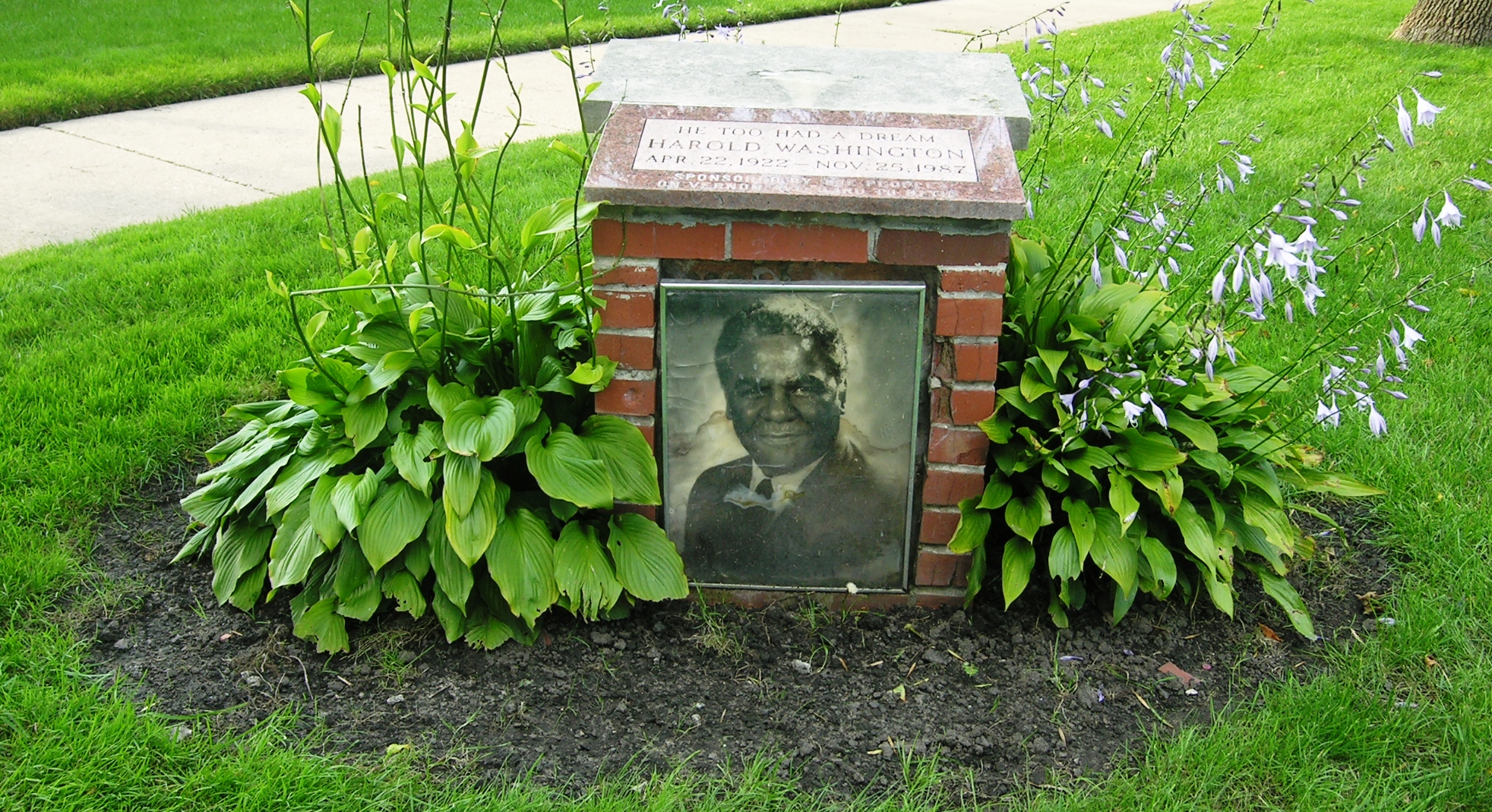
The pic at the top is of a Harold Washington memorial courtesy of YoChicago's Chatham neighborhood Flickr set. This memorial sitting on South Vernon Avenue was sponsored by the people of Vernon Avenue, from 83rd to 87th Streets. To YoChicago, it was more memorable of a tribute to Mayor Washington than the library named for him in downtown Chicago.

Read more...

James L. Merriner: Mr Inside Out

Merriner's Chicago Mag story on Rezko is available online. A quote from Ray Hanaia,

Hanania criticizes Arab American business leaders as "a small cluster of activists, and they are all in trouble. They had a push for clout empowerment, not community empowerment—you know, a hunger for being part of the system, sharing the perks among the insiders. When you connect all the names and lines, it's going to look like a spider web."
Clout empowerment, that's the Chicago away for sure.

Read more...

Ill. Green Party seeks to remove white supremacist from ballot--but what about McKinney?

An odious turd named Richard B. Mayers of Berwyn has filed the necessary papers to be placed on the Green Party ballot in the 3rd Congressional District. Mayers is a white-supremacist and if he wins the primary over Jerome Pohlen, who is endorsed by the state Green Party, Mayers will appear on general election ballot of the district, which encompasses Chicago's Southwest Side and parts of the western and southern suburbs.

The Chicagoist has a rundown on Mayers here.

Naturally the Greens want nothing to do with this trash, and want him off the ballot.

The Decatur Herald & Review has an odd article about Mayers and the Greens objections--but without saying what's so objectionable about Mayers.

"We don't want him on the ballot because of his past activities" is what Illinois Green Party spokesman Patrick Kelly said.

However, as bad as Mayers is, if his--to use a famous Nazi badgering technique--"papers are in order," the Greens can't kick him off the ballot because of his hateful views.

Bad in my opionion, but not as awful as Mayers is Cynthia McKinney, who will be on the Illinois Green Party ballot. McKinney, the first black congresswoman elected from Georgia, surrounds herself with race-baiters. Including her father, her bodyguards, and her campaign manager.

Before he assumed his title of Savior of the Earth--something Green Party members care about, Al Gore was a presidential candidate. During the 2000 campaign, McKinney complained that Gore's "Negro tolerance level has never been too high." Donna Brazile, an African American woman, headed Gore's campaign in 2000.

This YouTube video shows McKinney playing the "racial profiling card."

The Greens however don't seem to mind McKinney appearing on the Green Party ballot a a presidential candidate.

There was one objection made with the Illinois State Board of Elections about McKinney. It was made by Richard B. Mayers.

Can't we all just get along?

To comment on this post, please visit Marathon Pundit.

Read more...

Friday, November 16, 2007

Fighting corruption: The big picture

Cross-posted from ICPR's blog, The Race is On:

Yesterday, ICPR's blog noted ways that individual people can fight corruption. Today, we're happily surprised by the timing of an editorial in the Kankakee Daily Journal, which offers a helpful catalog of ways that the State of Illinois can act.

Their editorial, which notes Gov. Ryan as the latest in a too-long line of incarcerated ex-governors (and which asks, "is Gov. Rod Blagojevich next?") offers a thought-provoking list of ideas that would serve as a good starting point for any legislator wondering what to file for next Spring. Passing HB 1 is only a starting point, the Daily Journal notes. After that's accomplished (or, I assume, sooner, if HB 1 remains bottled up), they offer these ideas:

* Donations from gambling interests ought to be barred.

* Unused campaign donations ought to be given back at the end of a campaign, or given to charity. No more stockpiling of money.

* Donations given to one campaign should not be shifted to another. Our system now runs too much money through the Big Four (House and Senate leaders of both parties). The result is a concentration of power and a stranglehold of ideas. We're seeing it now.

* Donations from outside political districts ought to be restricted. Chicago cash should not be poured into downstate.


ICPR has supported some of these ideas before, including oversight of giving by regulated industries, and limits on transfers. Others may be, in our opinion, unnecessary to get at the root of the problem. Our positions aside, we applaud the Daily Journal for offering their thoughts and encourage all Illinoisans to join the discussion.

Individual people can do a lot to stamp out corruption. But the General Assembly can do more, too.

Read more...

Thursday, November 15, 2007

Fighting corruption, one person at a time

Cross posted from ICPR's blog, The Race is On:

The news recently has been full of stories reminding us of public corruption. One HDO organizer sentenced to 15 months in jail for perjury; another who "forgot" to mention 16 of his 22 previous criminal convictions when applying for a Chicago city job (who nonetheless was hired); and, of course, George Ryan's arrival at the federal prison in Oxford, Wisconsin.

Today's Christian Science Monitor has a timely editorial on what ordinary citizens can do to stamp out government corruption. After cataloging the costs of corruption (ranging from the loss of services and public trust to dampened job creation), the paper concludes with the cures. Greater transparency and oversight, for sure. But they also note that "individuals can remember their role. Fellow office workers need to speak up when they suspect wrongdoing." And voters need to remember that they have the power to hand out "pick slip(s) come election time."

And if you're looking for a place to start, why not head over to the Comptroller's fantastic new Open Book? They report 172,000 visitors in the first three weeks, so it's not like you'd be alone…

Read more...

Wednesday, November 14, 2007

Time for Plan C

Scooting around the Illinois General Assembly didn’t work this time for Gov. Rod Blagojevich. A bipartisan legislative committee shot down his emergency plan to expand state-sponsored health insurance to 147,000 Illinois adults Tuesday. The rule would have covered those adults who make up to 400 percent of the federal poverty level, or about $82,000 for a family of four. The committee voted 9-2 to reject and suspend that emergency rule on the grounds that it was too broad, didn’t warrant an emergency and bypassed the legislative process.

The governor did try to work such legislation through the General Assembly this summer, but the measure hasn’t gone anywhere since July. So instead, the Blagojevich Administration tried expanding the program through the Joint Committee on Administrative Rules, a 12-member committee with an equal number of Democrats and Republicans.

Two of the GOP committee members — Rep. Brent Hasssert of Romeoville and Rep. Rosemary Mulligan of Des Plaines — supported the governor’s emergency ruling. Nine others rejected it. Sen. James Clayborne of Belleville was absent.

But the rejection came with a recommendation. In its ruling, the committee said one part of the governor’s proposal does warrant emergency action in light of federal rule changes that will kick 15,000 to 20,000 adults off of the State Children’s Health Insurance Program next year. “We said in our recommendation that if they would simply issue a new emergency rule that just dealt with SCHIP, we would all support that,” said Rep. Lou Lang, a Skokie Democrat. “The department flack refused to do it, and so you have to wonder if they really feel any part of it is an emergency.”

As for the administration’s next step, Department of Healthcare and Family Services spokeswoman Ruth Igoe would only say the department is “reviewing our options and timelines available to us.” She did add that immediate action is warranted. “Our staff noted [Tuesday] that health care is an emergency for a lot of people in Illinois, and we believe this was an emergency. And we believe we have the authority to provide health care for these people. But at this point, we’re reviewing our options and the timelines available to us.”

The administration does have a fallback. It filed the same proposal as a regular rule, but that process takes a lot longer because it requires 45 days for public comment and another 45 days for JCAR review.

Lang said the committee will review that proposal, too, but the governor can’t keep trying to spend millions on new health care programs without legislative oversight. “While we all support a better health care system, we have something under our Constitution called the Illinois General Assembly. If governor wants to continue to try to bypass the legislative process in his effort to create a new health care system for Illinois, I think he’s got some real problems ahead of him.”

According to the department, expanding the state’s FamilyCare program to cover those 147,000 adults would cost about $43 million for this fiscal year, which ends in June 2008. Those costs were disputed by Rep. John Fritchey, a Chicago Democrat who also sits on JCAR. See the Gatehouse story from November 10.

And see more background in my October article, “Booster Shot?”.

Read more...

DOWN ON THE FARM

Every five years, Congress embarks on a lengthy process to reauthorize federal farm policy through legislation commonly referred to as the “Farm Bill.” The Farm Bill is one of the most closely watched pieces of legislation by Congress, media, lobbyists and rural America. Although many may not take a second glance at this legislation, you should. Why? This year the Farm Bill has the opportunity to tackle one of the most pressing issues facing the nation – obesity.

Over the past two years, a broad-based coalition of agricultural organizations have joined together to shape a Farm Bill that is more competitive, improves the quality and safety of foods and improves nutrition for all Americans, especially children. The Specialty Crop Farm Bill Alliance represents 120 specialty crop organizations and 350 individual specialty crops throughout the nation in their effort to raise the level of debate on nutrition.

So, what is a specialty crop?

This is a classification used to describe fruits, vegetables, potatoes, nuts, nurseries, etc. Just about everything you see in the produce section at your local grocery store. Actually, specialty crops account for nearly half of all the cash crop receipts in America and are a vital component of the agricultural economy.

Getting back to nutrition, how does the Farm Bill help combat obesity?

For the first time, Congress has the opportunity to write into law legislation that would establish a nationwide effort to include fruits & vegetable in schools in each and every state. The USDA Fruit & Vegetable Snack Program – if authorized by Congress – would allow more than 5,000 schools and 4.5 million children by incorporating healthy eating into the school lunch program. There is no more effective way to establish a routine for healthy eating than give children fruits & vegetables every day at school.

So, how is Congress reacting…

A recent editorial by The Hill - one of the top publications covering politics and policy in our nation’s capitol – sums up the efforts of the Alliance very well. “Most notably, growers of fruits and vegetables appear to be on the verge of winning significant support for the first time. The bill approved by the House last summer includes $1.6 billion to help growers of tomatoes, oranges and other so-called specialty crops…”


This boost was made possible – in part – by the efforts of House Speaker Nancy Pelosi who took her case to the floor indicated her support of the Specialty Crop Farm Bill Alliance and their priorities. Recently, the U.S. Senate Agriculture Committee passed a bill that would take the needs and priorities of specialty crop growers to even higher levels.

But, the food fight is far from over. The U.S. Senate is poised to vote on the Farm Bill very soon but there is still division on the bill as a whole. Robert Guenther, Senior Vice President for Public Policy at the United Fresh Produce Association, shared his thoughts on the future of the Farm Bill and its impacts on the nation’s specialty crop industry.


Many have voiced their concerns with the Farm Bill as a whole, but Congress has a chance to enact a program that is a true paradigm shift in nutrition policy and sets a course for health eating in our nation’s schools. Let’s hope they do just that.

Ryan McLaughlin
VP/Group Director
Zapwater Communications, Inc.

Read more...

Carol Marin: State GOP may need Strange Alliances

Good column by Marin on how Giuliani and Robertson will show the way for Illinois Republicans.

In Illinois it will be a social conservative who reaches out, and since the last primary I've felt the best guy for the job is Bill Brady. He convinced me during the primaries in a interview on WBBM's At Issue program last year.

It's going to take a little more than a bridge within the GOP though,

Paul Caprio, executive director of Family-PAC, a conservative political action committee, is torn yet surprisingly open to the discussion. Citing a "fraying of the [party's] coalition . . . the country club Republican never sees the Baptist fundamentalist who goes to church," Caprio says, social conservatives do worry someone like Giuliani will take the Republican platform from pro-life to pro-choice.

And yet in Illinois, he acknowledges, there is another fundamental problem for his party to grapple with. "During the past week, the only thing I've seen is Jim Thompson escorting George Ryan to a car . . . two previous Republican governors, one going to prison, the other defending him. What kind of image is that for the Republican Party?"

A corruption-busting, fiscally conservative candidate, Caprio believes, is something the party desperately needs, preferably one rich enough to fund his or her own campaign. "I don't think pro-life, pro-choice," he told me, "is the determinant. . . . There's some wiggle room with me, speaking for myself. Maybe some would be more doctrinaire."

But if other social conservatives agree, it would represent a seismic shift in Illinois Republican politics. One tent instead of two. Loaves and fishes to go with the wine.
Corruption busting is a big key and there are plenty of places to start.

Or City of Chicago allowing a chunk of the CPD go out-of-control for years another.

As for needing a millionaire to do it, Indianapolis didn't need one to bring that seismic shift. Just a candidate who knew people's key concerns and a resume showing competence to lead the City,
Ballard, a 52-year-old retired Marine Corps lieutenant colonel, capitalized on public discontent over property tax increases, a hike this year in the Marion County income tax and the city’s crime rate.

“I’ve got more experience than most mayors going in based on my Marine Corps experience, my corporate experience and small business experience,” Ballard said today. “I study leadership all the time, and so I have no problems at all leading this city.”
It can be done.

Read more...

Tuesday, November 13, 2007

Book review: Andrew Ferguson's "Land of Lincoln: Adventures in Abe's America"


Abraham Lincoln has shrunk over the years. Not his height of course, his physical size is one of the few things Lincoln buffs, Lincoln scholars, and Lincoln-haters agree on.

Author Andrew Ferguson set out to find the new and diminished 21st century Lincoln and writes what he found in Land of Lincoln: Adventures in Abe's America.

As he writes in his foreword:

From the enormous figure of the past he's been reduced to a hobbyist's eccentricity, a charming obsession shared by a self selected subculture, like quilting or Irish step dancing. He's been detached from the national patrimony, if we can have a national patrimony any longer. He's no longer our common possession. That earlier Lincoln, that larger Lincoln, seems to be slipping away, a misty figure, incapable of rousing a reaction from anyone but buffs.

But a newspaper headline caught Ferguson's eye, one about opposition to a Lincoln stature in Richmond. Lincoln mattered to these southerners.

And so the adventure begins. Ferguson makes a rendezvous with the the anti-Lincoln group in Richmond as the statue unveiling looms over the former Confederate capital.

He also attends a couple of Lincoln conference, where Ferguson comes to the conclusion during a Lincoln symposium, one with a decided liberal bent, that the participants believed "If Lincoln had been born 125 years later, he could have been Bill Moyers."

When Ferguson reconnects with an anti-Lincolnite, he's sarcastically asked, "Did you learn about the greatness of the great man?"--Ferguson counters with, "They think he was a wimp."

"Jesus, even I don't think he was a wimp" was the reply he got.

Naturally Ferguson spends a lot of time in Springfield, and meets with Julie Cellini, secretary of the board of the Abraham Lincoln Presidential Library Foundation. The author doesn't overlook her powerful lobbyist husband, Bill, and his controversial business dealings with the Abraham Lincoln Hotel and downstate casino.

As it's hard to write about Illinois' state capital without bringing up politics, the corruption of sleaze is not overlooked either. And he doesn't stop there...

Ferguson recalls a conversation with a professor who specializes in the 16th president about the "impossibility" of getting jobs for his graduate students at Illinois Historic Preservation agency and the state library, saying "These are good scholars who would kill for these positions. But the jobs always went to the party hacks."

Ferguson was in attendance at the 2005 grand opening of the Lincoln Library, and goes behind to scene to tell the story of the story-tellers--and the dreaded "D" word--Disney--figures in prominently in this part of the tale.

Ferguson makes his way to New Salem, the Chicago Historical Society, a Chicago Thai restaurant with a Lincoln shrine, a Lincoln re-enactors convention, Lincoln's birthplace site in Kentucky, Gettysburg, and he even catches a musical rendition of Lincoln's life in southern Indiana.

Don't laugh: Each summer, Medora, North Dakota puts on a similar show for Theodore Roosevelt. David Soul, who appeared in the 1970s TV cop show "Starsky and Hutch," is an alumnus of that musical.

The author finds the resolve, something that I didn't do when I visited Springfield earlier this year, to stop in at the Museum of Funeral Customs--where there is of course a Lincoln exhibit.

"Death is only the beginning" is the museum's motto. Perhaps I'll drop by the next time I'm in Springfield. Or maybe the time after that...

If you've read this far, you've probably made it through at least one Lincoln book, this bookshould be your next.

And it's nice to know Lincoln still matters, despite the multi-front attempts to bring him down that will continue long past the sleep-aid drug Rozerem fades away.

To comment on this post, please visit Marathon Pundit.

Read more...

You Gotta Keep 'em Separated

There were two big stories on Tuesday, but one common theme.

The day started with JCAR voting to suspend the Adminstration's efforts to establish an emergency rule that would allow 147,000 parents and other caretakers to buy discounted health insurance through a massive expansion of the state's FamilyCare program.

As a member of JCAR, I can tell you that despite efforts by some to paint it otherwise, our 9-2 vote was in no way a referendum on the issue of making access to health care available to more Illinoisans. Far from it.

Rather, the issue before us was whether HFS had the authority, via emergency rule (which has an immediate effective date) to make a significant policy shift on behalf of the State of Illinois. Members of both parties, and both chambers, decided that it did not.

The other major development was a Circuit Court Judge tossing out caps on medical malpractice damage awards. In her 10-page opinion, Judge Larsen ruled that the law violates the Illinois Constitution’s “separation of powers” clause — essentially finding that lawmakers interfered with the right of juries to determine fair damages.

And that is where we find the common thread.

Today marked the latest in a series of attempts by the Administration to do by rule what it has been unable to do via the legislative process. By exceeding its authority, the actions of the Administration jeopardize the very integrity of that process. As I have previously stated, JCAR was not created to be a shadow legislature, and it should not be used by the Administration to make de facto legislative policy determinations for the people of Illinois that it is unable to do via the proper and constitutional channels.

Similarly, today's court ruling, while narrow, focused on this same critical concept. During the debate on this issue, I maintained that the bill "isn't right, isn't fair and isn't legal". I have no desire to again debate the cause of malpractice insurance premium increases, and I will acknowledge that reasonable minds may come to different conclusions on the issue.

But I will say that the premise that it is not within the purview of the Legislature to artificially curtail the rights and responsibilities of the jury process received a ringing endorsement today. It wasn't legal.

And because the issue has been narrowly, and properly, decided on tight legal grounds, I would anticipate that the Supreme Court, notwithstanding last year's elections, will do the right thing and uphold today's ruling.

If that does in fact happen, I would hope that the proponents of the cap legislation would realize that a cap bill being passed and then ruled unconstitutional is becoming a near-ritual, and that continuing to pass such bills is not only non-productive, but amounts to little more than offering false hope to those desirous of such legislation.

The moral of today's stories is that like it or not, if they are sincere in trying to accomplish the goals that they claim to be seeking, both the Administration and the proponents of damage caps are going to have to find legal and constitutional means to reach those goals.

To read or post comments, visit Open House

Read more...

Medical malpractice returns

Consider a can of worms reopened. A Cook County Circuit Court judge struck down a state law limiting the amount patients can receive in cases alleging medical malpractice. Currently, the law caps jury awards for pain and suffering at $500,000 for doctors and $1 million for hospitals.

In Tuesday’s ruling, Judge Diane Larsen says the state’s 2005 medical malpractice law is unconstitutional because it violates the separation of powers and patients’ rights. “The basic argument is that it’s the judicial system that gets to decide what counts as an acceptable remedy and that the legislature is invading that province by enacting a cap,” says Professor David Hyman at the University of Illinois Law School, where he teaches civil procedure and health care regulation.

The ruling does not negate the state law. But it does open the door for the issue to make its way to the Illinois Supreme Court, which could overturn the law and has done so twice before with caps on damages in a broader sense.

State Sen. Susan Garret, a Lake Forest Democrat and original sponsor of the 2005 law, said she was a little surprised by the ruling. “When we crafted this legislation, I was under the assumption that it had passed constitutional muster.”

Then again, she said most physicians anticipated the court challenge. “So, for some it’ll be disappointing. For some it’ll be an opportunity to say, ‘We told you so.’ But I think we have to abet this and make sure it goes through the process.”

The 2005 debate over “med mal” spanned more than a year and posed trial lawyers against medical groups and the insurance industry, as well as Democrats against Republicans, in aggressive lobbying campaigns. For background, see an article I wrote in 2004.

The debate is just as polarizing today as it was then, demonstrated by the immediate and opposing statements released after the court ruling Tuesday. The Illinois Trial Lawyers Association applauds the judge’s decision and slams “record profits of insurance companies” as the problem fueling rising medical malpractice premiums. “One thing is clear: Our state constitution does not allow those who have been most seriously injured as a result of medical negligence to have their rights taken away in order to give bonuses to insurance companies,” association president Bruce Kohen
said in a statement.

The Illinois State Medical Society and ISMIE Mutual Insurance Company, the state’s largest medical insurer that’s owned and operated by doctors, backed the 2005 “caps” legislation and opposed the judge’s decision. “This is only ‘round one’ in the battle to uphold these reforms, which have been crucial in slowing the number of doctors fleeing our state and helping in the recruitment of specialists,” said Dr. Rodney Osborn, medical society president. “Getting rid of the 2005 medical litigation reforms now would be like benching your starting lineup in the toughest game of the season. We can’t afford to forfeit patients’ access to care.”

In April, ISMIE announced an $18.4 million dividends program for policyholders because of the company’s improved financial picture after the caps on non-economic damages became law.

The Illinois Hospital Association agrees with the doctors and still uses the word “crisis” to describe the effect of high malpractice insurance premiums that it says deter doctors from practicing in Illinois. “This comprehensive law is helping restore predictability to Illinois’ broken liability system that has been driving up costs for hospitals and physicians to unsustainable levels and that has jeopardized the state’s health care system,” wrote Ken Robbins, association president, in a statement.

Read more...

Monday, November 12, 2007

Ron Paul might not make it on the ballot in Illinois

I signed up for email updates from many of the presidential campaigns, including Ron Paul's. This one landed in my inbox today. It does not make me feel hopeful for the libertarian-leaning Republican.

November 11, 2007

If we don't get hundreds upon hundreds of signatures immediately in Illinois Ron Paul will have no delegates to send to the National Convention.

PLEASE HELP by doing the following:

1. We have delegates but many of those delegates HAVE NOT sent Jason Acebel [no idea who he is; no doubt a campaign official]their forms. If you are a delegate and HAVE NOT sent in your form contact Jason ASAP at ilpetitions@gmail.com and let him know when your form will be mailed. I

2. If you can take time off work or give 2-5 full days to gathering hundreds of signatures email Jason at ilpetitions@gmail.com with your phone number and best time to call. THIS IS MISSION CRITICAL. Please DO NOT contact Jason if you cannot give this amount of time. Many of you are gathering a few signatures and that is fine. Please keep up the good work but unless we get some major help soon Ron Paul will not have delegates. Jason does not have time to respond to a lot of emails. We need at least 1 person in each of the 19 districts to give us 2-5 days to get the job in that district done.

3. If you can commit full time for 1-3 days to make phone calls for Jason Acebel to call our delegates please email Jason at ilpetitions@gmail.com

Mike McHugh
National Ballot Access Coordinator
Ron Paul 2008 Presidential Campaign Committee

Sin ce this is an official email from the official Paul campaign, I have to take the words at their face value. They are worried they won't get on the ballot. And even if he does, you just know the other GOP campaigns are sharpening their pencils, awaiting a chance to challenge his signatures.

This is Paul's weakness. Much has been written about how Paul supporters, in one day, raised $4.2 million on the Internet. But it's easy to be a Ron Paul Internet Warrior sitting in front of your computer screen, eating Doritos and drinking Mountain Dew Red. It's quite a different thing to go outside on a cold, rainy day and walk door to door in your neighborhood collecting signatures and registering voters. That's hard work. I know, I've done it. Several lifetimes ago, I was a precinct committeeman for the Democrats. I backed Tom Harkin in 1992, if that tells you anything about my former politics.

Originally posted to Peoria Pundit.

Read more...

Lawyers, Lawyers And More Lawyers

One for Every 152 Of Us In Illinois

Lawyers were in the news last week.

In Pakistan, lawyers dressed in suits and ties demonstrated in the streets of Multan and Gujranwala and other cities protesting the imposition of martial law by General Pervez Musharraf.

Good for them.

Unfortunately for them, according to the New York Daily News, one-fourth of the lawyers in Pakistan were jailed. Pakistan has 12,000 lawyers, the Daily News reported, and 3,000 of them were locked up.

Musharraf's strong-armed tactics would never work in Illinois -- even if Governor Rod Blagojevich decided to step even farther across the lines of common sense than he already has.

One problem would be overcrowded jails. According to the Illinois Department of Corrections, Illinois prisons (not counting youth centers) have space for about 25,000 inmates. Most are filled well over capacity, in some cases almost doubled, so there would be no room for the lawyers.

But even if all current inmates were released, there would barely be enough space for Musharraf's method of justice in Illinois since one-fourth of the lawyers in our state number about 21,000.

That's right. Illinois has a staggering 84,000 lawyers, according to numbers provided by the Chicago Daily Law Bulletin. More than 2,350 new lawyers were sworn in last week in ceremonies throughout the state presided over by justices of the Illinois Supreme Court.

No doubt, lawyers provide valuable and needed services.

But 84,000? That means one lawyer for every 152 people in Illinois (and that includes infants and others under 18). If the 25% of the Illinois population that is under 18 years is removed from the mix, there is one lawyer for every 114 people in Illinois.

By comparison, Illinois has about 35,000 licensed doctors -- some of whom are still licensed but no longer practicing. So if there is ever an illness that attacks only lawyers, and a doctor is needed immediately, there would not be enough doctors to administer to the lawyers.

Nor would there be enough beds for the afflicted lawyers. According to the Illinois Hospital Association, Illinois has 33,022 staffed beds (beds actually being used). So some of the lawyers would have to wait.

This commentary is not intended as a criticism of lawyers. Every individual who enters law school has goals and intentions in mind, hopefully admirable goals and intentions.

But you wonder if more people would enter medical schools if there weren't so many entering law schools.

-- Ed Murnane
Illinois Civil Justice League
November 12, 2007

Read more...

Admitting Ill. has a gambling problem

Cross posted from ICPR's blog, The Race is On:

The rule used to be, if it’s late May, there must be a gambling bill afloat. This year’s session is long past that deadline, but the maxim holds true: when the going gets tough, gambling gets trotted out as a budget savior. But gambling is far more than a revenue source, as ICPR Director Cindi Canary points out in today’s Crain’s Chicago Business (subscription may be req'd). If the state is serious about looking to gambling for tens of millions of new annual revenue, then it’s time to get serious about how gambling is regulated in Illinois.

Read more...

Something Rotten in the State of Bolingbrook

Everything about the case of Drew Peterson, whose fourth wife Stacy Peterson has been missing for more than two weeks now, stinks to high heaven.

Drew met Stacy in 2001, when she was just 17 and he was 47 and still married two wife #3, Kathleen Savio.

In 2004, Kathleen turned up dead.

Now, normally when a wife who is divorcing her husband as Kathleen was turns up dead, apparently drowned in a bone-dry bathtub, the husband is an immediate suspect.

Fortunately for Drew Peterson, he is a sergeant in the Bolingbrook Police Department, and Kathleen's death raised no red flags.

Not even with Jeff "Law and Order" Tomczak, Republican State's Attorney for Will County at the time, and son of convicted City Hall insider Donald Tomczak.

"Law and Order" you may remember is the guy who tried to railroad Kevin Fox for the murder of his 3 year-old daughter, Riley.

While this Daily Herald story's headline screams "Tomczak in clear on Fox lawsuit", read between the lines in the story:

"Tomczak's attorney John Partelow declined to say why his client had been dropped from the suit. Fox's attorney Kathleen Zellner also said she was unable to comment on the dismissal against the former state's attorney"


Sounds an awful lot like an undisclosed settlement with a confidentiality agreement to me.

I hope the families of Stacy and Kathleen have hired great civil attorneys.

Update: Zorn adds his two cents.

Read more...

Liberals laud book by ex-con husband of Jan Schakowsky


This delicious morsel came to me via e-mail from a great American who prefers to remain anonymous.

Robert Creamer, not to be confused with the famed baseball writer, is now also going by the name of Bob, which I'm sure greatly pleases the more famous Creamer.

About Creamer the Lesser: For many years, he was the executive director of the Illinois Public Action Council. His wife, Jan Schakowsky, now a Democratic Illinois congresswoman who nominally represents me in Washington, was on the board of directors of the self-appointed consumer advocacy group. Creamer got caught kiting checks while running the group--he had done it before and was warned by federal authorities not to do it again. He didn't listen, and got nabbed by the Feds again, which got him a trip to a Federal Prison Camp for five months last year.

Rep. Schakowsky has not been accused of any wrong doing.

Click here for a good explanation of how check-kiting works, and how it undermines the integrity of our financical system.

Creamer has written a book, Listen to Your Mother. Stand Up Straight: How Progressives Can Win. Amazon lists it under "Robert Creamer," but the promotional hoopla mostly refers to him as "Bob."

Hey, I have no problem with an ex-con writing a book or trying to make a living. But I find it quite humorous that a whole bunch of big-time liberals, such as Sen. Dick Durbin, Jim Hightower, Rep. Jim McGovern, Rep. Lloyd Doggett, and a whole bunch of others fawn over Creamer in their endorsements of his book--and none of them mention his five months in prison last year, nor is that part of his life included in the summary of his public life below.

About those five months in the joint. Federal prosecutors had asked for a three year sentence, but US District Judge James B. Moran took mercy on Creamer. Coincidentally, Moran is the father-in-law of Peter Giangreco, a longtime Illinois Democratic insider who like Creamer, worked on Rod Blagojevich's successful 2002 gubernatorial campaign. Giangreco's endorsement is the first one I list.

To his credit, Creamer writes in his book, "I did much of the preliminary work on this book while spending five months on a forced sabbatical at the Federal Prison Camp at Terre Haute, Indiana."

Oh, Lynn Sweet, presumably the politically neutral Washington correspondent for the Chicago Sun-Times, gives an endorsement too.

Bob Creamer has been a consultant to Americans United since its inception in 2005 to successfully fend off the president's plan to privatize Social Security. Bob is one of the top political strategists in the country and he has spent four decades influencing the political and issues debates in America from Springfield, IL to Washington, DC. He has served as a consultant to some of the country's leading politicians and he has helped lead some of the most important issue fights in our nation's history.

Bob has taken all he has learned from his decades of public service and chronicled them in the definitive how-to-manual for how progressives can fight the right wing machine and win. Listen to Your Mother. Stand Up Straight: How Progressives Can Win is the Bible for progressive activists and politicians who want to and are willing to go toe-to-toe with the right over the future of the country. Please join Bob, his wife Rep. Jan Schakowsky (D-IL), and a host of Senators, Representatives and leading progressive figures for a reception on Tuesday, November 13, 2007 (see details below)

Celebrating the publication of Listen to Your Mother. Stand Up Straight: How Progressives Can Win. Comments appearing in the book (can be found below). Credentialed media will receive one complementary copy of the book. (Note, if you want you are credentialed media, leave your e-mail in the comments section, and I'll give you the e-mail address where you can RSVP.)

You Are Invited
To a Reception Celebrating the Publication of Bob Creamer’s New Book
Listen to Your Mother. Stand Up Straight: How Progressives Can Win

Tuesday November 13, 2007
The Mott House
122 Maryland Ave. NE, Washington
5:00 PM to 7:00 PM

New Book Says Progressives Must "Stand Up Straight" to Win

Washington, DC. A new book by veteran political organizer and strategist Robert Creamer says that progressives have an historic opportunity over the next two years to create long-term political realignment in the United States. But to be successful, he argues, progressives must forcefully reassert their commitment to fundamental progressive values and vision for the future.

"Some people think that in order to win, Democrats need to move to the political center by adopting conservative values and splitting the difference between progressive and conservatives positions," says Creamer. "History shows they are wrong. To win the next election and to win in the long term, we need to redefine the political center."

The book, titled Listen to Your Mother: Stand Up Straight. How Progressive Can Win, lays out a broad strategy for progressive victory and describes the tactics needed to win real-world political battles one at a time. In the book’s foreword, "Progressive today need to take direct responsibility for winning." This book lays out a game plan for victory.

As an organizer and strategist, Bob Creamer has won all kinds of improbable victories for progressive causes. This book is must-reading for his fellow progressives who seek to do the same, and to build a more decent world. Pete Giangreco, Democratic Political Consultant, Partner, The Strategy Group

Even before the book’s publication it has received wide acclaim.
If Progressives are ready to move beyond the "Age of W" into a winning era, they can start with Stand Up Straight. This is more than a call to arms. This is a battle plan from one of the best campaign minds in America. Bob Creamer takes his readers from values to votes with practical tactics and insight gathered over decades of experience. This book is for player...spectators need not apply.
Senate Democratic Whip Richard Durbin (D-IL)

If every activist in America read Listen to Your Mother: Stand Up Straight, we could change our country. This book will help bring on the New Progressive Era. It's that good." Senator Sherrod Brown (D-Ohio)

Creamer’s book is a one-stop shop for political junkies, from a novice to a know-it-all…While Creamer writes from the progressive Democratic perspective, his chapters on organizing, messaging, demographics and constituency groups comprise a how-to political manual. Chicago Sun-Times Washington Bureau Chief, Lynn Sweet

Stand Up Straight is nothing less than the bible for progressive political activists." Brad Woodhouse, President of Americans United for Change

Stand up Straight is a one-stop, nuts-and-bolts manual on how to run a winning campaign – and, in the process, return America to its progressive roots. Filled with learned-in-the-trenches lessons, Creamer's book is a master's class in electoral politics. Ariana Huffington, The Huffington Post

Stand Up Straight is a straight up shot in the arm for progressives. Robert Creamer has successfully turned decades of campaign and organizing skills into an essential handbook for understanding political power, activism, and progressive values. Creamer rightly argues that progressives should embrace their core principles and fight for the real political center in American politics today -- issues like universal health care and pre-K, energy independence, redeployment from Iraq, and a return to sane and sensible national security policies. John Podesta, President and CEO, Center for American Progress and former Chief of Staff to President William J. Clinton

Progress takes more than passion, it requires planning. This book is a blueprint for victory." Congressman Lloyd Doggett (D-TX)

Bob Creamer's welcome book rightly instructs progressives to say and fight for what they believe. To Hell with the politics of timidity - a long-term progressive majority is within our reach." Congressman Jim McGovern (D-MA)

Creamer's classroom has been (on) the frontlines and trenches of progressive organizing, from the Civil Rights Movement to the battle for children's health care. Here, he shows us how to replace fear with hope, to renew the call to commitment, and to create our society's next historical movement. Congressman John Lewis (D-GA)

A stand-up book from a stand-up guy, showing us how to put progress back into "progressive." From broad vision to minute details, Creamer offers an invaluable manual for those who want to reassert our country's historic egalitarian values of fairness, justice, and opportunity for all. Jim Hightower, best selling author, radio commentator and editor of the Hightower Lowdown.

In Stand Up Straight, Bob Creamer gives citizens an owners manual for Democracy. With a practical eye from his decades of experience, Bob shows how to do the real work of political organizing and win, by promoting deep progressive values. With hundreds of real world examples and step-by-step advice, Stand Up Straight is both inspirational and a serious tool. Thanks, Bob. Wes Boyd, Founder of MoveOn.org

This book is so important because it focuses like a laser on the one element that is essential to progressive victory: courage. With out exception, all of our historic victories have required that people had the courage to act -- and stand up straight. The lessons in Stand up Straight were learned the hard way by generations of Americans fighting for civil rights, women’s rights and important social change. It's a must read for anyone who is passionate about changing America – now. Rev. Jesse L. Jackson, President, Rainbow/PUSH Coalition

Jim Hightower's comment is my favorite. "A stand up book from a stand up guy..."

Try running that one past some bankers who had to deal with Creamers kited checks.

Also, considering the skeleton in her closet known as her husband, it's understandable why Schakowsky wants to bring back the so-called "Fairness Doctrine" to the public airwaves.

To comment on this or any other Marathon Pundit post, please visit Marathon Pundit.

Read more...

Sunday, November 11, 2007

Aaron Schock Digs Himself into Even Deeper Hole


Capitolfax has been providing blow-by-blow coverage of Aaron Schock's foreign policy plane crash.

Coverage which, CapitolFax notes, Schock's hometown newspaper, the Peoria Journal Star, is either unwilling or unable to provide.

Whether driven by their obsessive hatred of Schock's predecessor, State Rep. Ricca Slone, or whether they've just been hypnotized by Schock's boyish charms, the PJS has treated the "Boy Wonder" with kid gloves since Day One. And so we wave farewell to a once well-respected mid-size daily that has fallen victim to corporate take-over and tossed its journalistic integrity aside.

Cliff's Notes on Controversy

For those of you who missed it, Schock launched his campaign for Congress by saying he would arm Tiawan with Pershing missiles aimed at mainland China. A move so provocative that most foreign policy experts -- heck, most people with a political science degree -- believe it could trigger WWIII.

At the same time, Schock is on-record as opposing legislation requiring the Illinois Pension Boards to divest from Iran, to place economic pressure on them to halt their nuclear program.

Cornered into offering an explanation for his hawkish bent, Schock offered this weak explanation to the Springfield State Journal Register's Bernie Schoenberg:

"I don't believe that state government ought to be getting involved in foreign policy....With each additional restriction that's placed on a pension fund in Illinois, it further prohibits those pension managers' ability to make wise decisions, to keep those pension systems solvent," Schock said.

As CapitolFax points out, Schock voted for an identical bill that called for divesting from Sudan in response to the genocide in Darfur.

Flip. Flop. Splash.

I hope Bernie Schoenberg calls Schock with a follow-up question.

I'm just old enough to remember the fight in the late 80's and early 90's to divest Illinois pension funds from South Africa, in response to apartheid. Glenn Poshard was in the Illinois Senate at the time, and if my memory serves me correctly, he cast what was then viewed as one of his most courageous votes to do so.

I'd love to know what Aaron Schock would have done.

Whoever wins the three-way GOP primary will face Democrat Dick Versace, former basketball coach at Bradley University.

Please, give us Schock.

P.S. Don't expect Schock's brash plans to go too far too quickly. As ArchPundit points out, the U.S. destroyed our last Pershing Missile in 1991. When Schock was ten. God help us though if he ever figures out which nukes we do have and has his fingers within a hundred miles of the button.

Read more...

Since recall has been in the news...

For almost the past couple of weeks or so since the Tribune editorial I was going thru my blog archives and found a post mentioning that our Lt. Governor has spearheaded a movement to recall Gov. George Ryan when he was in office. So apparently this press conference wasn't the first time he has mentioned it.

So I suppose I can ask would any of you had recalled George Ryan if we had recall during his term? I could ask if you'd want recall right now or if you'd recall Gov. Blagojevich but I'm sure that has been done to death already.

Read more...

THANK YOU VETERANS

On behalf of the USO of Illinois, Zapwater Communications would like to salute the men and women who have and do serve our nation. Zapwater Communications is proud to tell the world about its pro-bono client the USO of Illinois and all of the work the organization does on behalf of our troops.

Happy Veterans Day.

Read more...

Homeland Security sues Illinois over E-Verify

E-Verify is a federal program that allows companies to check the employment eligibility at no charge to them to check the employment eligibility of job applicants.

In short, it's a check to see if a potential employee is in the country legally.

From WorldNet Daily:

Homeland Secretary Michael Chertoff recently told a congressional committee he didn't intend to "tolerate interference" by sanctuary cities that would block companies from participating in such programs as "E-Verify," which allows workers' IDs to be checked before hiring.

Chertoff also told Congress that, "I intend to take as vigorous legal actions as the law allows to prevent that from happening, prevent that kind of interference."

And guess who Chertoff has his eyes on? Illinois.

More from WorldNet:

Within days, the first fruits of that promised were revealed, with a lawsuit against the state of Illinois over a legislative proposal signed into law by Gov. Rod Blagojevich.

According to published reports Illinois is "complicating" efforts by federal agents with a state law that virtually blocks corporations from participating in the program that was set up to verify if new employees have legal standing to work in the United States.

"The state of Illinois has now made it illegal to comply with federal law," Chertoff told reporters when the action was filed. "That's not acceptable as a matter of the Constitution."

Hat tip to Third Wave Dave and Andrea Shea King for the story.

To comment on this or to vote in the Pajamas Media presidential straw poll, click here.

Read more...

Lauzen's Take a Bus or Train to the State Constitutional Convention

I was away from computers for a few days and unable to moderate comments from the nameless. My apoligies to readers and Sarah Lauzen for my absense.

Here's my Senator at his best on State issues. Off the top of my head, I don't agree with the recall --when the people speak, we're stuck with their voice except in extreme cases-- but this is the thoughtfull stuff peppered with facts that makes Lauzen the only choice for anyone voting in the GOP primary.


Take a Bus or Train to the State Constitutional Convention
by Senator Chris Lauzen

An effective mass transportation system is as important to a region's economic and environmental welfare as a healthy blood circulation system is to a human body.

Lower cost transportation, less pollution, more predictable travel times, equal access to opportunity, and civic pride are just some of the benefits of a well-run and properly maintained mass transit system. The Regional Transportation Authority (RTA) consists of Metra, Pace, and the Chicago Transit Authority (CTA), and is a public asset that should be nurtured and managed respectfully.

Many newspapers editorialized several days ago that area riders and the broader constituency should view the current situation instead with cynicism, disgust, and be appalled by yet another failure of leadership in Chicago and Springfield. They are absolutely right.

Once again because of the privilege you have granted to me to serve you, I used the opportunity to participate in the current debate by asking three questions of the respected Chairman of the RTA, Jim Reilly, during the Senate Executive Committee one week ago today.

Like you, I was curious to know from where $27 Million could miraculously appear for Governor Blagojevich to bail out the transit "Doomsday", especially when so many current commitments to schools, local communities, and medical providers have been left unfulfilled. You may recall that the RTA Board of Directors would not accept a loan from the state government; they wanted a grant that did not have to be paid back. Well, the answer was that the money was generated from the "B-Bond" Authorization Fund which basically means that Blagojevich is borrowing transportation funds to postpone the current crisis until the end of the year. That means that you and I will have to pay all that money back over the next 15-25 years. With interest expense, that largesse should cost state taxpayers approximately two to three times as much in the end.

When I review the management report and various audits of especially the CTA, the conclusion is obvious that spending on payroll fringe benefits like pension and retirement hospitalization insurance are exploding. I asked the Chairman, "How many years do employees have to work in order to receive lifetime hospitalization benefits when they retire under the current contract?" In the private sector, such a benefit is rare and in the typical public sector the answer ranges usually from 20 to 30 years. The shocking answer for the CTA was 3 years!

Finally, I confirmed in a third question that annual fare increases have ranged between 1.2% and 2.1% on bus and train routes during a period when gas prices have risen 173%.

It is obvious to most of the people I serve that borrowing to bail out an extremely valuable regional transportation system will not solve gluttonous fringe benefit concessions and inadequate fare adjustments. I would never vote to tax the people who trust me to protect their interests to compensate for this type of loose management.

But, this dilemma and a whole series of problems that have been created by the concentration of absolute political power into the hands of too few Downtown Chicago Democrats empowered by their majority caucuses in both the Senate and House is truly staggering. A capital spending program to build roads, bridges, and schools without massively expanding casino gambling, true education reform, blatant patronage hiring in sensitive and important administrative positions, former governors going to jail, and many others are symptoms of a system and structure in Illinois that is broken beyond repair with our current tools.

I am coming to the conclusion that we need a state Constitutional Convention where a recall provision for irresponsible politicians is put in place. The legislative redistricting process should be done without political gerrymandering in a system similar to Iowa and several other states. Spending caps need to be put in place to protect taxpayers. And, property tax rates and assessments must be frozen to protect all homeowners who are being taxed-and-spent out of this state, similar to my currently proposed Property Tax Freeze legislation, SJRCA13 (from "Proposition 13" in California).

If you would like to share your thoughts with me on this subject that will be debated in Spring 2008, please call 630-264-2334 or write to admin@lauzen.com. Thank you for your guidance.

Read more...

Saturday, November 10, 2007

Veterans Day Weekend


I took this photograph of a Morton Grove businessman, whose name I don't know, Friday evening on Lincoln Avenue. Yes it's Veterans Day Weekend, but the blonde-gentleman with is large US flag on his Harley, is a common site here.

To comment on this post, please visit Marathon Pundit.

Read more...

Friday, November 09, 2007

Emtpy Offices - Troutman and Ogilvie

Is anyone surprised that indicted ex-Chicago Alderman Arenda Troutman didn’t leave anything in her office for her 20th Ward successor Willie Cochran?

After all, this is the woman that had this fun-loving photograph on her web page.

The only thing like that was what I saw when I walked into the Governor’s office across the hall on from the State Treasurer’s second floor banking office after being sworn in as state representative in January 1972.

Governor Richard Ogilvie had been defeated by Dan Walker.

The place was vacant and empty.

I mean e-m-p-t-y.

Nothing on the bookshelves, except for one report.

It was the report attorney Richard J. Kissel had written on the McHenry County ‘s assessment mess. It was issued right at the end of Ogilvie’s term after earlier hearings in at least Woodstock and Cary. I’m sure no one else would have had any interest in it.

Kissel came to my attention because Ogilvie had him write a report on the Cook County assessment mess under Cook County Assessor Parky Cullerton.

I badgered the Ogilvie folks to even out their examination of assessment problems by looking at Republican McHenry County.

I still remember what the Greenwood Township Assessor said when I revealed at the Woodstock hearing how Greenwood Township’s assessment level was one of the, probably the highest level in McHenry County.

Of course, all were and are supposed to be the same.

“They did that to me?!” the conscientious assessor exclaimed in disbelief.

Ogilvie’s people were probably as angry at Walker as Clinton’s were at George W. Bush when they took all the “w’s” off the key boards.

This is only one of the articles on McHenry County Blog this weekend.

Read more...

Wednesday, November 07, 2007

The Lauzen's letter to my family

Two pages of from a four page mailing we received today.

Given a choice between Lauzen and Oberweis, I'd vote for Lauzen, but my wife sure shuttered when she saw this. She can't stand to see Pols roll their famlies out like this.

Maybe it works in a GOP primary in Kane County, but I just don't know many families that look like this anymore. Or even if many families ever really looked like this.

It just seems awfully detached from today's world and I wonder if others will feel the same.


Read more...

Cook County Tax Increases Pounded

The Chicago Tribune offers the best detailed analysis to-date of the impact that the tax increases being proposed will have on Cook County families.

Bottom-line:

Two-income family of four in Chicago will see a $670 increase in local taxes, or 6%.

Single retiree in Tinley Park will see an increase of $178 in local taxes, or 7%.

The analysis excludes income taxes paid, but lumps in state taxes and some federal taxes, which aren't going up.

When you focus only on taxes paid to local taxing bodies, the increases are:

Family of four: from $10,711 in local taxes to $11,381, an increase of 6.3%:

Retiree: from $1857 in local taxes to $2035, a 9.6% increase.


Stroger Utility Hikes Taking Even More Heat

While the Tribune ignored Stroger's secret plan to raise taxes on telephones, electricity and natural gas when/if his 2% sales tax increase goes down in flames, the Citizen's Utility Board isn't taking the plan lightly. At all.

CUB recently update their homepage with the theme "The Good, The Bad, and the Ugly", and it features a humongous "Stop Cook County Utility Tax" Logo.

The Bad!
Help Fight Cook County's Utility Tax Hike
There's a Cook County plan to jack up utility taxes, costing the average family $360 a year. Help us fight it! Please call 1-800-791-6540 to get connected directly to your county commissioner's office.


According to CUB, new phone taxes proposed by Stroger will cost the typical family $240 per year, and new taxes on electricity and gas will add another $124 to the typical family's energy bills.


NoPhoneTax.org Coalition reflects anti-Cook County sentiments

Launched less than a month ago, NoPhoneTax.org now includes more than 80 groups from across the political and apolitical spectrum, including AARP, CUB, Metro Seniors in Action, NAACP Chicago Southside, Americans for Tax Reform, the Chicagoland Chamber of Commerce, Illinois Retail Merchants Association, and what looks like for than two dozen churches.

Their website has had more than 62,000 hits, according to their home page ticker, and features a link for e-mailing the entire county board, as well as Board President Todd Stroger.

I've been doing campaign and grassroots organizing work long enough to realize that more than 60,000 hits in less than one month -- with no t.v. or radio ads to drive traffic, just earned media and word of mouth -- is unheard of. That is alot of anti-tax sentiment, which I would guess reflects opposition to not just the phone tax, but any tax increase by the Cook County Board.

Stroger would be wise to rethink his idea of raising any taxes, and Commissioners would have to be foolish to follow him down this path.

Read more...

Tuesday, November 06, 2007

"Tings are OK"

That's House Speaker Michael Madigan using his best Chicago accent to jokingly gauge the progress of leaders’ meeting with Gov. Rod Blagojevich Tuesday in Springfield to discuss the expansion of gaming for new revenue. Turning on the serious tone, Madigan said, “We had a good meeting, and it appears that we’re making progress. Not everything is resolved. There are differences, which I’m not going to get into.”

The four leaders of both parties met with Blagojevich in the Statehouse Tuesday afternoon and all reported progress, although they wouldn’t talk specifics. And it may take more than the seven to 10 days originally said to be the timeline for agreeing on how much to expand gaming and how to pay for Chicago mass transit, statewide construction projects and education.

The proposals on the table but not quite agreed upon include:
- A land-based casino owned by the city of Chicago, although they have to nail down a way to share the revenue between the city and the state
- One riverboat elsewhere in the state, although there’s no indication where that second boat would go
- Slots at horseracing tracks, although they aren’t releasing a number of new positions that would be allowed
- An independent gaming board, desired by House Speaker Michael Madigan, House Minority Leader Tom Cross and Senate Minority Leader Frank Watson, although it has some opposition or concerns about who would appoint the new gaming board members
- A 70-30 split of the revenue — 70 percent of the new gaming revenue would pay for road and school construction, while 30 percent would provide new education funding per Senate President Emil Jones Jr.’s desire, although the leaders haven’t yet agreed on how much revenue would be generated in the first place

Regarding the split of money, Watson said, “The bigger the capital bill, the better, as far as I’m concerned, but I’m not opposed to the 30 percent that’s being allocated to education.”

He also said he could vote for slots at the tracks, but added, “I’m not sure I’ve got members who can. That’s the biggest problem.”

And the revised timeline, per Watson, is that seven to 10 days may have been the original goal, but “I think we’re talking more time than that.”

The leaders scheduled a telephone conference for Thursday.

Read more...

George Ryan reports to jail Wednesday

Former Gov. George Ryan and friend Lawrence Warner are ordered to report to federal prison Wednesday after the U.S. Supreme Court denied their plea to remain free while trying to appeal their 2006 corruption conviction before the nation’s highest court. Ryan will start his 6 ½-year prison sentence in a federal facility near Oxford, Wis., while Warner will start his 3 ½-year sentence in Colorado. They both remained free for more than a year-and-a-half after being convicted for racketeering and fraud for using public office for private gain during Ryan’s years as secretary of state (1991 to 1999) and as governor (1999 to 2003).

One day prior, the U.S. Department of Justice’s solicitor general thought Ryan and Warner should not remain free pending an appeal to the Supreme Court.

Last month, a full panel of the 7th Circuit Court of Appeals affirmed that they would not receive a retrial.

Former Gov. James Thompson, Ryan’s lawyer, responded to the Supreme Court's denial Tuesday in a Chicago press conference (posted on the Web). He said that the defense team is disappointed, but Ryan will report to jail as ordered.

“We knew the petition for bail was a long-shot,” Thompson said. “No Supreme Court justice has granted bail under the provisions of the Bail Reform Act for over 30 years. So, obviously, this was always a likely outcome.

“We are exerting, as we do for any client of Winston & Strawn, every effort on Gov. Ryan’s behalf. And we file an appeal to the Supreme Court of the United States on the merits of his conviction.”

Read more...

Your Cook County tax dollars at work


This summer a private contractor resurfaced the North Branch Running and Bicycle Path that begins at Milwaukee and Devon in Chicago and ends at the Chicago Botanical Garden in Glencoe. I'm not sure the path needed to be redone, but the asphalt portion looks pretty good. Runners like myself prefer crushed gravel, and that portion of the work is terrible.

And it's not just me who's noticed. Last week while I was running, a cyclist recognized me, and pointed out that the edge of the crushed gravel is not only not well crushed, but the edge of that part of the path, in Harms Woods in Skokie, isn't graded well--it appears the the gravel is destined to be quickly eroded by the elements.

And I'm not road-apple picking here: Similar shoddy work can be found up and down the trail.

As for the photograph on the right, I took that one a couple of hours ago, it's just north of Beckwith Avenue in Morton Grove. This segment of the path hasn't been completed--that's because a water main appears to be broken and water is bubbling up. I haven't been on that part of the trail in a week, the water was bubbling then too.
I'm sure residents of states in drought-stricken areas will be horrified to learn that we have water to waste.

Speaking of waste, the dysfunctional government one-party rule unit known as Cook County Government wants to raise taxes. And yes, in response to a commenter on this blog, I'm fully aware that the Cook County Forest Preserve District and Cook County Government are separate public entities, but they are run by the same board of supervisors led by the same board president.

To comment on this post, or to vote in the Pajamas Media presidential straw poll, click here.

Read more...

Uh-oh. Green Party candidates multiply in Illinois


One year minus a day ago, Rich Whitney won just over 10 percent of the vote as the Green Party candidate for governor of Illinois. A former official of the Socialist Labor Party, it's a very safe bet that most of the people who backed Whitney last fall did so as a protest vote, knowing little about his stand on issues.

Why? Dissatisfaction with the Democratic and Republican candidates. The incumbent, Rod Blagojevich, won re-election despite an ethically challenged (and that's being nice) first term as governor and the general belief among Illinoisans that the first Democratic governor in a generation did little to fix the state's long-term fiscal problems--other than utilizing temporary fixes.

For his lack-of-efforts since winning reelection, The approval ratings for "Governor Elvis" are so low, they're below President Bush's in blue Illinois. "Blago" is now subject to a nascent recall drive, although there is no mechanism--yet--that allows recall of state officials

The Republican candidate, Judy Baar Topinka, never recovered from a brutal Republican primary, and in my opinion, Topinka's heart wasn't in the race, and the voters responded accordingly.

So that's how Whitney got his 10 percent last year.

But what hath the Green god wrought?

Well, Whitney's relatively high vote count makes the Greens an established party in the Land of Lincoln. That means the Greens can field candidates for ward and township committeemen, and unlike independent and other minor-party candidates, the Greens don't need as many petition signatures to qualify to appear on a statewide or local-office ballot.

And the Green Wave showed its strength yesterday.

From the Chicago Sun-Times:

The Green Party is supposed to be a bastion of of anti-war, pro-environment independents who don't sit in back rooms smoking cigars.

But when the smoke cleared at the Cook County Clerk's office Monday, 23 people had filed to run for Green Party ward committeeman.

Many more filed to run for everything from Metropolitan Water Reclamation District to U.S. Congress. Some Democratic candidates in close elections fear Greens will siphon votes from them, allowing Republicans to win.

"If that does happen, in most cases I'm not going to lose any sleep over it because most of the Democrats we're dealing with here are . . . hard to distinguish from Republicans," said Rich Whitney, whose 10 percent showing as a Green candidate for governor last year won the party its current ballot status as an established party. "We're not in races to spoil. We're in them to win. I think some of these races are going to be winnable."

Let's focus on Whitney's "hard to distinguish" comment. Sometimes that's true between Democrats and Republicans, particularly in Illinois. The 1998 gubernatorial race between Glenn Poshard and the to-be-imprisoned tomorrow George Ryan comes to mind.

What do the Illinois Greens offer? Are they the, "Hey, I've got some newspapers to drop off at the recycling center" types? Or are they something more sinister?

It might be a reach to call disgraced former Congresswoman Cynthia McKinney a Green Party member, but a few weeks after she indicated that she wouldn't run as the Green Party's candidate for president next year, she made appearance for two Green candidates, one in South Carolina, and one in Syracuse, New York.

The Palmetto Scoop has a run-down on McKinney's bizarre political career.

Here's what South Carolina Green Party official Gregg Jocoy has to say about McKinney:

I know Cynthia McKinney will bring an entirely new and energized group of people to our side.

That'll be interesting and I'm looking forward to the blogging opportunities the Green Party will offer me.

But there is more to the Green Party than Cynthia McKinney's involvement. The Massachussets branch is known as the Green Rainbow Party, and in August they had a convention, as Solomonia reported. That get-together turned into a racist, Islamist, anti-Semitic bash.

Oh, Cynthia McKinney showed up too.

To comment on this post, or to view my other Green Party posts, please click here.

Read more...

Monday, November 05, 2007

Uptown Update: Your Monday Chuckle

A post from the Uptown Update gives one addage to democracy in the City of Chicago. The addage being that the dead vote in Chicago.

This apparently is a precinct map of the 46th Ward where the 2nd and 27th precincts according to Uptown Update are cemetaries Graceland and St. Boniface. I think someone might need to redraw their precinct maps.

Read more...

E. St. Louis hires two ex-cons with vote buying convictions

Vote fraud is a serious problem in this country, and the bald truth is that most vote fraud is committed by Democrats.

Shortly after the 2004 general election, federal investigators began looking into allegations that the East St. Louis Democratic Party was paying voters $10 to vote "the right way" on election day.

Several East St. Louis officials were convicted fro their roles in the scheme. Two have served their sentence, and have comfortably found work--with the City of East St. Louis.

From WQAD-TV:

Sheila Thomas apparently has been hired recently as a part-time city secretary, and Jesse Lewis was brought on as an inspector in the city's Department of Regulatory Affairs.

Both were sentenced last year to prison for their roles in a scheme to pay local voters to cast ballots in the 2004 general election.

Now, Councilmen Delbert Marion and Roy Mosley say the two betrayed the public trust and shouldn't be back on the city's payroll.

Mayor Alvin Parks says he's all right with the hirings.

Some lucky voters, in addition to receiving cash, also got liquor and cigarettes to exercise their right to vote.

Related Marathon Pundit posts:

East St. Louis vote fraudster found guilty of improper asbestos removal

Convicted vote thief joined by top local Dems at his pre-prison going away party

East St. Louis blues


Hat tip to Cal Skinner at the McHenry County Blog

To comment on this post, please visit Marathon Pundit.<p>

Read more...

Another Local Government May Join Call For Legal Reform

We reported here just a month ago that the movement for civil justice reform in Illinois has been actively and aggressively supported by local governments, including municipalities, park districts, school districts, public transportation providers and others.

The reason: they are prime targets of lawsuits and their attackers realize they are "deep pockets," meaning they have -- or can raise -- large dollars for settlements or jury awards.

When the Illinois Civil Justice League was in its early stages, back in 1993, local governments played a significant role in describing the problems of excessive -- and at times frivolous -- litigation against them.

In one of the ICJL's first public forums, the then-superintendent of schools in Granite City, Illinois, Steve Balen, said liability costs had risen by 100 percent in the previous ten years in the Madison County community.

"People are realizing that is a simple way to get a lot of money, Balen said in a St. Louis Post-Dispatch story. "My insurance carrier probably will settle for $15,000 in a lot of cases because if is cheaper to do that than fight the claims in court.

"There has to be penalties" for frivolous liability claims, he continued. "There has to be systems of investigation. The money is too easy to get."
The comments from former superintendent Balen are typical of comments expressed by others -- doctors, small businesses, local governments and property owners especially: it is cheaper to settle than to fight the claims in court.

Many local governments realize they can and should join the fight against excessive (and in some cases fraudulent or frivolous) litigation and that's one of the reason more and more local government units are taking steps and expressing their concerns.

Just a few weeks ago, the City of Peoria passed a resolution calling for the Illinois General Assembly to pass meaningful lawsuit reform legislation.

Several years ago, the resolutions passed in Carbondale and Marion, both in Southern Illinois, were instrumental in the continued effort for reform in that part of Illinois.

This week, the DuPage County Board is expected to consider a similar resolution, introduced by County Board member Brien Sheahan. DuPage County is the second largest county in Illinois and it carries appropriate weight, which could motivate other local governments to act.

Cook County is not on the immediate horizon but a county with more excessive litigation than any in Illinois could save millions if it could cut lawsuit costs. Outgoing States Attorney Richard Devine expressed that view several years ago. And Cook County, like many units of government in Illinois, is facing serious financial problems.

The City of Chicago also has made no secret of its opposition to proposals and legislation that increase litigation costs.

While there are limits to what local governments can do to implement policies internally, they can send a message to Springfield to let legislators know that litigation-friendly policies have an adverse, even crippling, impact on the local governments (schools, municipalities, parks, counties, townships, library districts).

Legislators usually (not always) have antennae that are tuned to the local needs and concerns, particularly if those concerns are expressed through resolutions passed by local governments.

So go to it DuPage and all the others that are considering similar positive steps.

-- Ed Murnane
Illinois Civil Justice League
November 5, 2007

Read more...

Sunday, November 04, 2007

Family of dead Chicago Marathon runner may sue

Participants in any organized running event must sign a waiver absolving the race of any responsibility in case a serious injury or death occurs. But the family of Chad Schieber, the Michigan man who died while running in last month's Chicago Marathon has hired a lawyer who is looking into the tragic events of October 7.

From the Chicago "free registration required" Tribune:

The attorney, Gilbert Ross of Chicago, said Friday he believes the Village of Niles ambulance that picked up Chad Schieber, 35, of Michigan got lost on its way to the hospital.

But Ross said it's unclear how much time was lost and whether a faster response would have made a difference.

In court on Friday, Cook County Circuit Judge Ronald Davis entered an order that requires Chicago and Niles officials to preserve 911 tapes and other evidence in the case. Lawyers for all sides had agreed to the order.

Because of the heavy demand for ambulances that day, suburban crews were called into to the city to assist. My dominant post-race memory while resting in Grant Park if of sirens blasting constantly.

Related Marathon Pundit posts:

A participant's view of the cancelled Chicago Marathon: UPDATED

More questions surrounding Chicago Marathon runner's death

Chicago Marathon: Ambulance driver got lost, took dead runner to wrong hospital

To comment on this or any other Marathon Pundit post, or to vote in the Pajamas Media predidential straw poll, click here.

Read more...

Saturday, November 03, 2007

Don't Be Afraid of a Con Con

Last week's Tribune editorial about the need to add a recall provision to our state constitution has helped to turn up the discussion about whether or not the time is right for a Constitutional Convention.

While I've written about the issue before on the blog, below is a letter I wrote to the Tribune in response to their editorial.


Dear Editor:

When the same problems our state faced a generation ago remain unsolved, it is apparent that something in state government is not working right. Sunday’s opinion piece ‘Removing a Governor’, calling for an amendment to our State Constitution to create a recall provision serves as a clarion call for Illinoisans to seize their upcoming opportunity to consider this issue and others of even greater importance.

On the November 2008 ballot, voters will have the chance to exercise one of the most fundamental cornerstones of our democracy by voting for a Constitutional Convention. A “Con-Con” would provide the people of Illinois the opportunity to review how our state works and why, at times, it doesn’t. The Convention allows for elected delegates from each legislative district to assemble for the purpose of proposing amendments to the current State Constitution. The last such convention was held in 1970, and given that frustration with State government is exponentially higher today than it was almost forty years ago, the time seems right to send the delegates back in. For a state whose health is overdue for a check-up, a Con-Con may be just the right medicine.

Earlier this year, I filed House Resolution 25, to urge public awareness and support for a Con-Con. At its forefront, HR25 cites the need for delegates to examine the possibility of doing some things that the Legislature has been unwilling or unable to do itself. Namely, find solutions to some of the State’s most vital issues: how to equitably fund our schools; the need for an honest and open government; and a fairer approach to how we assess property in our state.

Support for the resolution is far from partisan or regional. With a roll call of 48-47, votes cast on each side of HR25 represented legislators from both sides of the aisle and from all parts of the State. This is not surprising given that the state’s most pressing needs know no geographic or partisan boundaries.

Critics from both the left and the right say that holding such a convention will open a ‘Pandora’s Box.’ In fact, there is no doubt that various front groups will be created and funded by the very special interests that want to preserve the status quo which has led us to our present morass. The purpose of these groups will be to coax voters into accepting our current dysfunctional government by convincing them that they should fear the unknown outcomes of a Con-Con. I submit that the majority of Illinoisans doubt that things could get much worse.

It is, however, important to realize that a Con-Con does not equate to a rewriting of the constitution of our State. To the contrary, the convention would be borne out of the document itself, which by its very content states that there shall be at least one opportunity every twenty years for the voters of Illinois to choose to review our State’s blueprint.

In fact, it is entirely possible that no substantive changes would be made at all as the result of a Con-Con. Another fact that should allay public concerns is that any recommendations adopted at such a Convention must then be submitted back to the voters for approval. It is truly democracy at its most essential. We have no way of knowing what the process will bring, but fear of the unknown is no reason to shy away from debate. Doing so simply signifies an acceptance of the current system.

A Con-Con could bring the kind of government Illinoisans deserve and should demand. Ideals could reign over agendas, and meaningful discussions could replace name-calling and political posturing. Having debates framed by policy rather than politics would refreshingly fill the capitol dome with fresh air, rather than hot air.

This may very well be an opportunity for citizens to cast one of the most significant votes in over three decades. I encourage everyone, regardless of their views or political stance, to set aside fear, cynicism, and apathy, and support the call for a Constitutional Convention.

To read or post comments, visit Open House

Read more...

Chicago-L.org annouces a transit funding rally

It's right smack-dab on the Chicago-L.org homepage where a rally is to be held on Monday. It's of course in light of the news from yesterday that there's been another band-aid that allows the CTA to continue running without service interuptions until the end of the year. Let Chicago-L.org give you the details...

The state has provided another short-term funding fix -- CTA® and Pace will operate full schedules on Monday, Nov. 5th -- but we still need a permanent fix to regional transit funding!

Help make it clear that supporting and expanding transit is critical to the region's future. Join the rally at the Thompson Center Plaza on Monday at noon to demand an end to funding band-aids!

  • What: A rally to expand transit - and hold our elected officials accountable!
  • When: Monday, November 5th at Noon
  • Where: Thompson Center Plaza (Randolph/Clark in the Loop)

  • I won't be there but hopefully someone will give a record of what happened there.

    Read more...

    Friday, November 02, 2007

    59% of McHenry County Precincts Have No GOP Committeeman Candidate

    How do you spell pathetic?

    “R E P U B L I C A N”

    That’s what came to mind when I looked at the spreadsheet showing which precincts had people filed to run for Republican precinct committeeman in McHenry County as of about 3:30 Friday afternoon.

    41% of McHenry County's 217 precincts had no candidate for Republican precinct committeeman by late afternoon Friday.

    Only 90 of 217 had candidates by then. The deadline for filing a notarized petition is 5 PM Monday afternoon.

    No wonder McHenry County Republican County Central Committee Bill LeFew wants out.

    Maybe I'm being too harsh.

    When I wrote a similar story two years ago, I wrote it on Wednesday, instead of Friday.

    Guess what?

    Only 41% of the precincts had candidates in that rack up, too.

    No. 41% too days later in election filing week is worse.

    "P A T H E T I C" fits.

    64.5% of the precincts ended up with candidates filing two years ago.

    I’m not going to publish the whole spreadsheet, but if you want to see what McHenry County precincts are still empty, click here. Naturally, there are other stories on McHenry County Blog this weekend.

    And, if you are wondering whose back of the head that is, it's of Bill LeFew, the recently-announced retiring chairman of the McHenry County Republican Central Committee. His real reason might be found here.

    If you are outside of Cook County, you to can run for precinct committeeman. Click below to get a petition and a detailed explanation of how to run (same rules for Democrats as for Republicans):


    In McHenry County, the notarized petitions are due in the building north of the jail on Route 47 on the north side of Woodstock by 5 PM Monday.

    Read more...

    The $27 million deal

    The end of the seemingly endless legislative session could be near if all goes by Thursday night’s seven-to-10-day promise. It started when Chicago-area mass transit officials announced a temporary budget solution that averts a “doomsday” scenario that would have terminated 600 workers and drastically increased fares on Sunday. The “solution” was a fiasco that didn’t peak until 3 p.m. Friday when the federal government approved a plan announced by Gov. Rod Blagojevich just hours before. But it’s not just a Chicago-area issue. The budget fix, even if only temporary, has statewide importance because it opens the door for a much-delayed agreement between the state’s top legislative leaders and the governor on long-awaited plans to fund road and school construction projects across the state.

    Jim Reilly, chairman of the Regional Transportation Authority in northeastern Illinois, said the federal government had to approve the plan to divert $27 million in federal capital dollars to cover the agency’s operating expenses. The grant — not a loan — is supposed to be enough for the RTA, the Chicago Transit Authority and suburban Pace bus services to operate through the end of the year.

    According to Blagojevich, the diversion of federal capital dollars for operating costs has been done in the past. Blagojevich said he plans to replace those federal funds with available state capital bond money. “By replacing converted federal capital money with state capital money, there will be no loss to either CTA or Pace’s capital plan,” he wrote in a release before talking to reporters outside of his Statehouse office.

    Ron Huberman, executive director of the Chicago Transit Authority, said at the Capitol that the scheme does avert a doomsday scenario, but it doesn’t solve the structural deficit that plagues the agency’s pension system and angers its union workers. Chicago Federation of Labor president Dennis Gannon added that the pension problem will only make the mass transit system worse if not addressed in the long term.

    Reilly of the RTA said he trusts the legislative leaders to come up with a long-term solution. “I believe that commitment,” he said, crediting House Minority Leader Tom Cross for becoming a mediator of sorts between House Speaker Michael Madigan, the governor and his ally, Senate President Emil Jones Jr., and Senate Minority Leader Frank Watson.

    On the House floor, Cross said, “This may not be the best solution, but it’s what is here and now and available, and I support it in the interest of keeping the system running.”

    The next step to ending the sixth months of overtime session is to draft an agreed capital program for road and school construction around the state. That, however, involves the expansion of gaming, a contentious and complicated subject. The legislative leaders are on opposite sides of the spectrum in terms of the size and scope of the revenue sought. There’s also disagreement on the spending side. The Senate version approved in September includes money for education and mass transit, neither of which Madigan wants to tie to gaming. Cross bears the burden of ironing out their differences.

    “We have a lot to discuss,” he said from the floor. “As far as I’m concerned, what came over from the Senate isn’t what we’re going to work off of. We will start over.”

    Cross and Madigan will meet frequently over the next seven to 10 days, but the House and Senate members left Springfield Friday and won’t be called back until the pending gaming and capital plans are ready.

    Read more...

    Thursday, November 01, 2007

    Wait for it ... wait for it ...

    The worries of Chicago-area mass transit riders, Illinois public schools and human service providers culminated at the state Capitol Thursday, but they were all put on hold for seven to 10 days. Gov. Rod Blagojevich said Thursday night outside of his Statehouse office that he would announce a short-term plan Friday that would save Chicago-area mass transit from severe cuts in services and in payroll.

    In those seven to 10 days, Blagojevich said he and the legislative leaders — three of whom stood next to him Thursday night — would urge the Regional Transportation Authority to avoid cutting Chicagoland mass transit services November 4. He said that’s because he and the Illinois General Assembly could tie up major differences in the capital program for road and school construction financed by a gaming expansion. And tying that up would allow for Republicans and downstate lawmakers to approve a mass transit bill primarily for Chicago, he said.

    He was joined by Senate President Emil Jones Jr. and the two Republican leaders, Tom Cross in the House and Frank Watson in the Senate.

    Quote Blagojevich: “There’s broad consensus among Senate President Jones, Republican Leader Watson, Republican Leader Cross and myself that the practical reality is that in order to solve the mass transit problem long-term for the Chicagoland area, we need an infrastructure, capital construction program to get the downstate members to vote for a Chicago issue and to get the Republican members to support a Chicago issue.”

    The missing force was House Speaker Michael Madigan, who arrived late and left early from the leaders’ meeting. Afterwards, Madigan said little other than that the House would wait to hear the governor’s announcement before voting on the mass transit proposal that would increase the regional sales tax and real estate transfer tax in Cook County and restructure the governance of the Chicago Transit Authority.

    “We’re going to wait to hear from the governor to see if he has produced more money for another short-term, one-week to 10-day bailout,” Madigan said before walking away.

    Downstairs from the leaders’ meeting, Chicago Transit Authority executive director Ron Huberman told a House committee that the agency can’t risk accepting another short-term solution. But that depends on whether he, as well as the mass transit riders and other service providers waiting for state money, believe the governor’s promise that everything will fall into place within seven to 10 days.

    Jones said the RTA and the CTA officials will testify to a Senate committee Friday.

    Schools held hostage?
    One more issue tangled in this mess is state aid payments for public schools.

    School districts across the state are still waiting for increases in state aid payments promised to them when the legislature approved a state budget in August. (They’ve been getting their fiscal year 2007 levels since August.) The piece of legislation needed for the state to distribute the new money — including an increase in per-student spending and an increase in reimbursements for special education teachers — is another victim of the political standoff on capital and mass transit funding.

    “Enough is enough.” That was the message delivered by state Rep. Roger Eddy, a Hutsonville Republican, on behalf of fellow House Republicans and school superintendents earlier Thursday in a Statehouse news conference.

    Without the legislation to release the new money, Eddy said not only will schools miss out on the promised increased funding, but some districts actually will lose money. The Illinois State Board of Education would have to recalculate general state aid payments using last year’s numbers.

    “In fact, 726 school districts, as of today, when the calculation is recalculated, will actually receive less money in state aid payments beginning with the November 10 payment,” Eddy said.

    For instance, Jeff Patchett, superintendent of Oblong Community Unit School District 4 in east central Illinois, said that his district, which is already on the federal financial warning list, would lose out on $8,571 in state aid per month without legislative action. If the legislation to implement the payments were approved, then the district’s state aid payments would increase by more than $21,000 per month.

    Logistically, the House could vote on one ”budget implementation bill” (a.k.a. BIMP) already approved by the Senate. Instead, the House advanced a new, more comprehensive BIMP bill that Democratic budget negotiator Rep. Gary Hannig of Litchfield said is more in sync with the approved budget than the one approved by the Senate month’s ago.

    The House and Senate are back in session Friday, and the leaders are expected to meet again. Jones said the leaders could continue to meet in Springfield and Chicago over the next seven to 10 days. Mass transit riders, school officials and service providers will be holding their breath in the meantime.

    Read more...

    Recall the governor?

    It’s no secret state Rep. Jack Franks, a Woodstock Democrat, often disagrees with Gov. Rod Blagojevich, also a Democrat. But Franks said Thursday that he’s been so disturbed by the governor’s actions in his first and second terms that he drafted legislation to change the state Constitution to allow voters the ability to recall an elected official after they voted him or her into office.

    “I don’t think I would have written it but for what’s going on in Illinois this year,” Franks said at a Statehouse news conference. “You talk about the perfect storm. It’s like this governor is the poster child for recall.”

    This comes after the Chicago Tribune asked readers whether they think Illinois voters should be able to remove a public official from office, Blagojevich specifically. The Tribune then published results that showed a majority of the 1,200 readers who responded did support a recall of Blagojevich.

    Lt. Gov. Pat Quinn stood by Franks Thursday but would not say he supports the legislation simply to get Blagojevich out of office. Rather, Quinn said he supports, and thinks voters support, the principle of recall as a tool for public accountability. And this year, being a “very disappointing year,” could serve as a vehicle for a grassroots campaign to put the question to voters in November 2008, he said, adding that it’s an ideal time because a presidential election year typically attracts a lot more voters.

    In particular, Quinn said he was disappointed by the governor’s proposed gross receipts tax on businesses, the stalled ethics reform and the governor’s lack of leadership on skyrocketing electricity rates after a state law expired.

    “This whole year has been so disappointing with the gridlock and the failure to respond to the public interest that I think it underlines the need for having extraordinary tools of democracy, direct democracy, like recall,” Quinn said.

    In order for Quinn and Franks to secure a question on the November 2008 ballot, they would have to win approval from three-fifths of both legislative chambers. It also would require six months of public debate before being posed to voters. Three-fifths of voters then would have to say, ‘Yes, recall the official and elect this person in his or her place.’

    If it were posed to voters and approved in 2008, then it would take effect in the April 2009 elections. That would be the last year of Blagojevich’s second term. And the lieutenant governor would not necessarily be the person listed on the ballot as the candidate to replace the governor.

    Franks said the recall provision would top his legislative agenda in January. “This is a perfect example, this session, why we need to have the ability to remember that the citizens control the government and that we are public servants and not their masters.”

    Read more...

    Implications of CTA Bailout/Tax Hike Vote

    With the filing deadline for state legislator being Monday afternoon, most potentially vulnerable incumbents will probably think they vote for a CTA/RTA bailout or tax hike with impunity.

    After all, no one can get 1,000 signatures after the vote and before the filing deadline.

    None, but House Speaker Mike Madigan, will remember the outspoken suburban Republicans who bit the dust because of their support of the Regional Transportation Authority tax hikes in 1974.

    Just to remind you, House Speaker Bob Blair, the RTA’s House sponsor, and the Senate sponsor, John Connolly, a Republican from Lake County, both lost to Democrats in the fall of 1974.

    Because of their outspoken support of RTA.

    Just because a suburban Republican doesn’t have a Democrat running against them yet, doesn’t mean one won’t pop up, if a suburban Republican casts the wrong vote.

    Others, like Tim Schmitz, already have a primary opponent. His is Jim Krenz.

    Thursday, Krenz issued the a press release warning that a "Yes" CTA bailout vote would be a primary election issue.

    Other suburban Republicans rationalize they are about to “do the right thing.”

    Just like Governor Rod Blagojevich in his dream world thinking that taking the sales tax money now collected on Motor Fuel (and, now that you mention it, on the MFT itself) won’t be labeled as a re-imposition of the RTA gas tax. (Can it really be possible that House Republican Leader Tom Cross came up with this idea and sold it to his buddy Rod?)

    I don’t know where Blagojevich was in the late 1970’s as a revolution against the RTA was building statewide, but I can safely predict that someone will raise the same objections again, if he agrees to impose what amounts to another RTA gas tax to bail out the CTA.

    They will point out, as my allies and I did, that when you take money from general revenue (sales taxes on gasoline and diesel fuel, for example), it can be prorated to show how much everyone in Illinois is subsidizing the Chicago Transit Authority.

    After all, the money comes right off the top.

    Ask Mike McClain, the only state rep. younger than I was when he and I served in the House, why he lost his Quincy seat. I’ll bet he’ll remember the radio ads shouting that he was “taken for a ride by the CTA.”

    That's the issue that got Lynn Martin elected to the Illinois House in Rockford, the only time Zeke Giorgi ran third.

    Downstaters who don’t think potential opponents can figure out a similar issue to use against them are deluding themselves.

    Dave Winters, who seems prepared to vote for the CTA bailout, comes to mind.

    So, it doesn’t matter whether one is a suburbanite or a Downstater.

    You may be thinking you are “doing the right thing.”

    And, you may well get whatever you are promised for your vote.

    But with Blagojevich being governor, don’t count on it.

    Think about Blagojevich’s promise to re-open the Lincoln Developmental Center, both during the 2002 campaign and in a legislative deal that a certain Springfield state senator was positive would be fulfilled.

    Unfortunately, if you vote for the CTA bailout, it won’t be until too late that you will realize that your tax hike bailout vote can and will be used against you.

    If not next year, then in future election contests.

    Suburbanites who are forced to drive to work don’t take kindly to being forced to help pay for rides to work of those fortunate enough to take the train to and from work.

    Surely suburban legislators can figure out that the cost of commuting by car has increased a lot in the last year or so. I can guarantee those driving to work know that. They will not understand why train fares have not increased proportionately and they are being forced to take up the slack.

    And Downstate constituents won’t like it when they are told how much they are personally being forced to pay to subsidize Chicagoans' bus and train rides to and from work because of your vote to bail out the CTA.

    Tim Schmitz’ opponent Jim Krenz’ press release follows:

    Read more...

    More live-blogging of Quinn Franks press conference

    Pat is asked by Dave McKinney if Rod has lost touch with the voters. Pat said the GRT was an out-of-touch move.

    Bernie Schoenberg asked how his relationship is with the Gov 'are you on speaking terms'? He said not like the old days when in 2003 there was a lot of energy and enthusiasm.

    Bernie brings up the noble elected official who might get scared off to do the right thing because of a recall, like Ogilvie. Pat said I trust the people and they will do the right thing. That's another good point. Too many advocates seem to trust noble officeholders more than the people, which hasn't happened so much.

    The great movements of our country don't come from the top down they bubble up from the people, said Pat. That's also true.

    Pat confessed that he hasn't spoken with Rod in a couple of months after Kevin's question.

    Pat also said recall should apply to all offices, not just the Governor.

    Tactically, Quinn calls for trying to move the recall amendment out of the House first and deal with the Senate later after more of a movement coalesces.

    Mike Flannery asked about con-con. You need to have a crowbar to break open the old system and let some fresh air in, Quinn said, and cited the environmental article as a beneficial product of the 1969 con-con.

    Quinn says there are populist moments in history where you can make populist movements into reality, and this is one of them. The people of their Illinois in their righteous might will get recall.

    Quinn: This whole year has been so disappointing with the gridlock that this is a time to implement good ideas with tools of direct democracy.

    Quinn refuses to engage with the question as to whether the Governor should be recalled. He believes in the power of recall and will simply not answer any question about the Governor.

    Franks said this would be on the top of his legislative agenda next year.

    I know Pat Quinn has been relentlessly for recall.

    That's all for now.

    Read more...

    Pat Quinn's presser live-blogged

    Since the caucuses are caucusing, might as well check out Pat Quinn's press conference with Jack Franks on recall.

    A ton of press. More Chicago cameras than i've seen in a while.

    Pat calls this a grass-roots effort to implement the American invention of recall. Government belongs to the people, not the officeholders or the insiders, so Illinois should join the other 18 states that invest voters with this right.

    Jack Franks says that this empowers the electorate and the issue isn't about partisan politics since the Governor supports the provision (is that true, at least conceptually?). Jack's thought process, as he is sharing it, is his disappointments with the Blagojevich Administration (executive order 1 setting up a hiring freeze moving over to scandals in hiring).

    Andy Shaw interrupts to say Jack, can you wrap it up?

    Jack's getting a little angry talking about the lack of good government.

    Carol Marin interrupts to say it's about Rod Blagojevich.

    Jack says yes, because I am hearing this from my constituents and they want to know why these things are happening.

    Mike Flannery says but we have elections.

    Jack says that new information comes to light after elections, where he promised James Meeks to put 10 billion into education and campaigned on that but after election, tries to put the money into universal health care. Where's the accountability?

    That's a fair point.

    I don't get why people hold fixed terms so sacrosanct.

    Kevin McDermot asked if Pat Quinn is backing a move to get rid of the person who put him into office.

    Pat said (quite rightly) the people put me in office. And this is an accountability measure for this and future generations. 365 days a year politicians are accountable to the voters with recall. Otherwise it's only once every two or four years. In the private sector, bosses don't have to wait 4 years to fire someone. Voters shouldn't have to either. I believe in recall as a principle of government.

    More in a bit.

    Read more...

    Why pay sales tax when you can buy the milk online!

    In a press release dated today, Jim Oberweis asserts that State Sen. Chris Lauzen “would have been opposed to [a bill] ensuring that the Internet remains tax-free -- based on his February 25, 2005, introduction and sponsorship of SB 2080, a bill to correct 'the current lack of enforcement of the Use Tax Act and the Retailers' Occupation Tax Act as they now apply to Internet transactions.'”

    What Oberweis doesn't seem to understand is that while internet access is not taxed (per the “Internet Tax Freedom Act”), it is not a "tax-free" zone. Regular state sales tax still applies to purchases made online, and the bill Lauzen sponsored was about streamlining the collection of those taxes (and dedicating 80% of resulting revenue to education). Oberweis's confusion on this issue is rather troublesome when you consider that his own business has an on-line store.

    Furthermore, to suggest that Lauzen's sponsorship of SB 2080 puts him at odds with the ITFA is ridiculous, because the Senate bill specifically exempted subscriber line services from state and local telecommunications taxes.

    Instead of misleading people about Lauzen's position on the federal bill, maybe Oberweis should take the time to understand the state bill Lauzen sponsored, and then explain just what exactly his position is on that - especially since it concerns part of his business's operations!

    Read more...